
Concert Review: Herbie Hancock at the Boch Center Wang Theatre
By Jon Garelick
At 85, Herbie Hancock can still funk it up
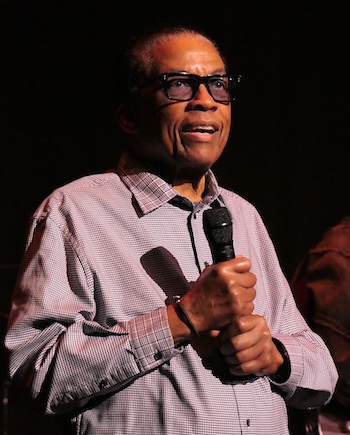
Herbie Hancock at the Boch Wang Theatre. Photo: Paul Robicheau
Who would have thought that the most exciting keyboard feature by Herbie Hancock on Wednesday night at the Boch Center Wang Theatre would be a keytar rave-up? Or that the most emotional portion of the two-hour-plus performance would be a 20-minute vocoder disquisition on AI?
It was that kind of show. Hancock, 85, was on a North American tour that brought him to the Wang with Terence Blanchard on trumpet, guitarist Lionel Loueke, bassist James Genus, and drummer Jaylen Petinaud. Following a spontaneously improvised Korg synthesizer overture — with the impromptu title “Prehistoric Predator,” conjuring a growling electronic landscape, and a group jam — they settled heavily on Hancock’s ’70s jazz-funk hits, and a nod to his years with Wayne Shorter in Miles Davis’s band with Shorter’s “Footprints.” Hancock shuttled between the Korg and a grand piano, often within the same song. In a phone interview a few weeks ago, he told me Genus would switch between acoustic bass and electric, but no such luck.
That’s not necessarily a bad thing, unless you were an acoustic-Herbie diehard. One thing about Hancock’s funk: He’s really good at it, and crossover hits like “Chameleon” (from the Head Hunters 1973 debut), and “Rockit” (the 1983 smash) got a generous airing. There were the usual problems with overamplified live electric bass: Too often it comes across as a toneless sub-pitch rhythmic thud. But Genus had his moments, weaving attractive guitaristic counter-lines in the upper register on “Actual Proof,” and he had a couple of solo features that showed off not only virtuoso speed but an attention to texture, dynamics, and narrative development.
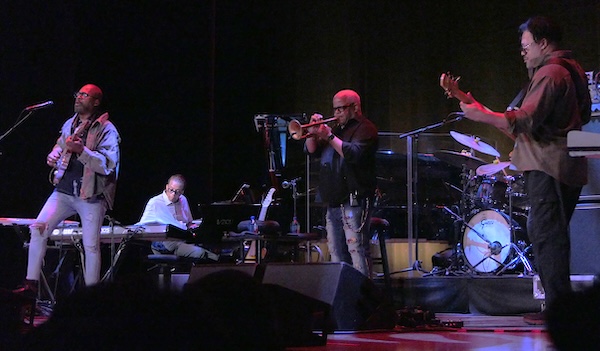
Lionel Loueke, Herbie Hancock, Terence Blanchard, and James Genus at the Boch Wang Theatre. Photo: Paul Robicheau
Blanchard used his effects pedals to enhance his natural sonic heft, and he often joined Hancock’s synth in creating orchestral effects. But too often an overly synthetic tone — especially when he was digging into muscular rhythmic crescendos — made me wish for the natural bite of the unalloyed horn.
For that matter, I wasn’t wild about what Hancock introduced as Blanchard’s arrangement of “Footprints.” The vaguely New Orleans-like clave beat locked that rhythmically and harmonically elusive composition into hard funk.
Loueke, as usual, was a magician. He would follow Blanchard’s bravura solos by bringing the dynamics down to a hush, giving us the sound of his naked strings, then build them up again, with bluesy licks and his own bit of effects, sometimes accompanying his rhythmic and harmonic excursions with unison vocalizing.
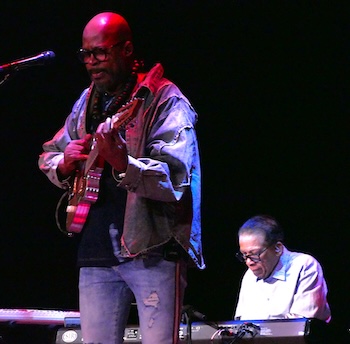
Lionel Loueke and Herbie Hancock at the Boch Wang Theatre. Photo: Paul Robicheau
Loueke’s singing came across most effectively in the joyous Afro-pop influenced anthemic “Secret Sauce,” which Hancock has been playing since 2018 but has yet to commit to an official release. Here it was part of a segue out of the vocoder feature.
About that vocoder: Hancock said he has been playing with the voice synthesizer technology since 1978. “Sunlight!” a fan behind me yelled before Hancock could mention the album title. Hancock pointed out that in the midst of his ’70s hits, this album was a flop (or at least didn’t make the Billboard charts), but that the technology has been vastly improved.
This led to his saying, via vocoder, that he had something “serious” to talk about, which led to a discussion of AI and ethics, and how this human invention can only be as good or as evil as the people who develop it. It was like something out of one of Hancock’s 2013-14 Charles Eliot Norton lectures at Harvard, except processed in a way that suggested a cross between HAL and the Swingle Singers. But damn if he didn’t land on some piquant chords that colored his speech with impressive gravitas. This was Herbie Hancock, after all — he knows something about harmony.
The bit went on for a good 15 minutes but turned out to be quite eloquent and moving — simple thoughts about human imperfection and the need for kindness packed a punch it might not have had without the musical enhancement. And the ebullient uplift of “Secret Sauce” was the perfect follow-up.
Earlier, Hancock’s tendency to blab almost sunk the show. Following a greeting to the audience and obligatory comments about the weather (“cold!”), the overture and that hearty jam, he began introducing the band, with, um, healthy digressions (“How old are you?” he asked Petinaud, with some argument about whether his answer, 27, was correct.) “Oh my God, this is gonna go on forever,” a man over my shoulder muttered.
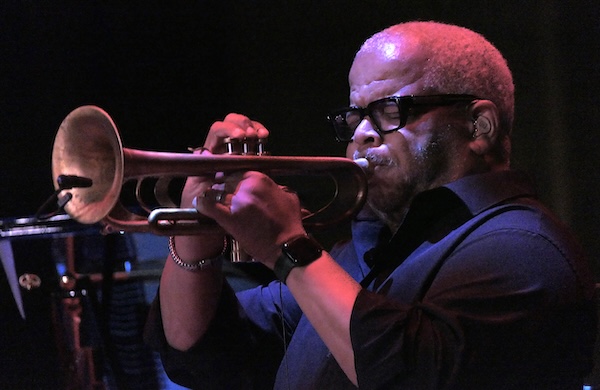
Terence Blanchard with Herbie Hancock at the Boch Wang Theatre. Photo: Paul Robicheau
But balance was restored. The funk was fresh, and Hancock’s outings at the acoustic piano showed his continued mastery — creating unpredictable patterns of tension and release that built to one funky crescendo after another. And, whatever my complaints about bass, the mix was always clean. Hancock’s piano was up front and bright, even as the band was roaring, and Petinaud had a knack for locking in that revealed ticklish surprises at every inevitable cadence.
But that keytar. Hancock strapped it on for a medley of “Rockit,” “Hang Up Your Hang Ups,” and “Spider,” and by the time of the closing “Chameleon,” he was jumping up and down with Loueke. His final crescendo, with a dog-whistle high note, had the audience screaming. Eighty-five, folks.
Jon Garelick can be reached at [email protected].
3 Comments
Leave a Comment
I was at the show as well and agree 100% with your review. Especially the synthesized effects on Terrance’s horn. Though, this may be my analog purist coming out lol, get off my lawn!
This a fantastic and spot on review. I appreciate the honesty. My reaction to the show was very similar, although i thought the Vocoder “speech” showed a real lack of depth and simplistic understanding regarding AI and the global race for dominance, consolidation of power and global control by world leaders, the wealthy and the powerful.
I’d have given a kidney to be able to see Herbie Hancock on this tour. Every review I’ve read has been exceptional and this is likely his last tour. I have to believe that this show wasn’t an anomaly. If someone behind me had muttered loud enough for me to hear over the show, I would wonder where that person thought they were and I’d be looking for an usher.