
Film Review: In “Club Kid,” the Party Gets a Plus-One
By Neil Giordano
Jordan Firstman’s charming debut gives a familiar growing-up story a welcome queer twist, as a New York party boy discovers fatherhood—and a reason to change.
Club Kid, written and directed by Jordan Firstman. Screening at Coolidge Corner Theatre, Somerville Theatre, and Alamo Drafthouse Seaport
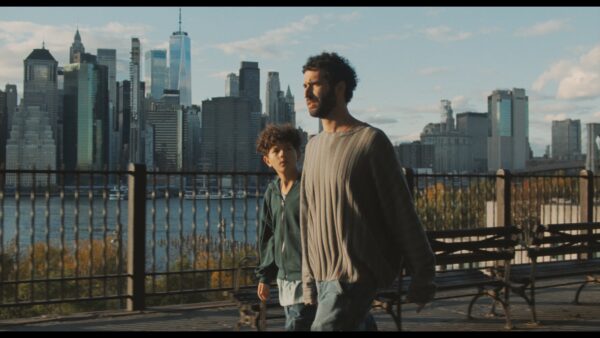
(L-R) Reggie Absolom and Jordan Firstman in Club Kid. Photo: courtesy of A24
The trope of the “immature adult learning to grow up” is a tricky one to pull off in movies. In its most hackneyed incarnations, we watch someone—usually a man—have an epiphany about their life and then learn powerful lessons about how to be a whole person by becoming a parent. About a Boy, released nearly 25 years ago, might be the most endearing example of the genre, with Hugh Grant in the role of the lost soul who learns how to be an adult after becoming a proxy father to a young Nicholas Hoult.
Club Kid, Jordan Firstman’s debut feature, transposes the story to the party scene of queer millennial New York and, thankfully, offers a charming riff on the formula. Firstman, known primarily as an actor (most recently in the comedy series I Love LA), plays the lead role of Peter while directing his own screenplay. What breathes new life into the trope is that the queer twist is more than simply a plot device.
The film’s prologue, via a series of fast-cut, disorienting montages, captures Peter as the consummate party boy. Amid endless cocaine, ketamine, and other party drugs known only by their nicknames or their effects, he basks in the power conferred on a club promoter who can, with a nod to the bouncers, let anyone join in the festivities. The club’s bacchanal also provides him with a steady stream of anonymous sexual encounters on the dance floor, in the bathrooms, or virtually anywhere he wants. The editing team of Taylor Levy (Bodies Bodies Bodies) and Sofia Subercaseau (The Testament of Ann Lee) deserves a callout, not only for the rhythm of the club scenes but for the way they layer comedy into a story built around drama.
After a time jump of a decade or so, Peter is beginning to show signs of burnout. The party isn’t bringing him joy so much as exhausting him, and the hookups take up time that might be better spent on the genuine friendships he’s letting wither. His business responsibilities take a back seat to sleeping late, and his cocaine-addicted business partner (Cara Delevingne) tries to pick up the slack. Both of them view adulthood as a chore. Peter, however, has no aspirations to do anything else with his life. So all that’s left is the party life, whether he wants it or not.
Enter 10-year-old Arlo, Peter’s son, conceived during an anonymous sexual encounter—one we caught glimpses of in the prologue but that Peter doesn’t remember at all. The first queer twist is that Peter is surprised he had sex with a woman. Arlo, endearingly played by young actor Reggie Absolom, appears in New York after his mom dies, perhaps from an overdose, back in London. A fellow party girl brings Arlo across the pond and then abandons him with Peter. Once Peter gets past his initial denials, he realizes that Arlo has nowhere to go. Pity might be his initial reason that the guy takes Arlo in, but pity soon gives way to real affection.
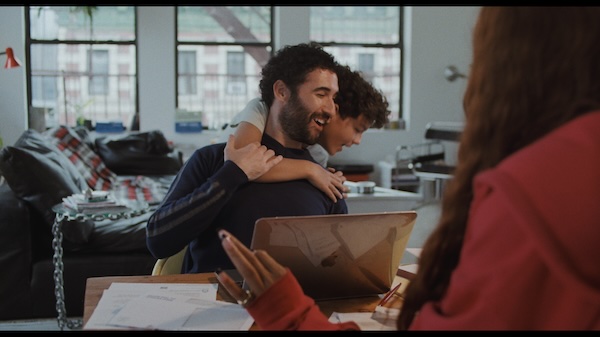
Jordan Firstman and Reggie Absolom in Club Kid. Photo: courtesy of A24
Peter’s transition into parenthood is smoothed by Arlo’s quiet charm and Absolom’s understated cuteness. The two immediately bond over Arlo’s musical tastes, which seem beyond his years; they were apparently cultivated by his mom and others back in England. We fall in love with the kid as much as Peter does. Peter also revels in the fact that Arlo develops an affinity for the DJ mixer in his apartment. Soon, Peter finds a happy way to integrate his new life with his old party friends (played by a gaggle of real New York and London drag performers and club mainstays, including Shygirl). Still, while surrounded by the party, Peter sheds his old habits as best he can, making Arlo his primary concern.
Of course, this setup seems too good to be true. The question of how it will all come crashing down creates tension whenever the group hits the town. Will Arlo be offered ketamine? Would any responsible adult realistically let a 10-year-old hang out in a club? Thankfully, the film’s third act is perhaps its greatest strength, because the narrative manages to avoid the obvious sentimental pitfalls. There are some deeply felt, even tear-jerking moments, but Firstman deftly avoids anything cloying or predictable.
That said, the movie has its moments of implausibility. How many 10-year-olds go around wearing Vampire Weekend T-shirts? And wouldn’t Arlo have a more distressed personality given that he had been brought up by a self-destructive addict? Peter’s new love interest (although wonderfully played by Diego Calva) also feels a bit too pat. Nonetheless, the story manages to transcend these shortcomings. Ultimately, Club Kid excels because it presents a range of competing visions of gay life—from club life to ho-hum domesticity—as equally valid choices in a world where being queer can be “so boring,” as Peter concludes. It’s not a revolutionary idea, of course, but here it makes for an emotionally rewarding conclusion.
Neil Giordano teaches film, creative writing, and journalism in Newton, MA. His work as an editor, writer, and photographer has appeared in Harper’s, DoubleTake, Newsday, Literal Mind, and other publications. He is currently in production on Betweens, a documentary film about artist Michael C. Thorpe.
Tagged: Cara Delevingne, Club Kid, Diego Calva, Independent film, Jordan Firstman, LGBTQ cinema, Neil Giordano, New York nightlife, Queer Cinema, Reggie Absolom, chosen family, club culture, directorial debut, fatherhood, film review, queer parenthood