
Arts Commentary: AI and the Death of Faustian Culture
By Joseph Horowitz
Leonard Bernstein heard in Gustav Mahler the restless striving that defined an age. As artificial intelligence conquers new realms of human inquiry, what becomes of the impulse to strive?
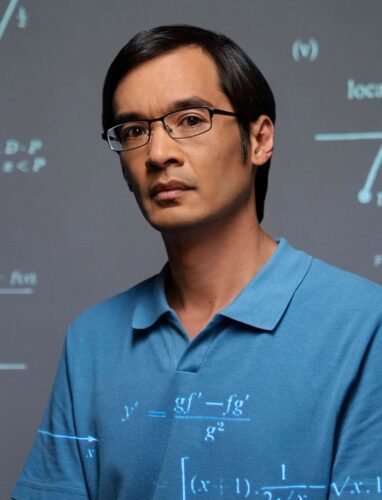
UCLA mathematician Terence Tao Photo: IPAM
A recent New York Times piece, “Why One of the World’s Greatest Mathematicians Is on a ‘War Footing’” (October 16), transcended the daily barrage of AI-triggered warnings. It read as a chilling parable. It also evoked certain prophecies of Leonard Bernstein.
Elizabeth Bumiller reported that Terence Tao, a legendary UCLA mathematician, had responded to an announcement that OpenAI had solved the Navier-Stokes problem, “one of seven ‘Millennium Prize problems’ that had stymied the great minds in math for nearly a century.” “I am horrified by the many person-years . . . being casually disrupted or destroyed,” Tao had written in a widely read math blog. Bumiller also quoted a draft report by a group of mathematicians meeting at Harvard. “Implicit in its pages,” she wrote, “was the sense of loss among humans drawn to math for the intellectual adventure of problem solving – often deeply frustrating, sometimes thrilling and euphoric if a personal breakthrough leads to an advance in the field.”
Whatever the substance of those “Millennium Prize problems,” it would be hard to envision a more sublimely disinterested version of the Faustian quest to turn base metal into gold—a metaphor, for centuries, for human aspiration, and one once considered timeless. For Goethe, Faust embodied an insatiable restlessness testing the limits of personal inquiry and discovery. In the realm of higher mathematics, those limits have just been blithely erased—and the entire project rendered lame.
I remember, half a century ago, feeling puzzled by Bernstein’s invocation of Faust in his much-debated Norton Lectures on the future of music and the arts. Bernstein’s language sounded curiously hyperbolic to me—and, I am sure, to many others. He foresaw “the death of society, of our Faustian culture.” He called the twentieth century the “century of death”—a “badly written drama” encompassing two world wars, then “postwar injustice and hysteria,” “greed and hypocrisy,” and—most tellingly—“galloping technology.” No one today would call that prognosis exaggerated. It was prophetic.
Bernstein also claimed that “all the truly great works of our [twentieth] century have been born of despair or of protest, or of a refuge from both. But anguish informs them all.” There followed a list of works whose creators included Sartre, Camus, Gide, Hemingway, Mann, Picasso, Eliot, Neruda, Fellini, Beckett, Berg, Schoenberg, and Brecht.
A crucial catalyst for these dire thoughts was an idiosyncratically dark reading of the legacy of Gustav Mahler—for Bernstein, the iconic twentieth-century composer. Mahler’s cycle of nine symphonies (there is also an unfinished Tenth) comprises a sustained Faustian inquiry. It, in fact, deserves an exemption from Bernstein’s list of “truly great works of [the twentieth] century . . . born of despair or of protest.” Though his aspirations are often desperate, Mahler’s ultimate message—Bernstein notwithstanding—is nearly always sanguine.
Was Mahler’s consummated Faustian quest the last of its kind in symphonic music? He once wrote: “Why did you live? Why did you suffer? Is it all a terrible joke? We have to solve these questions in some way if we are to continue living – even if we are only to continue dying! Anyone whose life has heard this call must give an answer.” He also famously said: “A symphony must be like the world.” He left a radiant death mask. He knew his time would come.
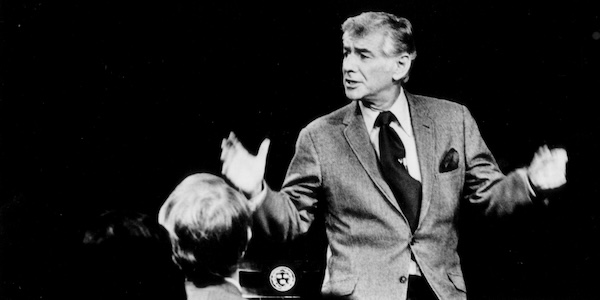
Leonard Bernstein delivering the 1971 Norton Lectures at Harvard University. Photo: Leonard Bernstein Office
Every Mahler symphony ends with an existential message. The First is triumphant—he once dubbed it “From the Inferno to Paradise.” For the Second (the Resurrection), he composed the words: “Rise again, my heart, what you have conquered will bear you to God!” In the Third, the eruption of summer—of flowers in the meadow, of animals in the forest—eventually yields a transcendent meditation on the power of love. The Fourth attains a child’s paradise. But Mahler is ever Janus, yearning for past pleasures, anticipating future confusions; every victory he records is challenged by intimations of calamity. Only once, in his Symphony No. 6, does this jousting yield an ending—surely the most devastating in the symphonic repertoire—in a minor key.
Three years later, in 1907, Mahler endured a seminal personal tragedy: his daughter Putzi died at the age of five. The same year, he resigned his post as director of the Vienna Court Opera. Two years after that, his Das Lied von der Erde and Ninth Symphony charted a different kind of redemption, infused with Eastern poetry and philosophy—a diffusion of the ego.
There is also his “Symphony of a Thousand”—No. 8—in which Mahler sets aside existential combat and scores the triumphant final scene of Goethe’s Faust for an immense ensemble of instruments and voices. Charting Faust’s final ascent, borne aloft by the “Eternal Feminine,” Mahler impersonates Goethe’s tenacious protagonist, whose salvation rewards a lifetime of striving for betterment.
Leonard Bernstein doubtless inhabited Faust when he conducted Mahler. He also made a specialty of Liszt’s Faust Symphony, which closes with a setting for tenor and male chorus of the same redemptive apostrophe to “das ewige Weibliche.” His identification with Faust becomes explicit in his 1972 Young People’s Concert “Liszt and the Devil.” Bernstein calls the Faust Symphony Liszt’s “greatest piece,” his “true masterpiece”—a distinction more often reserved for the Piano Sonata. Liszt himself is—and here one thinks of Bernstein—“a sort of Faust – a striving, daring, endlessly inquisitive man, who wants to know and experience everything.” The portrait grows ever more suggestive: “He seemed to do everything, and he did it all with smashing success.” He was “dynamic, sexy, famous, gifted,” “the darling of the whole musical world.” And “he seemed to have control of his own destiny”—as when he abandoned recitals to devote more time to composing and to his “ever continuing love life.”
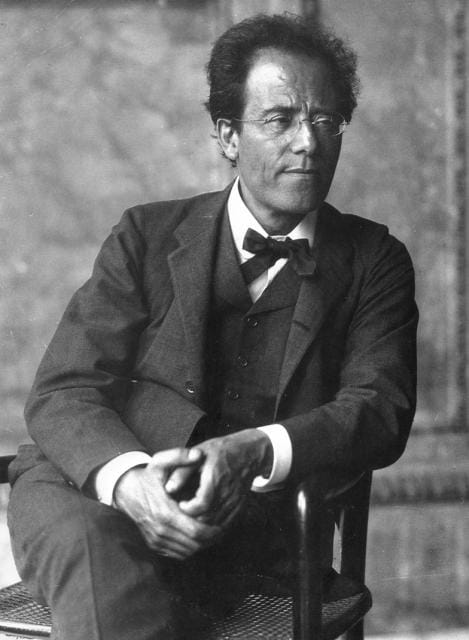
Composer Gustav Mahler. Photo: wikimedia
Liszt died in 1886; Gustav Mahler in 1911, at only fifty. Had Mahler lived longer, what might World War I have done to his fables of quest and redemption? You will look in vain for a post-1918 symphony in which the Faustian quest achieves consummate fulfillment. Beethoven’s struggle-to-victory template—a symphonic sourcebook for Brahms, Bruckner, and Mahler—had lost its credibility. In opera, Ferruccio Busoni’s Doktor Faust (1924), based on the traditional legend rather than Goethe, ends with Faust falling dead even as he begets a naked youth. In fiction, Thomas Mann’s Doctor Faustus (1947) consigns the master composer Adrian Leverkühn, doomed by his pact with the devil, to dementia and death. Decades later, the Liszt–Mahler–Bernstein Faust equation yielded no Bernstein Faust symphony. Instead came Mass (1971), Bernstein’s bid for a magnum opus, which takes on the fractured America of the sixties. Its placid closing plea for love and peace, however, is a wishful non sequitur: less compelling than the embattled resurrections of Goethe and Mahler, or the chilling fates of Busoni’s Faust and Mann’s.
Of World War I, Henry James wrote: “The plunge of civilization into this abyss of blood and darkness is a thing that . . . gives away the whole long age during which we have supposed the world to be, with whatever abatement, gradually bettering.” Ezra Pound asked why men had died “for a botched civilization.” The senselessness of the Great War and its punitive aftermath yielded the Third Reich and the Holocaust. That the arts inherently uplift, a credo once especially resilient in the United States, was cancelled by the art lovers Hitler and Stalin. Goethe’s aspirant Faustian trajectory, “Zieht uns hinan” (“ever upwards”), lost buoyancy.
Mahler’s protean genius was to bear witness to a pivotal fin-de-siècle moment: he savored the past; he feared the future. Decades later, Bernstein read him pessimistically, as a prophet of doom. And Bernstein himself proved an acute and prophetic witness to civilizational decay. He also keyed on the symphonies of Dmitri Shostakovich. During Cold War decades when others in the West dismissed Shostakovich as a Soviet stooge, Bernstein gleaned how subversively Shostakovich’s symphonies intimated the horrors of Hitler and Stalin both. A people’s artist (rather than the dutiful Soviet artist some imagined him to be), Shostakovich charted the deepest currents of post-Faustian decay.
Today no such chronicler of the times exists. It would be hopeless to expect an American novel as capaciously ontological as Melville’s Moby-Dick, or an American symphony as existentially vast as Charles Ives’s Fourth. Ives wrote that it poses “the searching questions of What? and Why? which the spirit of man asks of life”—a Mahlerian quest.
Will AI pre-empt these past strivings with a new species of Faustian symphonies and novels? Can it master the arts as it masters mathematics? Not for now, at least. Instead, an ironic outcome of the efforts of today’s tech Fausts, testing the limits of human intelligence, will surely be new realms of human passivity.
This shrinkage of artistic compass is by no means a new topic. But with AI solving Navier-Stokes, it has attained a new dimension.
Joseph Horowitz’s Bearing Witness: The American Odyssey of Leonard Bernstein will be published in fall 2027.
Tagged: Classical Music, Dmitri Shostakovich, Faust, Faustian Culture, Franz Liszt, Goethe, Gustav-Mahler, Human Creativity, Human Passivity, Joseph Horowitz:, Leonard Bernstein, Music Criticism, Symphonic Music, artificial intelligence, cultural criticism