
Jazz Album Reviews: David Friedman — The Art of Partnership
By Steve Elman
Each of these new releases — one newly recorded and one recorded seven years ago — casts a distinctive spell, and each gives us another welcome opportunity to hear vibraphonist David Friedman.
Light from a Person (Jane Ira Bloom, David Friedman, Ken Filiano) & Glow (A Tribute to Dave Samuels) (David Friedman, Tony Miceli)
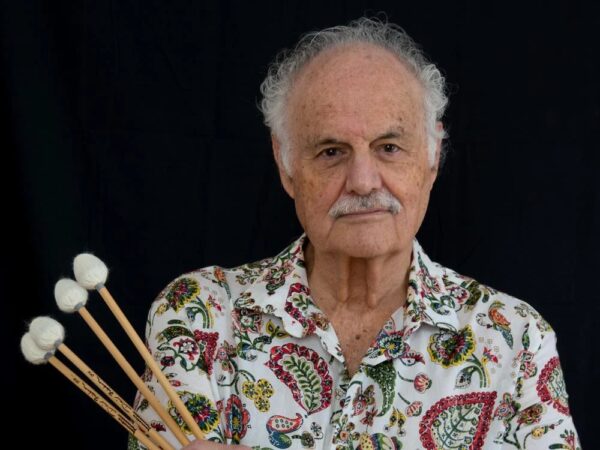
Vibraphonist David Friedman. Photo: Courtesy of the artist
Two releases this year remind us of the greatness of vibraphonist David Friedman. True to form, he never eclipses his partners in these recordings, but he makes each recording exquisite, with an unerring sense of how to shape and fill a musical vessel.
Friedman, now 82, is one year younger than Gary Burton, who pioneered the use of four mallets in playing the vibes and remains the Grand Master of the instrument, despite his retirement in 2017. Friedman is still playing; like Burton, he is a four-mallet virtuoso, but he is less pianistic in his approach. Because he is sparer in his playing, his choice of notes is crucial, and it never disappoints. The music he’s made in the past decade testifies to his vitality, as well as to his remarkable gifts for being the Right Man at the Right Time.
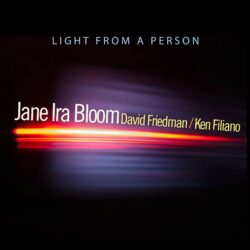 His most recent recording is Jane Ira Bloom’s Light from a Person (Outline, 2026), on which he plays as a member of a trio — a reunion of sorts with soprano saxophonist Bloom. More than forty years ago, Friedman contributed to two tracks on Bloom’s second record (“Shan Dara” and “Jackson Pollock” on Second Wind, Outline, 1980). A bit less than forty years ago, he played on another two tracks on her fifth recording (“Cagney” and “NFL” on Modern Drama, Columbia, 1987). They had not recorded together since and had never previously made a full album together.
The third element in Light from a Person is bassist Ken Filiano, whom many Bostonians remember from his residence and performances here in the early 1980s. He is a dependable anchor and, at the same time, an eloquent voice at the bottom of the sonic spectrum.
Everything about this new recording is about partnership, and yet, as in all her recordings, Jane Ira Bloom is primus inter pares. She is now magisterial in her control of the tricky soprano sax, coaxing from it all the nuances and strengths that most players only hint at. And now, coming off a series of recordings since the pandemic that delved deeply into free-form playing, she shows a confidence in silence that is remarkable.
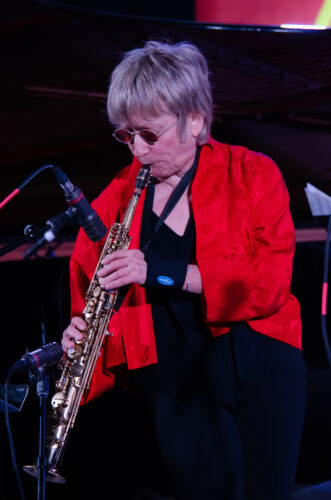
Soprano saxophonist Jane Ira Bloom. Photo: Ken Hunt
On this recording, she returns to “White Tower,” a composition she introduced on her first one, We Are (Outline, 1978). It is one of her most elegant originals, and the confidence with which she approaches it now illuminates its beauty and, at the same time, reminds us of her amazing maturity as an artist almost 50 years ago. Here it is interpreted loosely, with Friedman sounding very heartfelt on a spontaneous bridge within the theme. As solos unfold, the changes are there, but more as a set of feelings to be called on as needed than as a scheme that must be adhered to. Filiano’s solo is in the same spirit, and Bloom joins him at the end for a seamless transition to the written line.
Bloom adds a new piece to her catalog of painterly tributes with “Van Gogh” and returns to an older one, “Miró,” which she introduced on Slalom (Columbia, 1988). There is a sweet symmetry to Friedman’s presence on these tracks, since he also appeared on “Jackson Pollock,” her first recorded exercise in translating sight to sound. In all three cases, Bloom makes her admiration for the artists as clear as her musical interpretations of their work.
Almost the entire repertoire of this new release is devoted to Bloom’s compositions, and I was glad to hear her introduce so many new ones after her recent recordings in which they took second place to open improvisations. She can write angularly, or spaciously, or lyrically, but in any mood, her compositions show cleverness balanced with depth, and they always accomplish their purposes without a single extraneous note.
“Bright Bars” suggests an homage to Friedman via his instrument. “Slydini” is perhaps a descriptive nickname for Filiano, who is featured on it. But most of the ideas here are abstract. “Desert” is as austere as its title. “Airspace” offers a good deal of it in the theme, but the players then fill it up. “True City” is a new piece that is as pretty as “White Tower.”
All but the title tune receive confident interpretations from the full trio, and the overall landscape of the album is deeply satisfying and (for want of a better term) three-dimensional.
But the closing tune, “Light from a Person,” which gives the whole release its title, is different from all the others. It was written by Kent McLagen, who played bass on Bloom’s first two records and on Slalom. It is a setting for Bloom and Friedman by themselves. I found it especially touching, in Bloom’s clear-eyed way. The theme statements are the only times in the tune when the two play together. Each has an unaccompanied free solo that draws on the beauty of McLagen’s line (Bloom has some gorgeous glissandi), and it seems to me that each soloist is nodding to the unheard presence of the other.
Friedman is a masterful partner here, and on all the other tracks as well. In settings like the one on this album, without drums or other percussion, his brilliance with four mallets — never showy, always harmonically rich — allows him to fill out the accompanying spaces with perfect decoration and assume the lead position with gracious ease.
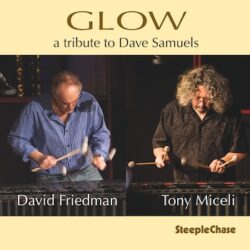 His duet record with fellow vibraphonist Tony Miceli, called Glow (A Tribute to Dave Samuels) (SteepleChase, 2026), is retrospective, like Light from a Person, but with a different slant. The session was recorded in 2019, shortly after Samuels’s death, but has only come to market this year.
Friedman and Samuels (1948–2019), each of whom played vibraphone and marimba, performed and recorded together as Double Image, initially a quartet with bassist Harvie S and drummer Mike DiPasqua, and then as a duo. They made records together in the late 1970s and the mid-1980s, and finally reunited for a live concert in 2006. The partnership was so remarkable that I confess that, for me, it eclipses the 24 records Samuels made with Spyro Gyra and even the 10 records made by Samuels’s own group, The Caribbean Jazz Project.
Miceli makes an excellent partner for Friedman, although they both play vibes throughout. They revisit “Sunset Glow” and “Carousel,” both well known from Double Image recordings. Each contributes original pieces: Friedman offers a solo called “Traffic.” Miceli presents three: one is a solo called “I Am Lost”; two are duets, the first simply called “Samuels” and the second an impromptu-sounding “Noisy Blues.”
The two solos are mixed with the respective player at the center. The other tracks have Friedman in the right channel and Miceli in the left — I think. The interplay is so good-natured and warm throughout that the two players’ identities tend to merge, much as the sounds of the two malleteers did in Double Image.
Four non-originals round out the program, and these sound like tunes chosen for their familiarity. To a certain extent, these four — “Nature Boy,” “When You Wish Upon a Star,” Steve Swallow’s “Falling Grace,” and Herbie Hancock’s “Dolphin Dance” — enjoy more relaxed interpretations, and the two soloists sound like they are just enjoying one another’s abilities rather than deliberately remembering a friend.
What these two releases have in common is atmosphere. Each casts a distinctive spell, and each gives us another welcome opportunity to hear David Friedman.
Steve Elman has contributed to The Arts Fuse since its early years in the late 2000s, writing on jazz, classical, and related art forms. Since the 1970s, he has contributed articles on music to The Boston Globe, The Boston Phoenix, and The Schwann Record & Tape Guide, where he served as Editor of Jazz and Popular Music. His four decades in Boston public radio include hosting music programs, producing arts programming, and management at WBUR, and several years as a fill-in classical host on WCRB.
He is co-host (with John Redman) of JazzAve, a podcast / website based on his sixty years of listening to music and engaging with the people who make it. The monthly podcasts, exploring personalities and topics in jazz, are available at https://jazzave.net/.
Tagged: Dave Samuels, David Friedman, Double Image, Glow, Jane Ira Bloom, Jazz, Ken Filiano, Light from a Person, Outline Records, SteepleChase Records, Steve Elman, Tony Miceli, jazz duets, jazz improvisation, jazz reviews, jazz trio, soprano saxophone