
Concert Review: Sudan Archives Finds Freedom but Little Focus in “Any Shape I Want”
By Paul Robicheau
At the ICA, the violinist and vocalist conjured immersive textures and inventive loops, but her day-in-the-life concept remained elusive.
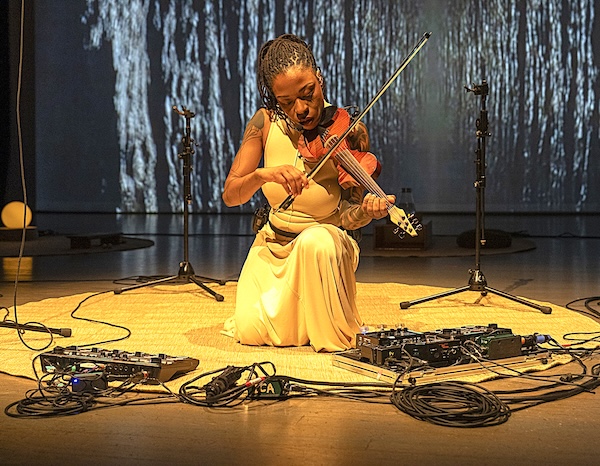
Sudan Archives at the ICA. Photo Michael J. Lutch
“I need to be free, time to spread my wings,” Brittney Denise Parks, who performs as Sudan Archives, sang in “Nont for Sale,” a snippet of which she wove into her multimedia program Any Shape I Want at the Institute of Contemporary Art.
Granted, that song addresses a break from relationship nonsense. But Sunday’s performance (a co-presentation by the ICA and Boston Symphony Orchestra under the BSO’s Creation Festival) shared Parks’ desire to spread her wings further as an artist.
As Sudan Archives, Parks forged her path as a violinist and vocalist who thrives on experimental, beat-driven R&B, and electronic music. Yet Any Shape I Want floated her avant-garde inclinations into an atmospheric world of random question marks.
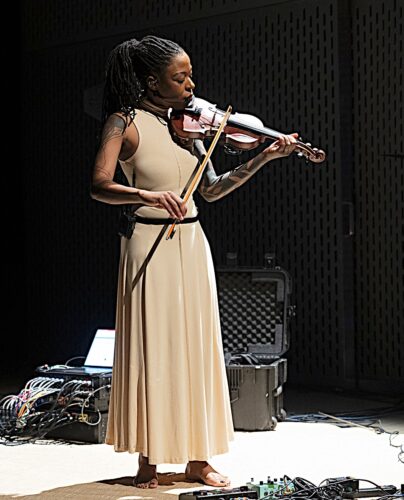
Sudan Archives at ICA. Photo” Michael J. Lutch
The program was billed as “a meditation on the freedom to move between instruments, identities, and imagined selves, staged across six stations representing four-hour blocks of a single day.” But that explanation didn’t help much in understanding what was supposedly going on during the roughly one-hour performance at the ICA’s sold-out Barbara Lee Family Foundation Theatre.
Six stations were indeed spread around the stage, with circular rugs lit by electronic candles or Asian lanterns, suggesting rooms with separate accoutrements. Along the front, one accommodated a cozy, full-size bed, while two others each displayed a spread of effects pedals and a violin on a stand, awaiting her visit.
Following a darkened, droning 10-minute intro that initially brought the audience to hushed anticipation and then light chatter, Sudan Archives strode onstage and paused in front of a backing screen showing water images. She moved to one rug, where she hung her jacket on a coat hook and unzipped her boots, only to cross the stage and crawl into bed. She checked a bedside phone, gazed off at some unknown distraction, then lay on a pillow and sang into her headset mic through a vocoder that rendered her phrases unintelligible. Upon rousing, she pounded beats on the side table with her fists, knocking over an alarm clock.
Sudan Archives walked to the primary center mat to pick up an electric violin and kick the show into gear, starting with koto-like pizzicato lines and then tapping into looped effects. She poked pedals with the toes of her bare feet, adding layers of cries and huffs as she altered her voice electronically to the point that lyrics from “Nont for Sale” were also barely distinguishable.
Chimes signaled that it was time to go to another station (not sure about that concept of four-hour blocks, though), and Sudan Archives moved one rug over to play the acoustic violin. While the phases of the moon slowly cycled across the screen, she went from a plucked pulse to delay-soaked bow strokes fed into more loops.
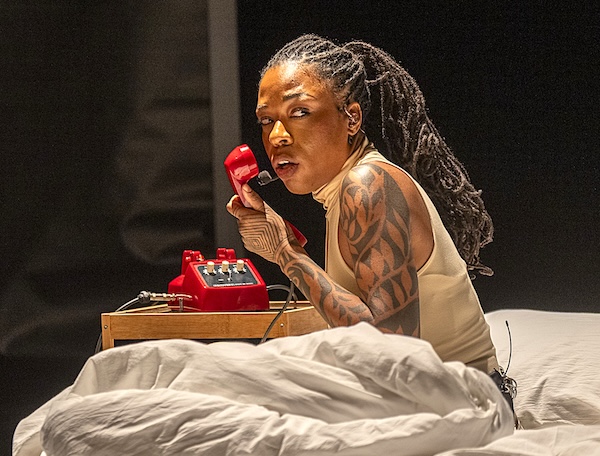
Sudan Archives at the ICA. Photo: Michael J. Lutch
She took a percussive detour to a rear rug, spinning a shell-shaker mobile and an egg shaker before banging her fists on a wooden step, looping it all. Then she returned front and center to crouch within the folds of her dress, as beige as the rugs, and simply turn dials to manipulate her soundtrack at whim, cracking a smile as she listened.
Flames flickered onscreen as she turned to bow Eastern tones on her customized electric violin before returning to the acoustic violin and vocalizing into its tiny pickup mic, her phrasing unclear, even when she generated volume by yelling into it. She then returned to her center mat merely to pace in slow circles, clapping her hands in patterns to loop, before launching into a melodic, if still abstruse, chant for a last round.
Finally, with a sun rising on the backdrop, Sudan Archives broke the spell. She stood to invite the audience to briefly join her in moving to the heightened club beat of “Selfish Soul,” singing its refrain, “Am I good enough?”
Good enough? Sure, when it came to Sudan Archives’ technical tinkering and subtle mood-setting. But what was the point? Simply a day (or an hour in real time) of her relaxed free expression? Well, perhaps if freed from the need to live up to its conceptual billing, Any Shape I Want could be seen as an oblique victory lap.
Paul Robicheau served more than 20 years as contributing editor for music at the Improper Bostonian, in addition to writing and photography for The Boston Globe, Rolling Stone, and many other publications. He was also the founding arts editor of Boston Metro.
Tagged: Any Shape I Want, Boston Symphony Orchestra, Boston concerts, Brittney Denise Parks, Creation Festival, Institute of Contemporary Art, Sudan Archives, alternative R&B, concert review, electronic music, experimental music