
Soul Album Review: Lalah Hathaway’s Chicago State of Soul
By Rick McLaughin
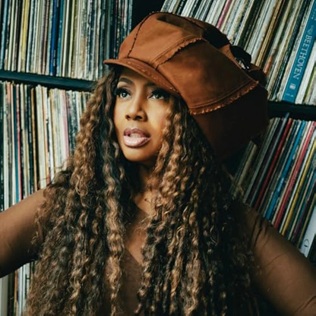
On “Made in Chicago,” Lalah Hathaway turns family memories and hometown roots into a dreamlike journey through soul, jazz, and R&B.
Made in Chicago, Lalah Hathaway. (Hathaway Entertainment and SRG/ILS Group)
The cover art for Lalah Hathaway’s Made in Chicago
Chicago, Illinois, in the late 1960s was a city experiencing a gamut of news coverage. In 1968 alone, the April riots and, in August, the Democratic National Convention kept the Windy City on the five o’clock news. This was also fertile ground for the arts, where jazz-rock and horn bands like Earth, Wind & Fire and Chicago [Transit Authority] got their start, and Picasso’s Maquette for the Richard J. Daley Center Sculpture had recently been installed at the Civic Center. This is the Chicago that Lalah Hathaway was born into, and it forms the foundation of her new album. Released on her father Donny Hathaway’s birthday, Made in Chicago explores themes of family, community, and love. Its musical palette is steeped in the sounds of 1960s and ’70s Chicago, then broadens to encompass Los Angeles, the Sound of Philadelphia, and beyond.
In addition to being the birthplace of great jazz-rock and horn bands, Chicago is the birthplace of Soul Train, a television show hosted by the baritone-voiced Don Cornelius that ultimately introduced the country to soul-inspired music, dance, and fashion. On the opening track, “47th Street,” poet and storyteller J. Ivy (James Ivy Richardson) tells the story of Chicago’s Bronzeville neighborhood in a voice evoking Cornelius. Against a horn-band-inspired backdrop, Ivy speaks of migration, struggles, and successes, while Hathaway sings reminiscences about her neighborhood, her family, and her father: “that’s where my daddy laid his hat down.”
As Hathaway moves away from reminiscences, she widens her sphere of influence. “So Smart” is saturated in the sounds of Earth, Wind & Fire during their Los Angeles period. While the electric guitarist plays seventh chords in a perpetual eighth-note rhythm, the drummer’s backbeat is ever so slightly behind the beat, and horns float over the top, bobbing and weaving around Hathaway’s voice. Here, her story of a relationship marred by one party’s inability to see past their own ignorance is told with EWF’s “Reasons” and “After the Love Has Gone” in the air.
Tracks four and five work together to close out what feels like the first side of this 39-minute album. These tracks, “Can’t Let Go” and “Every Little Thing,” feature saxophonist MAE.SUN (aka Hailey Niswanger). Brought in late in the process, Niswanger recorded solos without stepping into the studio with Hathaway or producer Phil Beaudreau. Rather, she received the tracks by email and spoke briefly with Hathaway before recording at home. “Can’t Let Go” moves from Chicago to Philadelphia, quoting the Stylistics’ “You’re My Everything.” Niswanger’s thoughtfully built solo moves the music forward in time as well as across geography. “They were very communicative of what they wanted,” says Niswanger. “[Hathaway] was like, ‘I want it ’80s…the saxophone comes ripping out, like on the Late Show.’”
On “Every Little Thing,” Niswanger can be heard throughout the track. “It was really cool that it wasn’t just a moment. [Hathaway] wanted it to be very conversational,” she says. This approach inspired Niswanger to play around and between Hathaway’s vocal lines throughout the track, as well as during the surprisingly long fade-out at the end. Though the turnaround time for Niswanger was quick and recording was done remotely, she was included in the final editing of her solos, which is unusual in these situations. “I got to chime in to say, ‘that sounds natural, or that sounds a little weird to me.’” This care contributes to the track’s cohesiveness and to a sense of musical conversation that never actually happened.
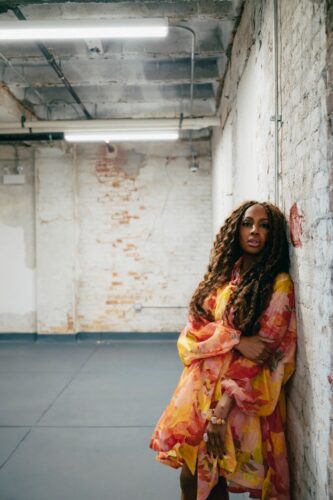
Lalah Hathaway. Photo: Lyndon French
The outlier on “side one” is “Follow,” which uses arranging and production to stay connected to more recent music. The interlude marks a startling shift in the track’s overall sound, drawing heavily from gospel music. Horn lines float throughout the piece, keeping it sonically connected to the rest of the first five tracks, but its outlier nature feels more like a foreshadowing of the tracks on “side two.” Although “Rainbo” uses disco-era string and bass lines and includes a “Funky Drummer”-inspired drum break, production decisions drawing from contemporary dance music and EDM transform Hathaway’s “all skate” roller-skating memory. The shag-carpet-lined roller rink dissolves into a steamy, sweaty dance hall and back again.
“Someday” offers a change in orchestration, using arpeggiated guitar, xylophone, strings, flute, and Hathaway’s head voice to lighten the texture of “side two.” It could have been on a Roberta Flack album. On “Time,” Hathaway sings, “Now I replay it with the movie of my mind; wish I could rewind,” returning to reminiscence. An electric piano with wide vibrato and the track’s harmonic choices create a feeling of translucence, like a dream sequence. “Magic” closes the album, bringing the music into the present moment. A chord progression evoking Robert Glasper’s Black Radio albums, a vocoder-heavy production, and a buoyant, flowing flute solo by Elena Pinderhughes end the album in a dreamscape: “Destiny is an illusion, Flow your own way through.”
In the classic Chicago film The Blues Brothers, a bar owner is asked what kind of music the venue hosts, and the answer is “both kinds.” This is both a punch line and a metaphor for the rigidity with which artists, record labels, and fans categorized music at the time. Made in Chicago blends and blurs genres. It is a late-1960s jazz-rock album and a 1970s R&B album; it invokes jazz albums on the CTI label and session musicians working nighttime television gigs. It blends the music of different cities and time periods. It acts like a dream, where time and place can be suspended and converge.
Made in Chicago drew me in and kept me there. Orchestration, production, arranging, and lyrics all work together to inform and transport. Chicago images like Cubs hats and Bears shirts, cuisine de terroir like sausage and peppers or Tastee-Freez, and essential terrain like the Chicago River and Lake Michigan all leap from the songs, even if none are mentioned. Hathaway’s songs and the stories she tells in them bring the warmth of a summer evening in Chicago.
Bassist, composer, author, and educator Rick McLaughlin has anchored the Grammy-nominated Either/Orchestra for over 25 years, performing alongside Danilo Pérez, John Zorn, and Mulatu Astatke in a career spanning four continents. His credits include his acclaimed debut Study of Light, a Bob Moses co-production, and bass work with saxophonist Grace Kelly and Guggenheim Fellow Felipe Salles. He has written for Berklee’s FUSION and DrumPro magazines, and his book The Holistic Bassist anchors his company, Holistic Sound. McLaughlin is Professor of Harmony and Jazz Composition at Berklee, where his Stevie Wonder course landed him on the Obama-produced podcast The Wonder of Stevie.
Tagged: Chicago music, Elena Pinderhughes, Hailey Niswanger, Jazz, Lalah Hathaway, MAE.SUN, Made in Chicago, Phil Beaudreau, R&B, album review