Theater Review: “The Getaway Driver” Confronts the Human Cost of Political Violence
By Susan Saccoccia
Rebecca Gibel and Rachael Warren deliver potent performances in a true-crime drama that confronts political violence, personal responsibility, and a family’s enduring grief.
The Getaway Driver by Deborah Salem Smith and Charlie Thurston. Directed by Chris Columbus. Staged by Central Square Theater, 450 Massachusetts Avenue, Cambridge, October 29 through November 29.
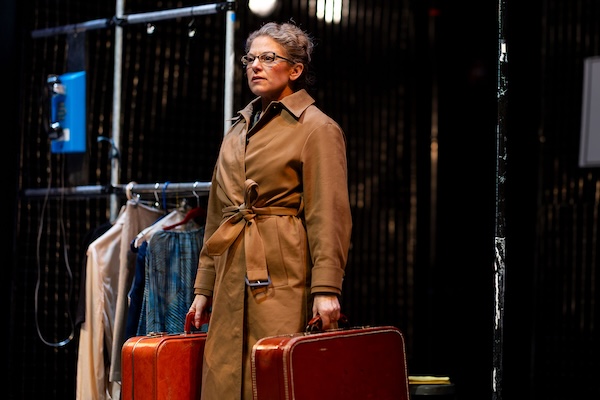
Rebecca Gibel in the Central Square Theater production of The Getaway Driver. Photo: Nile Scott Studios
The Getaway Driver is a taut, suspenseful true-crime drama with ambitions beyond entertainment. Deborah Salem Smith and Charlie Thurston’s script, incisive staging and two potent performances turn the evening into a contemporary morality play.
Created at Trinity Repertory Company in Providence and first presented in September at Trinity Square Theater, the production is directed by Curt Columbus, Trinity Rep’s artistic director from 2006 to 2026. Smith is the company’s playwright-in-residence; Thurston is a playwright, Drama Desk Award-winning actor, and company member.
Rebecca Gibel, as Katherine Ann Power, and Rachael Warren, as Clare Schroeder, reprise their Providence roles in Cambridge. Both belong to Trinity Rep’s resident company.
In February, the play’s rolling three-state premiere moves to Northern Stage in White River Junction, Vermont, with a different cast.
The Getaway Driver reimagines an actual crime through the voices of two women whose lives it transformed. On September 24, 1970, Boston police officer Walter A. Schroeder was fatally shot in the back while responding to a robbery by anti-Vietnam War activists at the State Street Bank in Brighton. Power, a 21-year-old Brandeis student, drove the getaway car for the group, including the gunman.
Schroeder, a 42-year-old World War II veteran and decorated officer, lived with his wife and nine children in Boston public housing. His eldest child, Clare, was 17. In this 90-minute, intermission-free production, she speaks for her father, herself, and her family. The script portrays Power and Clare as women in their 40s, each recounting the crime and its aftermath directly to the audience.
Power’s accomplices were arrested within five years; one later died when a bomb he was building in prison exploded. Power eluded capture for 23 years, remaining on the FBI’s Most Wanted List longer than any other woman to date. Under an assumed identity, she settled in Eugene, Oregon, had a son, married, and ran a popular restaurant. In September 1993, she disclosed her past to her family and community and surrendered. Her return made the cover of Newsweek. A fawning New Yorker article described her as “The warrior who represented the moral outrage of a generation.”
Clare, meanwhile, helped her mother raise eight younger siblings, the youngest just 11 months old. She eventually became a police officer herself. Much of her statement at Power’s sentencing, published in an October 1993 New York Times article, becomes dialogue for her fictional counterpart.
In the program, the writers thank both women for supporting and reviewing the play. Power, now a 77-year-old grandmother and local real estate agent, served six years at MCI Framingham and has given interviews to several publications. Schroeder has declined publicity.
Intense throughout, with heroic performances by Gibel and Warren, the production’s rapid pace and episodic structure is shaped by its script, as well as expressive staging. An-Lin Dauber designed the sets and costumes, Christina Watanabe the lighting, Kaileykielle Hoga and DJ Potts the sound, and Peter Sasha Hurowitz the videos.
Watanabe’s lighting marks the shifts from recollection to reenactment. Scaffolding holds objects that evoke the past like the detritus of memory; a semiautomatic rifle figures prominently among them. Vintage television monitors show news footage of the National Guard’s killings of unarmed student protesters at Kent State, mounting American troop deaths in Vietnam, and escalating deployments. Many in the audience at the performance I attended were old enough to remember those broadcasts.
Small spaces within the set become a classroom, a jail, or a courtroom, allowing the actors to slip into other roles: a schoolgirl, a jail officer, a judge.
The production’s only excesses are occasional blasts of TV static that needlessly punctuate key moments and Warren’s exaggerated Boston accent—a well-intentioned but unnecessary touch.
Each woman begins her account on the morning of the shooting.
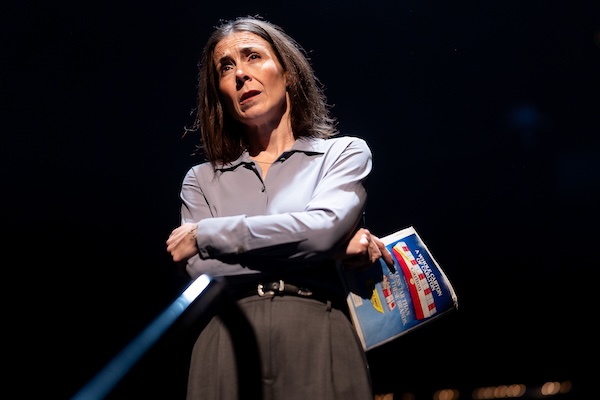
Rachael Warren in the Central Square Theater production of The Getaway Driver. Photo: Nile Scott Studios
Scribbling on a legal pad, Gibel’s Katherine recalls an air freshener in the getaway station wagon—a detail she revisits while preparing a statement for a hearing to shorten her sentence. She then shifts to her farewell dinner in Eugene, where she reveals her hidden past to her young son and ponytailed husband (not the boy’s father, she notes). Holding the audience in unnervingly intense eye contact, Gibel traces Katherine’s transformation from Catholic high school valedictorian to violent antiwar radical. “Well, it’s complicated,” she says—a recurring appeal to understand her embrace of violence in the context of the times.
Gibel nimbly reenacts Katherine’s initiation into gunplay, tutored by a heartthrob who advocates violent resistance and would later die by his own bomb. Changing outfits to signal her shifting identities while on the run, she conveys quiet pride in her ingenuity at evading capture. That self-possession gives way to terror as she reenacts the wait in the getaway car.
Warren’s Clare arrives as a relief, her rawness an antidote to Katherine’s subtle self-compassion. “You thought this was just her story, didn’t you?” she asks. “What about me and my family?” Where Katherine invokes complexity, Clare demands justice. In a plain shirt and belted pants, Warren embodies her character’s strength, anguish, and rage.
Clare first appears in a small cubicle, seated at a classroom desk in her Catholic girls’ school. She is utterly bored—until she is summoned to the principal’s office and told that her father has been shot. Warren makes Clare’s pain physical, her body writhing and her face tightening into grimaces as she addresses the audience. She slips just as convincingly into brief roles as a judge and prison guard.
The Getaway Driver gives both women dynamic voices, but, true to its title, it remains primarily Katherine’s story. Hers is the character who changes. The audience faces a different reckoning: examining its own judgments—and blind spots.
Susan Saccoccia is a recipient of NEA Arts Journalism fellowships in theater, dance, and music. She is an independent arts journalist who reviews visual and performing arts in the US and overseas.
Tagged: Accountability, Boston-theater, Cambridge Theater, Central Square Theater, Charlie Thurston, Clare Schroeder, Curt Columbus, Deborah Salem Smith, Justice, Katherine Ann Power, Political Violence, Rachael Warren, Rebecca Gibel, The Getaway Driver, Trinity Repertory Company, theater review, true crime