
Film Review: Faustian Bargains and Family Betrayals in “Fatherland”
By Peter Keough
Director Paweł Pawlikowski’s austere account of the writer Thomas Mann’s 1949 homecoming puts art, political idealism, and family loyalty on trial.
Fatherland. Directed by Paweł Pawlikowski. At the Coolidge Corner Theatre, starting on November 6.
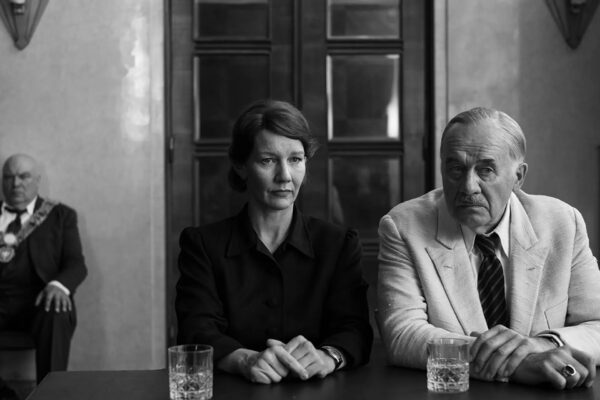
Sandra Hüller and Hanns Zischler in Fatherland. Photo: courtesy of Mubi
World War II never really ends in the recent films of Paweł Pawlikowski. Its repercussions are felt in the monochrome images of his Oscar-winning Ida (2013), in which a novice nun and her aunt search for the burial place of their Jewish family members murdered during the Nazi occupation of Poland, and in Cold War (2018), in which a pair of lovers strive to preserve artistic integrity and personal loyalty in Stalinist postwar Poland. Fatherland, the third film in this trilogy, relates the true story of Nobel Prize-winning German writer Thomas Mann (Hanns Zischler), author of The Magic Mountain (1924) and Doctor Faustus (1947), as he travels with his daughter Erika (Sandra Hüller) from exile in California to visit his divided homeland in 1949. This film, though, differs from the other two not only in that it is based on a true historical event but also in its rigorously austere dynamics and structure: it is more dialectical than dramatic, featuring a clash of antithetical ideals that crush those who uphold them.
The ostensible reason for Mann’s trip is to receive Goethe Prizes both in Frankfurt in the West and in Weimar, Goethe’s spiritual hometown, in the East—a gesture that the renowned author hopes will inspire the reunification of the country in the spirit of its common language and culture. But familial difficulties complicate the mission. In a phone call at the beginning of the film, Erika, an ardent anti-fascist, encourages her brother Klaus, who is estranged from his father (adding another layer of meaning to the film’s title), to join them on the trip. Klaus, who languishes in exile in Cannes, mired in addiction and despair, unenthusiastically assents, which doesn’t exactly please his father. His failure to show up when they arrive in Frankfurt—and the reason for his absence—adds to the anxiety of an already tense situation.
Once in Frankfurt, father and daughter, though greeted with effusive ceremony for the US-sponsored event, see evidence of the growing antipathy toward them in their adopted country, which was then in the midst of the HUAC witch hunt. A journalist colleague of Erika’s shows her a magazine that depicts her father as part of a Communist “Fifth Column” alongside such other suspects as Albert Einstein and Bertolt Brecht. “At least he’s in good company,” Erika observes. A threatening letter arrives at the hotel, accusing Thomas of “betraying the Fatherland.” Erika gives it to their handler, a CIA agent of dubious trustworthiness.
Eyeing the crowd at the reception, the Manns notice that the denazification process has not been totally successful. Erika’s ex-husband Gustaf Gründgens, an actor who sold his soul for success in the Third Reich and who was the subject of Klaus’s novel Mephisto (1936), accosts her. The encounter ends with a satisfying slap. Meanwhile, Thomas is in conversation with Richard Wagner’s grandsons, who ask him to support their efforts to reestablish the Wagner Bayreuth Festival, since he is “the world’s most famous living Wagnerian.” “You mean, after the demise of a certain Adolf Hitler,” he replies, and then suggests that the Bayreuth opera house be razed and their mother, the notorious Nazi Winifred Wagner, be put in jail. Finally, the evening before they head east, Erika is kept awake by drunken ex-soldiers singing Nazi songs. She opens the window and shouts, “Shut up, you fascist scum! Murderers!”
The prospects in Weimar at first seem more promising: the Manns are greeted by singing children, and no Nazis are evident. But this visit threatens to be more treacherous, especially when the head of the Soviet propaganda unit, Colonel Sergei Tiulpanov, greets Thomas by quoting Mephistopheles from Goethe’s Faust: “I am part of the force which always wills evil but always produces good.” The functionaries tempt Thomas to head up the newly created East German Academy of the Arts, but he declines the offer. Perhaps the nadir of their journey occurs when a stranger bursts into their hotel room and tells Thomas he must reveal the fact that the Soviets are using Buchenwald to house thousands of political prisoners. Security personnel drag the desperate intruder away as Thomas and Erika look away in silence.
Fatherland is a dour road movie in a tradition stretching from Ingmar Bergman’s Wild Strawberries (1957) to Wim Wenders’s Kings of the Road (1976), in which Zischler likewise played a troubled traveler in a broken land. Like Joachim Trier’s Sentimental Value (2025), it examines a family of artists—its betrayals, ideals, and resilience. Above all, though, the film bears the stamp of Pawlikowski’s detached, meticulous sensibility: rigorous mise-en-scène and subtle montage give its penetrating moral inquiry visual form. Throughout Fatherland, the cold geometry of ruined architecture and the regimentation of human bodies occasionally yield to expressive faces and unspoiled nature. Civilization and culture stand trial. As for the verdict, the last scene, in which Bach’s “Jesu, Joy of Man’s Desiring” is played on an organ in a battered chapel, offers a glimmer of hope.
Peter Keough writes about film and other topics and has contributed to numerous publications. He was the film editor of the Boston Phoenix from 1989 to its demise in 2013 and has edited three books on film, including Kathryn Bigelow: Interviews (University Press of Mississippi, 2013) and For Kids of All Ages: The National Society of Film Critics on Children’s Movies (Rowman & Littlefield, 2019).
Tagged: Art and politics, Cold-War, Erika Mann, Exile, Family relationships, Fatherland, German cinema, Hanns Zischler, Historical drama, Paweł Pawlikowski, Polish cinema, Postwar Germany, Sandra Hüller, Thomas Mann, fascism, film criticism