
Film Review: “Wicker” — What Women Want
By Peg Aloi
Olivia Colman and Alexander Skarsgård are an odd but irresistible couple in a darkly funny fable about marriage, passion, and the scandal of a husband devoted to his wife.
Wicker, directed by Alex Huston Fischer and Eleanor Wilson. Screening at Alamo Drafthouse Seaport.
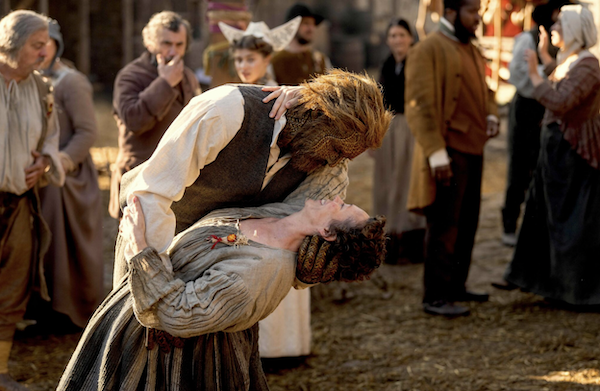
AAlexander Skarsgård and Olivia Colman in Wicker. Photo: Black Bear Pictures
“Come. It is time to keep your appointment with the wicker man.” —Lord Summerisle, The Wicker Man (1973)
The 1973 film The Wicker Man, written by Anthony Shaffer and directed by Robin Hardy, has become an icon of British cinema and folk horror. Edward Woodward plays a Scottish police officer lured to a remote island to investigate a report of a missing teenage girl. The island is known for its odd pagan ways and is run by a feudal patriarch named Lord Summerisle (Christopher Lee). (A disastrous 2006 remake by Neil LaBute hardly bears mentioning at all — at least in my opinion.) The wicker man is a giant burnable structure built to appease the gods via human sacrifice; there is little doubt that the film’s imagery inspired Burning Man, the yearly music festival in the Southwest desert. In the darkly funny new film Wicker, the wicker man is made flesh and becomes an alluring but disruptive influence in an 18th-century village.
Directed by Alex Huston Fischer and Eleanor Wilson, who adapted the script from a short story by Ursula Wills (“The Wicker Husband”), Wicker is a sharp, fresh, and timely fable that tears apart rigid social norms despite its period setting. Olivia Colman plays a woman known only as “Fisherwoman” in a small English village where everyone is known by their occupation rather than their name: there’s the Bottlewasher, Tailor, and Innkeeper, for example. The Fisherwoman lives alone, works hard, and sells her daily catch in the local market square. She is frequently ridiculed by others in the community for being somewhat unkempt and for stinking of fish. The villagers joke that she will never find a husband. She returns their insults with gusto, but her loneliness is palpable. The Tailor’s Wife (Elizabeth Debicki) is subtly cruel about the Fisherwoman’s single lifestyle, even though her own marriage to a kind, hardworking man (the wonderful Nabhaan Rizwan) seems devoid of passion.
The Fisherwoman impulsively goes to the home of the Basketmaker (a brilliant Peter Dinklage) and says, simply, “I want you to make me a husband.” He looks at her briefly and tells her to meet him at the chapel in one month. While she spends the interlude tossing and turning in frustration, he refines his creation, which emerges in the form of a tall and strapping Alexander Skarsgård. The Wicker Husband is not quite human, yet he can speak, walk, move, and perform useful household tasks. He is also perceptive about others and honors basic social customs. He understands, for example, that he must find a suit to wear on his wedding day and borrows one from a neighbor.
When the Fisherwoman meets her new mate, she is struck by his brawn and taken aback by his rapt attention. Their wedding night is momentarily awkward — until sudden passion ignites. Moans of pleasure escape the Fisherwoman’s hut over the ensuing days while her new helpmeet makes himself useful doing household repairs, including fixing the bed, which they break frequently. The villagers learn of the Fisherwoman’s marital situation, and they find the manly physicality of the new groom almost as striking as his steadfast devotion to his wife.
At the wedding of the young Bottlewasher (Gustav Lindh) to his bride (Marli Siu), the Wicker Husband invites his wife to dance. His sturdy grace and romantic gestures mesmerize the guests. When the Bakerwoman (Ella Bruccoleri) overhears him murmuring to the Fisherwoman, “You are the reason I live and breathe” (as if he were created for her, which he was), she is consumed with envy, enraged because her Bakerman husband (Ben Ashenden) is so inattentive.
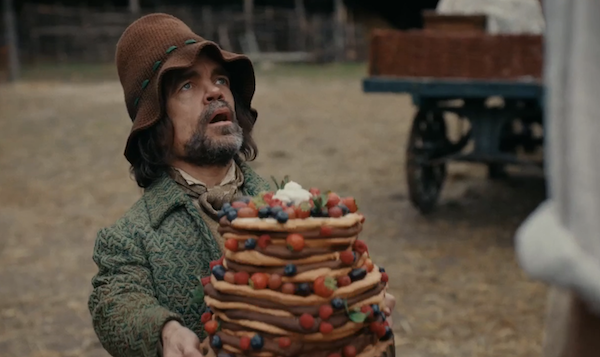
Peter Dinklage in a scene from Wicker. Photo: Black Bear Pictures
Predictably, the new couple inspires both curiosity and hostility among the small-minded villagers. Some of the menfolk allow themselves to be schooled in the ways of tenderness by the Wicker Husband, but the women are generally spiteful. The couple’s cozy home life is a haven from this social drama. The Fisherwoman longs for her husband to sit by the fireplace with her, but he refuses, saying, “I am very flammable.” Skarsgård’s guileless deadpan delivery is hilarious and often moving. When unsubstantiated rumors of his infidelity start to spread through the village, the Fisherwoman confronts her husband in anger. He is bewildered and hurt, unable to fathom why she would question his loyalty. She lashes out, targeting his one vulnerability, and then fears she has lost him forever.
Wicker is less a love story than a biting satire of the institution of marriage. When the minister asks the couple at their midnight chapel ceremony if they have the metal collar traditionally worn by the bride (a symbol of ownership), the Fisherwoman blithely says, “We won’t be needing that.” The nurturing relationship of this unconventional couple ignites an uneasy excitement in a community throttled by conformity, a seeming catalyst for change toward a kinder social order. The Wicker Husband sees no purpose to his life beyond his wife’s happiness. Her disdain for convention, however, is not strong enough to stop her from succumbing to the small-minded jealousy that pervades the provincial village. Happy with what she has, the Fisherwoman risks losing it all by giving in to what others expect of her. The film’s satiric spirit is undoubtedly feminist, but the story’s themes of unconditional love and self-actualization transcend sex and gender roles.
Wicker is solidly designed and produced, with Hungarian locations providing a backdrop that is, fittingly, bucolic and slightly wild. Colman continues to astound in every role she inhabits. This nameless character is stunningly realized, a drab woman with a sharp wit, made luminous through love. The rest of the cast is also outstanding, especially Skarsgård, who radiates warmth and nuance beneath layers of wood and flaxen prosthetics. Dinklage takes a small role and imbues it with intricate hilarity. The score by Anna Meredith balances dark and light motifs skillfully, a fine counterpart to the lush, earthy cinematography of Lol Crawley (The Brutalist). Wicker pleases on many levels: it is artfully executed, beguilingly entertaining, and strikingly original, its bold, brash story a call to reimagine what love can be.
Peg Aloi is a former film critic for the Boston Phoenix and member of the Boston Society of Film Critics, the Critics Choice Awards, and the Alliance for Women Film Journalists. She taught film studies in Boston for over a decade. She has written on film, TV, and culture for web publications like Time, Vice, Polygon, Bustle, Dread Central, Mic, Orlando Weekly, Refinery29, and Bloody Disgusting. Her blog “The Witching Hour” can be found on substack.
Tagged: Alex Huston Fischer, Alexander Skarsgård, Anna Meredith, Dark Comedy, Eleanor Wilson, Elizabeth Debicki, Gender Roles, Lol Crawley, Olivia Colman, Peter Dinklage, feminism, film reviews, folk horror, marriage, satire