
Classical Album Review: Pianist Igor Levit’s “Resistance” Speaks to the Present
By Jonathan Blumhofer
Schoenberg’s “Ode to Napoleon” and Liszt’s transcription of Beethoven’s “Eroica” make a forceful pairing in the pianist’s fierce, illuminating new album.
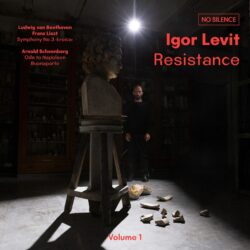 Napoleon Bonaparte was no Hitler—Andrew Roberts’ magisterial biography, among others, makes that abundantly clear. But before the Nazi dictator arrived on the scene, few modern figures fit the popular definition of megalomaniacal tyrant better than the Corsican corporal. So it was only fitting that Arnold Schoenberg adapt Lord Byron’s 1814 “Ode to Napoleon,” a stinging riposte to the excesses of the self-appointed French emperor’s rule and his stunning fall, as a forceful protest against authoritarianism.
Despite his often high-minded artistry, Schoenberg was hardly aloof from daily concerns, and, on occasion, his music comments directly on the big issues of his age. The Ode, written in 1942, is one such work, and its timeliness—both poetical and musical—emerges with potent force on Igor Levit’s Resistance. One of the inaugural releases on the Berlin-based pianist’s No Silence Records label, the album pairs Schoenberg’s opus with Franz Liszt’s arrangement of Beethoven’s Symphony No. 3. If that’s a predictable combination, it’s nevertheless a forceful one.
In the Ode to Napoleon, Schoenberg offered something of a 12-tone parallel to his landmark Pierrot lunaire of 1913 (that work, freely atonal, predated the development of the 12-tone system by about a decade). It involves a narrator declaiming Byron’s poem in notated, inflected rhythm, as well as a solo piano and string quartet (Pierrot’s foursome is a combination of woodwinds and strings). Levit’s account expands the string unit to a chamber orchestra—here, the Kammerakademie Potsdam—but otherwise adheres to Schoenberg’s original design.
The results are appropriately fierce and defiant. Actress Dörte Lyssewski captures the ironic turns of Byron’s verse with aplomb, while the Potsdam players, led by Antonello Manacorda, bring a welcome weight to the proceedings. Throughout, their playing and Levit’s are fresh and well-defined.
But the real star of the undertaking turns out to be Schoenberg, whose moral convictions shine like a beacon. Certainly, the Viennese native’s musical language is difficult, and there’s little that’s particularly comforting about the Ode’s gritty scoring. Yet the clarity of his writing and its almost visceral responsiveness to Byron’s lines are striking. The text and musical language may be a marriage of opposites—but, artistically, they operate as equals.
As a result, the combination works to illuminate fascinating parallels between Byron’s 200-plus-year-old poem and strongmen the world over today: if you’re looking for a defense of the important role serious art can play in the fight to preserve democracy, here is Exhibit A. Just listen to the concluding verse, holding up “The Cincinnatus of the West”—George Washington—as the answer to Napoleonic despotism, where “neither guilty glory glows, / Nor despicable state.” Has the E-flat-major triad with which the Ode closes, once an emphatic period, ever read more like a question mark?
Leave it to Liszt’s arrangement of Beethoven to restore something approaching the latter’s original meaning.
The Symphony No. 3, in that key and originally dedicated to Napoleon, is, once stripped of all the extramusical detritus that’s accumulated around it since its 1805 premiere, essentially a study of that tonality. Liszt’s transcription captures much of the orchestral flavor of the original—the connection between the older composer and the virtuoso tradition of the younger is readily apparent in its pages—but, more importantly, boldly articulates the strengths of its underlying musical arguments.
To be sure, this is strange music, especially the huge second-movement funeral march. Yet its scope, invention, and sense of purpose are hugely invigorating. Levit, who’s one of the finest Beethoven pianists of our day, makes for an ideal guide, playing with flexible, rhetorical phrases; lucid voicings; terrific energy (his ecstatic take on the Scherzo is rightly breathtaking); and a profound sense of where everything is supposed to be going. If only, one can’t help but wish, the rest of life could be so ordered.
Jonathan Blumhofer is a composer and violist who has been active in the greater Boston area since 2004. His music has received numerous awards and been performed by various ensembles, including the American Composers Orchestra, Kiev Philharmonic, Camerata Chicago, Xanthos Ensemble, and Juventas New Music Group. Since receiving his doctorate from Boston University in 2010, Jon has taught at Clark University, Worcester Polytechnic Institute, and online for the University of Phoenix, in addition to writing music criticism for the Worcester Telegram & Gazette.
Tagged: Antonello Manacorda, Arnold Schoenberg, Classical Music, Dörte Lyssewski, Eroica, Franz Liszt, Igor Levit, Kammerakademie Potsdam, Lord Byron, Ludwig van Beethoven, No Silence Records, Ode to Napoleon, Political Music, Resistance, album reviews, piano
1 Comment
Leave a Comment

Jon is the expert, but I agree. My recent column on this timely album:
“At a time when timidity pervades the arts and cultural community and business as usual provides cover for cowardice, artists who confront attacks on democracy and the escalating environmental crisis offer invaluable models of the artist as citizen. A salute, then, to German pianist Igor Levit for launching his new recording label, “No Silence”— which will stand as a rebuke, in his words, “against conformism, against extremism, for humanity.” And a huzzah for its terrific first release: his performances of Liszt’s transcription of Beethoven’s Third Symphony, the Eroica, and Schoenberg’s Ode to Napoleon. Both works challenge the depredations of tyranny.
Levit’s mission statement for No Silence identifies dehumanization as a major force that’s driving today’s chaos: “It is my answer to the many crises of our time, of which the loss of humanity, including through technology, is the greatest.” How will that ethical position fare against creators who embrace human–machine collaboration—given that political power will inevitably define its limits? Brian Eno is intrigued by AI, but underscores fears about the issue of control: “My problem with AI is the ownership of it and what I know are the moral and social values of the people who own it.”
A condemnation of inhuman domination runs through Levit’s new album, most forcefully in its splendidly spiky rendition of Schoenberg’s 1942 Ode to Napoleon, an attack on fascism aimed squarely at Hitler. Levit performs with the Kammerakademie Potsdam under Antonello Manacorda; German actor Dörte Lyssewski delivers Byron’s English text with delightfully sardonic aplomb. The poem is wonderfully ambivalent: it fiercely condemns autocracy (“Nor till thy fall could mortals guess/Ambition’s less than littleness!”), yet also reproaches Napoleon for failing to die on the battlefield like a proper warrior.
Today, the poem’s final verse comes off as ghoulishly ironic. Byron turns his admiring gaze to George Washington, “Where neither guilty glory glows,/Nor despicable state.” Napoleonic delusions of grandeur now possess the American presidency—we are in a despicable state.”