
Book Review: The Many Prisons of Capitalism
By Bill Littlefield
In Capitalism & Confinement, A.J. Bohrer argues that liberation requires more than reform—it demands a radical rethinking of work, borders, policing, and even the family.
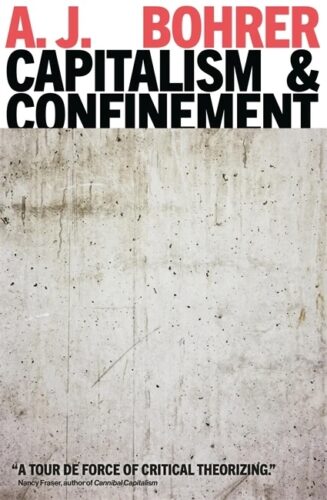
Capitalism & Confinement by A.J. Bohrer. Verso, 225 pages, $29.95.
A.J. Bohrer, a professor in Notre Dame’s Gender Studies Program, has written for Al Jazeera, In These Times, and Truthout, as well as academic journals including Historical Materialism and Philosophy Today. In their latest book, Capitalism & Confinement, they argue that capitalism depends on restricting the lives and possibilities of much of the world’s population.
“Confinement,” as Bohrer uses the term, includes literal incarceration—not only of people convicted of crimes, but also of those whose resistance or presumed superfluity makes them obstacles to the accumulation of profit. It also encompasses borders that restrict the movement of people in ways that allow profitable goods to circulate; it also refers to the confinement of Indigenous populations to assigned territories through law, custom, or extralegal violence. These are not incidental abuses, in their account, but expressions of capitalism’s underlying logic. Meanwhile, those who benefit from the system persuade those it constrains that the alternatives would be worse: feudalism, perhaps, or slavery. For many people who have known nothing else, Bohrer argues, an alternative to capitalism is difficult, sometimes impossible, to imagine.
They open their introduction with the story of Awdah, a close friend living under Israeli occupation amid “segregated roads,” a restrictive permit system, and “the imposing border wall.” Their critique of the apartheid system Israel imposes on Palestinians is detailed and grimly convincing. Their description of themselves as “a product of Zionist schools, summer camps, and family” gives that critique a personal dimension, as does their account of “Israeli activist friends who were beaten by Israeli passersby” in Jerusalem for protesting the state’s oppression.
But Palestine is one instance of a worldwide system. Through its control over “labor, land, and life,” Bohrer argues, capitalism deprives people of “a life worth living.” As they put it early in the book, “if your chances of going to a university or to prison are easily predicted by your postal code, that is a form of confinement.” Such predictions need not be infallible to reveal the underlying pattern. The occasional escape from poverty does not disprove the existence of structural barriers; it can instead help legitimize them. And even those who escape remain confined in another sense: their reward is relative security within a system that oppresses the many for the benefit of the few. The argument has an evident appeal at a time of increasingly concentrated wealth and power.
Bohrer’s proposed alternative is “abolition communism.” The abolition of capitalist institutions and the establishment of communism, she writes, can serve as “the two joint beacons of light guiding our struggles.” Their ambitions extend well beyond a more progressive income tax, the removal of the cap on Social Security taxes, or stronger regulation of banks and financial institutions. She wants not to temper the system but to replace it.

A. J. Bohrer. Photo: courtesy of the artist
They nevertheless finds grounds for hope in existing resistance. In the “abolitionist dream in Minnesota,” where activists protested the murders of two people by ICE agents, they see the beginnings of a movement that could demand the abolition not merely of ICE or the police, but of the broader system they enforce. They also dras connections between policing in the United States and Israel. “Members of the Minneapolis Police Department had been training with Israeli law enforcement for years,” they write, while six years earlier, protesters in Ferguson, Missouri, had confronted police agencies “that had been trained in Israel.”
For Bohrer, these connections reflect more than coincidence. Repression, wherever practiced, serves what they call “a central police function under capitalism.” Cooperation among states seeking to suppress resistance is therefore neither surprising nor peripheral to their argument: it illustrates the common interests that link apparently distinct systems of confinement.
Throughout the book, Bohrer draws on writers including, unsurprisingly, Karl Marx. Their emphasis focuses on confinement as the means through which capitalism restricts, impoverishes, and shortens lives. To their credit, Bohrer acknowledges that ostensibly communist states have failed to fulfill the emancipatory promise of communism. They attribute those failures, however, to insufficient abolition. Such regimes preserved too much of the order they claimed to overthrow: police, mass incarceration, hierarchies of race, gender, and age, and concentrated wealth. In their account, these failures do not discredit abolition communism; instead, they demonstrate how thoroughly abolition must proceed.
The family, at least in its present form, must also be transformed. In “The Carcerality of Care,” Bohrer imagines “the ‘something else’ of a liberated world in the realm of love, intimacy, desire, and care,” invoking “the joys of a non-proprietary self, the seductive whisper of a world that may be to come.” They believe many people have experienced fleeting moments of such freedom. The task for activists is to make those moments sustainable.
That aspiration gives the book its hope, but also leaves its central difficulty unresolved. Bohrer is more concrete about the institutions that must disappear than about the arrangements that would replace them. Their account of confinement makes a forceful case against treating existing conditions as inevitable. Whether abolition communism can turn glimpses of liberation into a durable social order remains the larger question.
Bill Littlefield’s most recent novel is Mercy (Black Rose Writing).