
Visual Arts Review: Suzanne Jackson’s “What Is Love” — Devotion Beyond the Shadows
By Avary Amaral
At the MFA, a long-overdue retrospective traces six decades of paintings and suspended abstractions shaped by nature, grief, Black experience, and an unwavering commitment to art.
Suzanne Jackson: What Is Love at the Museum of Fine Arts, Boston, on view through January 18, 2027
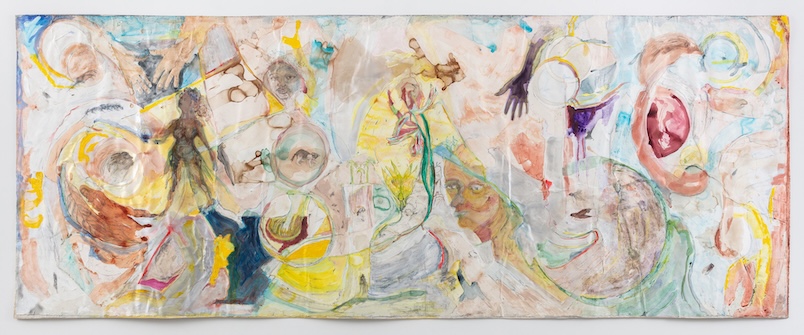
Suzanne Jackson, a history drawing–cracked wall, 2016–19. Photo: Timothy Doyon, courtesy Museum of Fine Arts, Boston
Through whimsical, layered paintings and sculptures, Suzanne Jackson’s What Is Love explores her deep connections to nature, spirituality, and the shared experiences of Black women. Her work moves from watery acrylic washes on canvas to suspended structures, revealing an artistic spirit increasingly willing to claim space. Early paintings feel translucent and delicate, almost tentative. Drawing on the magical Alaskan landscapes of her childhood, Jackson gives Black experience richly pigmented, aqueous form. As she confronts grief, social upheaval, and personal tumult, her work expands into multilayered forms, incorporating rougher, everyday materials to reflect an increasingly complex world.
Organized chronologically, the retrospective spans the late 1960s, when Jackson began exhibiting, through the present decade. She started painting at 16 but did not receive recognition from a major museum until she was 67. The exhibition traces not only her artistic development but also the devotion that sustained it through decades of limited institutional support.
Honoring a Black woman artist long overlooked by museums carries particular weight at this moment. Earlier this year, the MFA eliminated 33 active staff positions—6.3 percent of its active workforce—including its senior inclusion, diversity, equity, and access position and its only Black, Muslim, and Indigenous curators. The museum disputes that the cuts disproportionately affected any group.
Against that backdrop, making room for Black love, beauty, and perseverance at the museum feels like a necessary offering to Boston. But this exhibition does not feel like a commemorative event: as MFA curator Claire Howard puts it, Jackson is “making some of her most experimental and radical work today.” The retrospective honors six decades of persistence as it insists on the vitality of Jackson’s present. It feels not merely overdue but urgent.
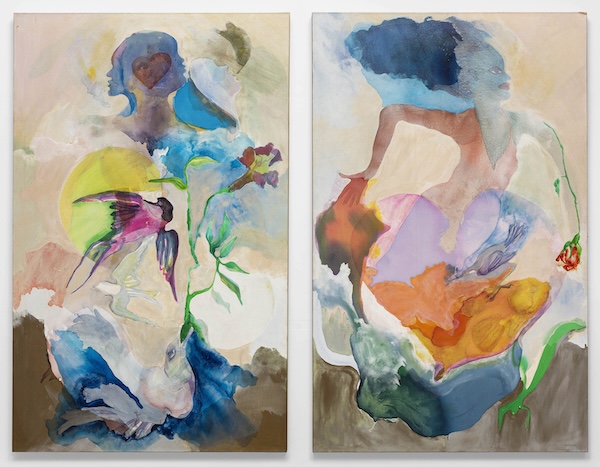
Suzanne Jackson, Wind and Water, 1975. Photo: Ruben Diaz, courtesy Museum of Fine Arts, Boston
Jackson’s diptych Wind and Water, painted in acrylic wash and graphite on gessoed canvas, opens the exhibition by conjuring the enchanted landscapes of her childhood. Mountain-like forms rise across both canvases, their contours met by water in a spectrum of blues. Above, Black figures float among clouds and wind currents as plants and animals reach toward them or emerge from their bodies. A fuchsia barn swallow dominates the left canvas; beneath it, a ghostly counterpart flies in the opposite direction. Nature and spirit are inseparable here, the figures both nourishing and nourished by the world around them.
On the right, a heart tethers a celestial traveler to the earth; on the left, another overlays two Black faces looking in opposite directions. Beside them, a muted white face tilts back, seemingly releasing a faint breath. For Jackson, the natural world speaks to those willing to listen. “I could hear voices in the trees and I could hear the moss. You pass a tree and you hear a love story,” she says in the San Francisco Museum of Modern Art’s introductory video for the exhibition.
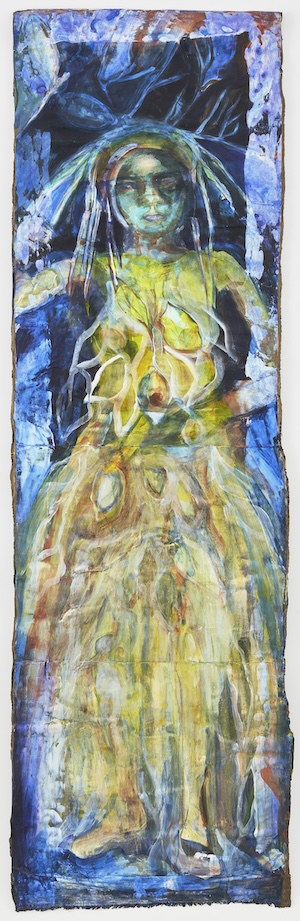
Suzanne Jackson, Ma‑Yaa, 1994–98. Photo: Timothy Doyon, courtesy of Museum of Fine Arts, Boston
Wind and Water appears in “Blooms and Washes,” beneath a quotation that distills Jackson’s approach: “I try to say strong things . . . in a very sensitive way . . . in the sense of a Black woman and how she feels within her whole society.”
Critics sometimes dismissed her early paintings as too light and melodic. But Jackson persisted, layering washes and gradually turning their delicacy toward more forceful ends. Seen alongside her later work, these paintings reveal not an artist awaiting a firmer identity but one discovering how much strength translucence could hold.
In “Mythical City Spirits,” those washes grow denser, giving Jackson’s figures greater weight and presence even as their outlines blur. Ma-Yaa, from her water-spirit series, pays tribute to Yemoja, a Yoruba orisha associated with water and motherhood. Color and brushstrokes radiate around the goddess, who rests one hand on her stomach and raises the other arm at a right angle, as if taking an oath. Her expression is stern, her gaze elusive. Warm-toned leaves billow from her chest and drape over her abdomen and legs like a dress.
Painted 13 years after Jackson’s father died, the work takes on added poignancy beside a quotation from Jackson in the section’s wall text: “The aura now is quite different . . . Fantasy is almost wiped out.” The painting suggests not that grief extinguished Jackson’s imaginative world, but that it gave that world new gravity. Transformation becomes a means of survival.
In “Environmental Abstractions,” Jackson’s evolving relationship with acrylic becomes a kind of symbiotic love: the material supports her vision, and she releases it from its conventional role. Acrylic gel medium no longer lies flat on canvas. Built up in layers and dried into a rubbery form, it becomes the structure itself, suspended from the ceiling and exposed on all sides.
Crossing Ebenezer hangs ragged and torn. Crimson paint skins and flakes, firewood-bag netting, peanut shells, wood, and D-rings form a memorial to the roughly 600 formerly enslaved people abandoned at Ebenezer Creek as Confederate cavalry approached during the Civil War. Hundreds drowned, were killed, or were re-enslaved. Light filtering through the textured, translucent acrylic evokes air bubbles struggling toward the surface amid what looks like shrapnel. With its flared bottom and tattered edges, the work resembles a war-torn flag arrested in the wind. Time may offer too little opportunity to absorb such loss; Jackson’s acrylic holds it in suspension.
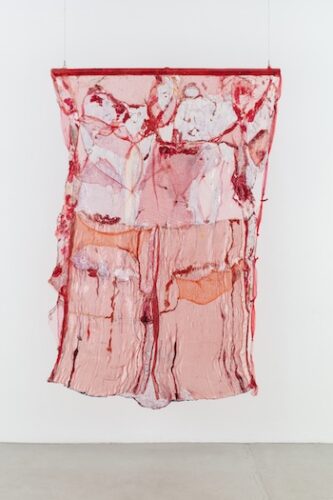
Suzanne Jackson, Crossing Ebenezer. Photo: Timothy Doyon, courtesy Museum of Fine Arts, Boston
In an interview with PBS, Jackson explains: “I’m interested in history. I’m interested in how we got here. And that’s what the abstraction can do. It’s not telling you a story directly. It’s allowing you to think. I want people to think.”
In a back corner of the final room, Saudades—named for the Portuguese word evoking yearning and the ache of absence—comprises four suspended sculptures. Where other works command the room, this one seems to drift through its still air. Made after the death of Jackson’s son, Rafiki, it incorporates her mother’s quilting cotton, her father’s tie, and Rafiki’s T-shirt. Metal bells encircle the vertically strung elements of the largest sculpture, promising a bright chime. Their silence makes for a piercing dramatic presence.
The title What Is Love isn’t given a question mark, but Jackson’s work offers an answer: devotion. Her tender meditations and monumental expressions of grief reveal a steadfast attachment to her materials and the lives they hold. In her experiments with acrylic gel, paint becomes both structure and vessel, carrying memory, loss, and possibility.
That devotion extends beyond the studio. Through Gallery 32, which she ran in Los Angeles from 1968 to 1970, Jackson supported fellow Black artists, including Gloria Bohanon, Emory Douglas, David Hammons, Betye Saar, and Timothy Washington. After decades of limited recognition, What Is Love honors both her persistence and her commitment to making room for others. The retrospective asks us to pause and attend to a Black creativity that flourished long before institutions learned to look.
Avary Amaral is a senior journalism major and sociology & anthropology minor at Emerson College. She is currently the projects editor for The Berkeley Beacon and has interned at The New Bedford Light, BINJ, and Boston Magazine.
Tagged: Avary Amaral, Black artists, Black women artists, Boston art exhibitions, Suzanne Jackson, abstract painting, art reviews, contemporary art, mixed media, museum-of-fine-arts-boston, sculpture