Classical Album Review: Matthew Aucoin’s “Music for New Bodies” Poses Big Questions, with Uneven Answers
By Jonathan Blumhofer
The composer leads a virtuosic debut recording of his Jorie Graham–inspired oratorio, whose striking invention is sometimes blunted by relentless intensity.
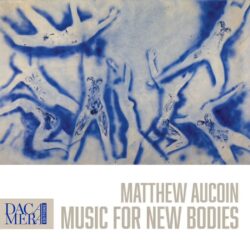
Some composers like to deal in big questions. Matthew Aucoin is one of them. What would it mean, he writes, to give voice to the experience of being alive in the mid-21st century? To make sense of our various, fractured identities? What does it mean to live, as he puts it, “a single, embodied human life” in our tortured, confusing, technology-centric times?
Aucoin’s oratorio on texts by Jorie Graham, aims to resolve these queries, at least insofar as possible, along with others that arise in the course of the journey. Written in collaboration with Peter Sellars and for American Modern Opera Company, the 70-minute work for five vocalists and an 18-piece ensemble is out now in its debut recording. Sometimes eerie, sometimes bewildering, sometimes austere, it’s also sometimes quite touching.
Aucoin is a much-heralded wunderkind (he was awarded a MacArthur Foundation “genius grant” at 28), and it’s clear that his reputation is fully deserved: Music for New Bodies is the work of a deeply knowledgeable, exceptionally creative and capable artist. While there are (or seem to be) nods to various influences—Stravinsky and Schoenberg in the first movement, Berio in the second, Ligeti and James MacMillan in the fourth, John Adams over it all—these are generally passing, and the overriding impression the score leaves is of a singular voice carving out a distinct niche.
While his style is often disjunct and abstract, Aucoin’s got a gift for melody when he chooses to use it. Music for New Bodies offers more than a few demonstrations of rich, sinuous lyricism, particularly in its writing for woodwinds. There are also times when the score manages to craft a particularly haunting atmosphere, notably during the short “I [know myself]” movement and the more expansive “Prying.” The latter, with its hallucinogenic depiction of a body undergoing surgery for an undisclosed ailment, yields the most urgent episodes in Music for New Bodies, culminating in a weirdly grooving, combo-like refrain with electric bass.
And yet, Music for New Bodies doesn’t entirely satisfy. Admittedly, this may be partly due to experiencing it apart from its intended staging: beguiling as parts of the work sound, it is clearly intended to be encountered live. Still, the settings of Graham’s poems, which range from relatively straightforward to more recondite, lack a certain degree of variety.
To be sure, Music’s vocal aspect—delivered with admirable panache by sopranos Kathryn Lewek and Meryl Dominguez, mezzo-soprano Megan Moore, tenor Paul Appleby, and bass-baritone Evan Hughes—is involved. Depending on the context, the quintet functions as a unit, a collection of separate entities, a disembodied voice, or something else altogether. In every case, the demands made on the singers are highly virtuosic. Lewek, especially, impresses with her high-tessitura leaps, and the larger group exhibits both excellent intonation and diction in its collective moments.
Here, though, some of Aucoin’s pet devices—high, close harmonies and singers dovetailing poetic phrases among themselves—grow wearying with repetition. One might prefer more of the occasional (but very effective) canonic moments, such as those near the start of the opening “Cryo.”
At the same time, a bit of simply letting go might also be in order: in or out of its context within Music, the concluding “Poem” stands as a welcome essay in clarity and relative simplicity. As it stands, the sheer intensity of the rest of the score sometimes becomes overwhelming.
The instrumental writing in Music is similarly dense and busy. That said, the composer understands how to balance instruments, and the voices rarely find themselves covered. Some misfires aside, Aucoin’s crafted a fascinating and individual sound world. The opening half of “Deep Water Trawling,” however, comes off a touch too literally in its effort to evoke a fish. Nor is that passage aided by an obnoxious, recurring electronic pulse.
The performance, which is conducted by the composer, is as secure and definitive as these things come. Joseph Jordan’s oboe solos are sensitive and superb, attributes that apply equally well to the efforts of the larger group (which includes the excellent quartet Sandbox Percussion).
Jonathan Blumhofer is a composer and violist who has been active in the greater Boston area since 2004. His music has received numerous awards and been performed by various ensembles, including the American Composers Orchestra, Kiev Philharmonic, Camerata Chicago, Xanthos Ensemble, and Juventas New Music Group. Since receiving his doctorate from Boston University in 2010, Jon has taught at Clark University, Worcester Polytechnic Institute, and online for the University of Phoenix, in addition to writing music criticism for the Worcester Telegram & Gazette.
Tagged: American Modern Opera Company, Choral Music, Jorie Graham, Matthew Aucoin, Music for New Bodies, Peter Sellars, Sandbox Percussion, album review, contemporary classical music, oratorio