Book Review: Jean-Philippe Toussaint’s “The Chessboard” — The Pieces Don’t Quite Fit
By David Mehegan
This minimal memoir reminds me of a backyard clothesline, festooned with socks, shirts, pants, dishtowels, suspenders, underwear, bras, new things and old, all in various colors and shapes, flapping briskly in the wind.
The Chessboard by Jean-Philippe Toussaint. Translated from the French by Ruth Diver. Other Press. 191 pp. Paper. $16.99.
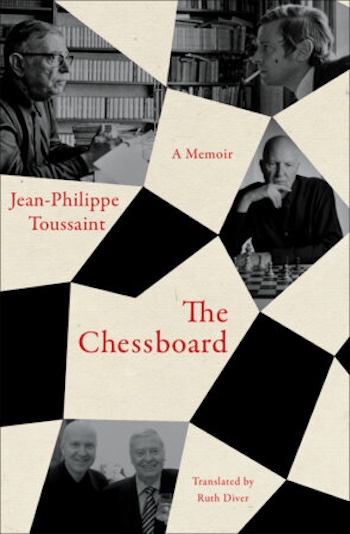 Jean-Philippe Toussaint, 68, is a Belgian novelist, playwright, photographer, and filmmaker who lived much of his youth in France. Since 1985, he has written and produced a handful of movies and published numerous fiction and nonfiction works, including the Proustian Cycle of Marie: four novels, published between 2004 and 2013, chronicling the rise and fall of a love affair.
I have not read the Cycle of Marie, said to be Toussaint’s magnum opus (could anyone but the French appreciate a multiyear quartet about a boy-girl split? Even The Lord of the Rings is only three books), but his most recent fiction, The Emotions, published in French in 2020 and in English last year, is an astounding performance. Only 150-odd pages in length, it is told in the first person by Jean Detrez, a bureaucrat in the European Commission who specializes in analyzing the future and trying to anticipate it for policy planning. While his marriage is ending, Detrez grapples with great future challenges and issues. However, he cannot understand his own future or present and is continually tripped up by surprise encounters, usually involving women. That he doesn’t understand women is an understatement.
Toussaint is said to be influenced by Samuel Beckett and the modern school of French writers, including Alain Robbe-Grillet, who discarded traditional literary devices and rules. The style of The Emotions reminded me strongly of the German novelist W. G. Sebald, notably in its lack of paragraphing (it runs on page after page, with occasional line breaks) and quotation marks, as well as, paradoxically, its paucity of expressed emotion in the narrative. We never find out what wrecked Detrez’s marriage, which is his second, or what wrecked his first. Attraction and alienation drive the tale along. He is aware of both but cannot understand or manage them. This might sound unappealing in a novel, but the vividness of detail, as in Sebald, is mesmerizing, and the tension never falters.
Now Toussaint returns with this decidedly awkward and shapeless sort-of memoir. “Sort of” because it is not clear what story he is out to tell. At least he is honest about this. He describes his misgivings, confusions, writer’s block, and perfectionism, and even confides that he is not sure what the book is supposed to be.
The central narrative shows Toussaint in March 2020 going from Brussels to his writing office in seaside Ostend to “edit”—that would seem to mean proofread—The Emotions. He also intends to translate Austrian writer Stefan Zweig’s 1942 novel, Chess Story, into French while (as if working on two books at once were not enough) tackling this little memoir. The COVID-19 pandemic hits just as he arrives in Ostend, and he must try to do all this working and thinking while he and his family are locked down.
It was a confusing situation, as the pandemic was for everybody who lived through it, and the upshot is a confusing and unsatisfying little book.
Despite its title and its sixty-four short chapters—one for each square on the chessboard, Toussaint helpfully tells us—The Chessboard isn’t really about chess, so far as I can tell. Yes, there’s a lot of chess and there are a lot of chess players in it, but if all that is meant to be some sort of metaphor for life off the board, it does not come off.
Toussaint tastes various topics: his writing method; his grandmother’s sore legs; how he enjoyed the COVID-19 lockdown, given his need to concentrate on his writing; how his father stopped playing chess with him when the son became skilled enough to win; detailed memories of two friends (one in grade school, another in adulthood) who died unexpectedly and mysteriously; the thrill of meeting his future wife; and his efforts to carry out the Zweig translation (published in 2023).
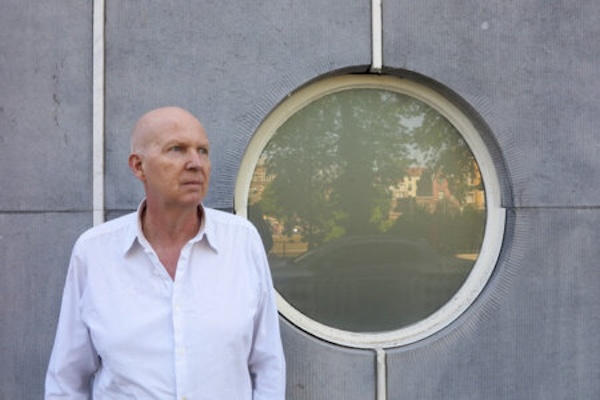
Jean-Philippe Toussaint. Photo: Madeleine Santandrea
What this little book does not have, so far as this reader could detect, is a thematic through-line, unless it is the lumpiness and awkwardness of life, full of surprises and unexpected turns. Not unlike, come to think of it, The Emotions. We expect a memoir to be about its author, but possibly this one has TMI with too little provocative revelation.
“This morning,” chapter 52 begins, “I am stalled again in my writing process.
“But I must not succumb to the temptation of starting to reread what I have written right away, I must continue to write.
“I got up at 6:00 a.m., it’s a beautiful day, I feel energetic, I got into my office to work, I don’t quite know how to go on.
“Last night, I finished writing the episode about Yusupov in Berlin…”—an incident involving Toussaint’s 1993 film, Berlin, 10:46, in which real-life Russian chess master Artur Yusupov plays himself.
Chapter 53 starts in a similar vein:
“It is the book that I am now writing that has become the object of all my attention.
“For a long time I didn’t have a title for it, I simply noted down ‘Journal.’ I also thought about giving it a subtitle, with would then qualify it with a word in italics, in the manner of Thomas Bernhard, a decision, a collapse, an irritation. I gave up on the idea, for that was precisely what I wanted to avoid, to talk exclusively about lockdown in this book.”
Then follows a nearly full-page paragraph of all the wonderful things he wanted this book to be: “an opening, an availability, a freedom, a dare, but also a bulwark against the outside words, a talisman, an aegis…. to be a wider reflection on literature… to be sensitive, concrete, malicious, human , shadowy, unexpected, generous….” On and on, ending with this bit of lameness: “I had the intuition that the secret topic of this book, submerged in my very depths, still remained to be discovered.”
Ah, so that is our task as readers. But how are we to plumb a writer’s “very depths” to discover the “secret topic” of his book, if not through his writing?
If you are going to use space listing all the things you wanted your book to be, it seems to me that you are indirectly admitting that it is not any of those things, at least not yet. Perhaps he felt that it had become those things by press time.
This little book reminds me of a backyard clothesline, festooned with socks, shirts, pants, dishtowels, suspenders, underwear, bras, new things and old, all in various colors and shapes, flapping briskly in the wind. Lots to look at, to be sure, some of it most interesting and curious and colorful. But if the author doesn’t know exactly what he is about in a published book, and candidly admits (in the book itself, no less) that he does not, it leaves the reader flapping as well.
David Mehegan is the former book editor of The Boston Globe.
Tagged: Belgian Literature, COVID-19, David Mehegan, French literature, Jean-Philippe Toussaint, Other Press, Ruth Diver, Stefan-Zweig, The Chessboard, book-reviews, chess, memoir