Film Review: “Wild Horse Nine” — A CIA Farce That Takes Aim But Misfires
By Neil Giordano
John Malkovich and Sam Rockwell skillfully ladle on the caustic comedy, but Martin McDonagh’s latest leaves the moral wreckage of American imperialism largely unexplored.
Wild Horse Nine, directed by Martin McDonagh. Screening at the Alamo Drafthouse Seaport (Oct 30), Somerville Theatre (Oct 30), and Coolidge Corner Theatre (Nov 5 through 8)
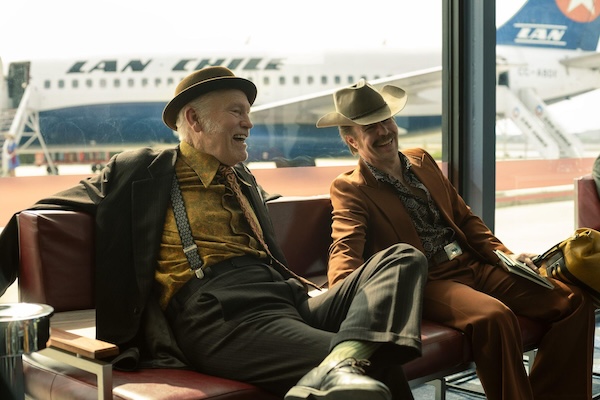
A scene from Martin McDonagh’s Wild Horse Nine. Photo: courtesy of IFFBoston
You know what you’re getting into with a Martin McDonagh film: witty, blasphemous dialogue steeped in unresolved guilt, punctuated by violence, and unlikely to lead to redemption. As in his stage plays, the action often revolves around two men, one more unbearable than the other—a comic double act with flare-ups into existential anxieties. Rosencrantz and Guildenstern with guns. As in 2022’s excellent The Banshees of Inisherin, McDonagh’s brand of bathos teeters on the edge of kitsch, rescued by his characters’ stubborn humanity.
Wild Horse Nine returns to the formula with a few twists and achieves considerable success. This time, the pair have much—perhaps too much—in common with the hitmen in McDonagh’s debut, In Bruges. In the latter, the pair are dispatched on a forced European vacation after a killing goes disastrously wrong. Here, the writer/director shifts the action to early-1970s Chile, where two CIA operatives travel to Santiago shortly before the 1973 Chilean military coup against Salvador Allende’s government. The blood on their hands belongs to the past—and the future. The injection of American imperialism gives the familiar McDonagh crisis of conscience a geopolitical edge. Whether he knows what to do with it is another question.
Chris (John Malkovich), the grizzled veteran, casually recalls his exploits in Vietnam, Guatemala, and other theaters of America’s covert interventions on behalf of capitalism. And, oh yes, he may have had a hand in the Kennedy assassination. Malkovich’s delivery is nonchalant, but he manages to let traces of remorse seep through the bravado. Chris is dying and possibly suffers from dementia: he has to scribble notes to remind himself of basic facts. He also can’t stop telling anyone within earshot in Santiago that the CIA has designs on the Chilean government. His partner, Lee (Sam Rockwell, playing him with hound-dog sadness), runs interference and serves as his de facto caretaker. Their station chief (Steve Buscemi, looking more haggard than usual) orders Lee to take Chris to Easter Island — and to keep him quiet. En route and on the island, they encounter two young Chilean women (Mariana di Girolamo and Ailín Salas). Chris’s idea of flirting is to brag some more about the CIA’s plans. The women, though, are not what they seem.
The bare-bones plot grinds forward; the dialogue keeps threatening to make you spit out your drink. Alert to spooks everywhere, the operatives wonder whether they are “paranoid about not being paranoid enough.” Parker Posey literally phones in her role as Lee’s faithless wife back home; her exchanges with Rockwell are among the film’s best. McDonagh’s satiric provocations crackle as Chris classifies countries as gay or not according to the quality of their cheese. Russia: not gay. More pointedly, this consummate loud American idiot cannot fathom why anyone uses the word “indigenous” and insists on calling Easter Island’s famous statues “the heads” rather than moai.
But McDonagh steers the banter toward something more somber than usual. Death has always been an inspirational wellspring for comedy; here, sadness threatens to overtake the humor—sadness about aging and its ravages, and about the good lives these two men might have led had they not devoted themselves to murder.
It is here, as melancholy seeps in, that his venture into geopolitics falters. The political point-scoring is, at best, vague; at worst, it lets its lethal targets off the hook. Are we laughing at American imperialism or merely at two of its more colorful functionaries? Do Chris and Lee grapple with the suffering they have helped inflict on millions, or does their private unhappiness pass for remorse? McDonagh seems more intent on giving them good lines than on confronting the implications of their work. The men win our sympathy; the machinery they serve escapes scrutiny.
Malkovich does the most to suggest there’s a conscience stirring beneath Chris’s catalog of horrors. Chris spends part of the film tape-recording his memoirs, though whether he is confessing, boasting, or settling accounts remains unclear. Ambiguity need not be a failure. Here, though, it lets the film gesture toward a moral reckoning without risking one. What does it matter if Chris learns to call the island Rapa Nui — when the country he serves keeps doing what it does best?
A character in McDonagh’s 2003 drama The Pillowman fears that his stories will not survive him: “It isn’t about being or not being dead, it’s about what you leave behind.” Chris and Lee’s legacy is a body count; no memoir can undo the crimes or justify the killings. McDonagh supplies plenty of his usual acidic wit, but his moral imagination is limited to spoofing the spectacle of American idiocy. The jokes land. The consequences remain someone else’s problem.
Neil Giordano teaches film, creative writing, and journalism in Newton, MA. His work as an editor, writer, and photographer has appeared in Harper’s, DoubleTake, Newsday, Literal Mind, and other publications. He is currently in production on Betweens, a documentary about artist Michael C. Thorpe.
Tagged: American Imperialism, CIA, Chile, Easter Island, John Malkovich, Martin McDonagh, Neil Giordano, Parker Posey, Sam Rockwell, Steve Buscemi, black comedy, film reviews, political satire