Book Review: “flutterrudderbutterfly” — The Word Fleshified
By Igor V. Satanovsky
In Heller Levinson’s exuberant verbal universe, words acquire bodies, punctuation takes command, and a sustained interrogation of love gives linguistic experiment an emotional charge.
flutterrudderbutterfly by Heller Levinson. Black Widow Press, 372 pages, $19.95.
Open Heller Levinson’s flutterrudderbutterfly almost anywhere and English appears to have escaped supervision.
A philosophical proposition sheds its syntax. Botany crashes into legalese. Slang elbows metaphysics. Scientific terminology gets stuck beside food, anatomy, American geography, or a scrap of song. A sentence starts out behaving like an argument and wakes up several lines later with no memory of how it got there. “The Abyss is the Void accelerated.” A semicolon suddenly commands a page and begins reproducing. And then, deep into the book, once you come to expect more—more vocabulary, more collisions, more improbable company—it abruptly clears the page and gives you one loaded word:
LOVE
And the word stays, page after page.
how much of
love
is
concatenation
The predicate changes each time: anchorage, accidental, archival, non-resistance, evolving, homecoming, indispensable, miserable, immeasurable, indisputable—and then some. Levinson also asks: Can love be learned? When sex goes, how much love remains? Is the remaining love more loving?
By then, the book’s wager is clear. Words have been denied the right to remain where we thought they belonged.
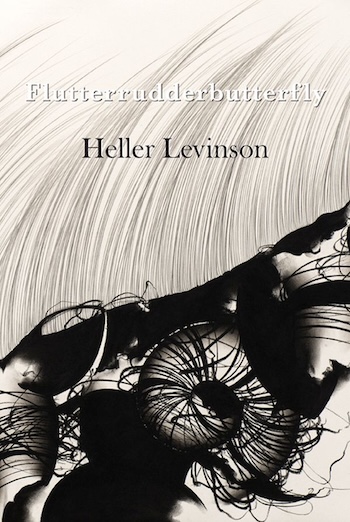 The title is the first clue: three words hinged into one creature, no seam showing. One of the opening epigraphs, from Heraclitus, supplies the book’s most compact description of the project: “whole and not whole, connected-separate, consonant-dissonant.”
Connected-separate is what a hinge does: it joins by permitting movement.
Levinson has been developing what he calls Hinge Poetics for nearly two decades. Its vocabulary includes scatter and gather, linguistic particles and modules, words released from expected contexts into unfamiliar relations. Placement itself becomes an event. A legal term beside a vegetable embodies Shklovsky’s dream. Aristotelian logic gets sandwiched between “random smacks of sincerity” and “wish you were here”—Pink Floyd included. Put a scientific term next to a cliché and they may infect or deform each other.
That is only the setup. The question is what proximity does—how the terms begin to alter, contaminate, or reroute one another.
The page participates. Levinson scatters words across white space until the word’s position carries as much information as its grammar. Dense verbal fields give way to pages with only a few isolated units. Sometimes you proceed for stretches, sentence by sentence. At other points, your eye has to jump, backtrack, invent a bridge, refuse one. A phrase can be stranded at an edge. A word may be isolated by empty space until it acquires a ridiculous grandeur.
And the book is funny.
That needs saying because any description of Hinge Poetics risks making the work sound grimly theoretical. Not this book. Levinson has a serious appetite for philosophical language, but he drops it into disreputable company: materialism turns up beside zucchini, Nietzsche near flabby snickers, “metaphysical data” among macaroons and an alveolus hitch.
The humor also keeps solemnity in check. A poetics in which every juxtaposition arrived weighed down by its own halo of profundity would soon collapse under its own importance. The author permits collisions to be stupid, tacky, embarrassing, overgrown. And often that is where language comes alive.
When “pleasure’s mine” summons an “AI Overview” explaining that “The pleasure is mine” is a polite, formal response to “thank you,” the standardized voice rushes in to stabilize the idiom. Levinson immediately lets language leak out from under it:
so many ways to thank a thing say a thing see a thing sing a thing
ding
a
ling
ling
The machine performs semantic crowd control; the words disperse anyway.
Afterward comes THE ABYSSAL RESUSCITATIONS, one of the book’s great territories. Its epigraph from Artaud invokes an “incantation in the void” through which the unconscious resuscitates ancient allegories. The Abyss ought to mean terminal depth, disappearance, the place where things stop. Levinson makes it hyperproductive: “Abyssal Pierce,” “Abyssal Lodge,” “Abyssal Rib,” “Abyssal Roam,” “Abyssal Flutter.” “The Abyss is where certainties are decimated & die,” he writes, yet everything around that declaration proliferates. “Abyssal” keeps returning as a modifier before otherwise unrelated words.
Later he makes the linguistic premise explicit. The Word, born of chaos, has been demeaned into “categories, classifications, calculations, labels.” Then comes the counterclaim:
“The word does not mean, it fleshifies.”
Fleshifies may be the book’s best theoretical verb. Khlebnikov and Kruchenykh would have recognized the premise: the word is a thing in its own right, acquiring force, body, and new being in operation.
Meaning shifts from possession to event. In Hinge Poetics, that event is relational: change the neighboring word, the placement, the reader, and the word changes too.
Hinge also works below the lexical level. Slashes, paired vertical bars, triangles of different sizes, and other nonlexical marks interrupt the verbal units. They suggest cartography, music, mathematics, orthography—but supply no map. The collisions happen beneath the alphabet.
At moments, Levinson reduces the system to near-cartoon simplicity. After pages of extravagant vocabulary, a semicolon takes over. Then semicolons multiply.
Of course they do.
The semicolon is Hinge compressed into punctuation: two units joined without surrendering their independence. Connected-separate. The compression works because the book has spent hundreds of words demonstrating how much a mark can do.
Over a book this long, the surprises can become predictable. The method can become a manner. Some collisions are more productive than others. At times sheer abundance blunts the effect. When virtually any word can enter the Hinge field, the harder question becomes why this word needed to encounter that one. A poetics devoted to keeping language from settling has to guard against hardening into its own recognizable style.
The long LOVE sequence matters because it changes the experimental conditions. Love arrives pre-used by lyric poetry, religion, advertising, pop songs, family, sex, psychoanalysis, marriage vows, greeting cards. Everyone already knows what love means.
Levinson has used this device before. His how much of module already appears in Wrack Lariat (2015), while Query Caboodle (2023) extends sustained questioning across a whole volume. One representative construction is:
how much of
wisdom
is
accumulation
In flutterrudderbutterfly, the module continues to move while one particle stays fixed: love. That persistence changes what the poem can register.
how much of
love
is
generosity
Then:
how much of
love
is
extermination
Across the sequence, the final line keeps changing: indispensable, miserable, immeasurable, impertinent… Each proposition survives the next. Indispensable does not cancel miserable. Each briefly promises to tell us what love is; the next breaks the definition open.
Here my work in Quantum Poetics offers another vocabulary for this process. In QP, superposition names the coexistence of concrete, incompatible possibilities—not generalized ambiguity. Each question temporarily collapses love toward one state—generosity, say—before the next changes the conditions of the reading.
The sequence holds one lock in place and tries different keys. Some fit; some jam. After enough turns, you begin to question your understanding of the lock. Once extermination has entered your reading of love, you cannot arrive innocently at indisputable. The propositions interfere.
The sparse page intensifies that interference. Dense passages scatter attention across dozens of relations; here, extermination has nowhere to hide. Levinson holds most of the textual variables constant so that a single substitution hits with full force.
Set against the book’s maximalist passages, these pages expose the mechanism. Hinge is a poetics of relation: excess multiplies relations; repetition puts each one under pressure. Each question becomes a relationship test.
The sequence remains recognizably Hinge—cantankerous, comic, ready with an absurd predicate—but repetition changes its emotional temperature. The persistence of the testing becomes unexpectedly moving. Elsewhere he keeps language in motion; here repetition makes it stay. It also points beyond love to a larger implicit claim: a thing does not end at its apparent boundary.

Heller Levinson. Photo: Jeff Zucker
Much earlier, he had written, “The more of a thing emblazons its not.” Things exceed themselves: “stone is more than stone.” Mystery, too, returns without ceremony: “the informality of mystery.” Disjunction, parataxis, the material word, the page as visual field: these now belong to experimental poetry’s established repertoire. In Language poetry, they often served to unsettle the apparent naturalness of syntax, reference, and voice. Levinson rehinges that inheritance, unfastening its techniques from the critique of linguistic transparency and attaching them to an older philosophical premise: the word is more than its meaning. The techniques are familiar; the attachment is new.
The third opening epigraph, from Vico’s New Science, supplies the phrase “imaginative metaphysics.” Vico contrasts rational comprehension with a mode in which man “becomes all things by not understanding them”—through imaginative transformation. Levinson carries that intuition into language, releasing the word from its expected context to discover what else it can attach to—and what follows.
That question also animates the title’s peculiar creature. Flutter: unstable motion. Rudder: direction. Butterfly: metamorphosis, a creature whose erratic movement still traces a shape. Scatter and control, accident and decision, detachment and renewed attachment: connected-separate.
Not every experiment works. It would be suspicious if a project this committed to risk produced no weak parts. Some pages grow so crowded that individual relations cease to register; some verbal sparks never catch. But Levinson’s method leaves language room to surprise him, bore him, embarrass him, grow mannered, empty itself, and start again.
By the last pages, you catch a neighboring word altering a sentence, an unused meaning hovering beside the one you chose, a gap on the page beginning to act as syntax.
The experiment has migrated into the reader and keeps going. You find yourself looking for hinges in the next book.
Igor V. Satanovsky is a Kyiv-born poet, translator, artist, and book designer, and the author of ten poetry collections. He co-hosts the Quantum Age Poetry reading series at the Stavros Niarchos Foundation Library (NYPL). His essay on Quantum Poetics appeared in the spring 2026 issue of BlazeVOX, and he has recently completed a book on the subject. He lives in New York City.
Tagged: Heller Levinson, Hinge Poetics, Igor V. Satanovsky, Poetry reviews, Quantum Poetics, contemporary poetry, experimental poetry, flutterrudderbutterfly, language and meaning