Film Review: “Possible Love” — How Capitalism Obstructs Human Connection
By Steve Erickson
A filmmaker’s interest in a laid-off worker draws two couples into an intimate, uneasy tangle of money, power, and desire.
Possible Love, directed by Lee Chang-dong. Opens in select U.S. theaters today, and begins streaming worldwide on Netflix on November 6.
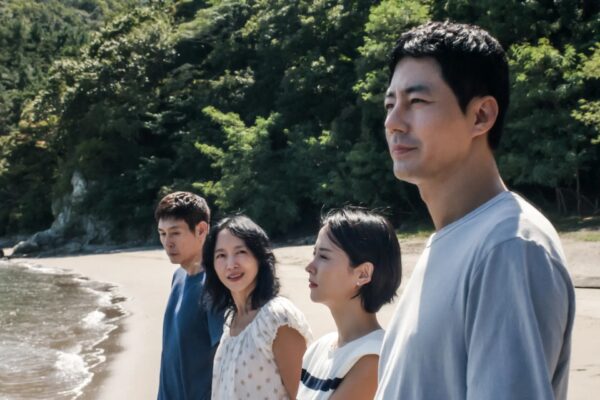
(L to R) Sul Kyung-gu as Ho-seok, Jeon Do-yeon as Mi-ok, Cho Yeo-jeong as Ye-ji, Zo In-sung as Sang-woo in Possible Love. Photo: courtesy of Netflix
Love may be possible, but it doesn’t conquer all. That’s one takeaway from South Korean director Lee Chang-dong’s sprawling Possible Love. Arriving eight years after his 2018 Burning, it revisits that film’s class-fueled conflict between men but broadens the lens to include two equally realized women. Lee interrogates the pretensions of documentary filmmaking, in which one person’s life can become another’s hobby. A chain of surveillance extends to the final shot, where the moon resembles a camera’s eye. If desire can disrupt class hierarchy, Possible Love tests how far it can go.
The film begins with an epigraph: “thou shalt not covet.” Its drama ignites when two married couples meet. Ye-ji (Cho Yeo-jeong) is making a documentary about the fallout of a failed strike at SP Heavy Industries. Most of the workers remain unemployed, including welder Ho-seok (Sul Kyung-gu), whose wife, Mi-ok (Jeon Do-yeon), supports him. After a vicious attack during the strike, he’s developed a drinking problem that makes him emotionally volatile. The pain of being treated like dirt registers in his body. He’s not alone: in the opening scene, he attends the funeral of a former co-worker who killed himself.
Ho-seok’s unpredictability attracts Ye-ji, who makes him the documentary’s main subject. Her rich husband, Sang-woo (Zo In-sung), supports her artistic endeavors. The couples spend more and more time together, culminating in a trip to Sang-woo’s vacation home by the sea.
Ye-ji is the easiest member of Possible Love’s quartet to read. She didn’t grow up rich—she mentions working as a waitress in the U.S. for seven dollars an hour—but married into wealth. Although she welcomes her husband’s financial support, she still pitches her films to arts grant committees. Blithely unaware of the power she wields, she runs roughshod over the people she wants to help. Her savior complex turns them into fodder for her lens.
If Ye-ji were its sole focus, Possible Love would be terribly simplistic: she’s just not reflective enough to reckon with the harm she causes. Sang-woo is more self-aware—he even calls her a method actor—but remains the quartet’s most enigmatic member. He exercises power in the shadows, making mysterious deals on his phone in English. More willing than Ye-ji to engage with the other couple as people, he nevertheless often seems to be toying with them. He resembles an affectionate dog unaware of how menacing it appears; even his movements in a sexually charged scene with Mi-ok are animalistic. To the end, his desires remain elusive.
Possible Love sets its four main characters in motion without reducing them to symbols. Each behaves unpredictably. Neither man commits an act of violence, but both at times seem a short step away from it. Sul’s performance is intensely physical: Ho-seok has a panic attack during an interview. His drinking leads him to stumble around a bathroom while urinating all over it.
Films and TV shows about the wealthy often present them as charismatic, debauched monsters luring victims into their decadent lairs. Sang-woo and Ye-ji don’t fit that mold. They’re not actively malicious, but their assumption that everyone shares their privilege blocks the possibility of genuine friendship. Mi-ok begins to grasp the gulf between them when she photographs Ye-ji’s designer handbag and looks up its price. Possible Love raises the specter of adultery, but what Mi-ok most covets is freedom from worrying about money and work. Nor does the film simply condemn Ye-ji’s methods. Her documentary gives Ho-seok a chance to speak about his life – an opportunity for us to learn just how viciously the bosses put the strike down.
Kim Ji-young’s digital cinematography shifts focus subtly but noticeably. Flashbacks interrupt the naturalism; Lee pits Ye-ji’s images against his own. The film’s voyeurism takes various forms: in its attention to embarrassingly intimate moments as well as its camera placements. At the end of a key scene, for example, the frame reveals both Ye-ji lurking in the background and a bank of security monitors.
At this point, extended runtimes have become a badge of middlebrow “ambition,” but Possible Love earns its 165 minutes. Its length gives its characters’ relationships room to evolve believably. Refusing easy, snap judgments, Lee powerfully traces the complicated ways capitalism obstructs human connection.
Steve Erickson writes about film and music for Gay City News, Slant Magazine, the Nashville Scene, Trouser Press, and other outlets. He also produces electronic music under the tag callinamagician. His latest album, Bells and Whistles, was released in January 2024, and is available to stream here. He presents a biweekly freeform radio show, Radio Not Radio, featuring an eclectic selection of music from around the world.
Tagged: Capitalism, Cho Yeo-jeong, Jeon Do-yeon, Korean film, Lee Chang-dong, Possible Love, South Korean cinema, Sul Kyung-Gu, class conflict, documentary filmmaking, film reviews, marriage, voyeurism