
Book Appreciation: “Gulliver’s Travels” at 300 — Small Men, Tech Bro Delusions
By Allen Michie
Jonathan Swift’s satire of power, flattery, and human folly feels uncomfortably at home in the age of Trump and artificial intelligence.
 I can’t get the picture on the right out of my head. This is what ChatGPT thinks Jonathan Swift would look like in 2026. He looks like Swift was: suspicious, self-assured, unimpressed, and still defiantly Irish despite spending much of his life wishing he were somewhere else. Let this picture (or one you generate yourself with AI, which Swift would have mercilessly mocked) be your invitation to consider him alive today, informed and pissed off, missing his old pals Tom Wolfe and Kurt Vonnegut, and fully armed with a Substack account under the name The Drapier. (They published by subscription back in the eighteenth century, too.)
It was 300 years ago this month, in October 1726, that Travels Into Several Remote Nations of the World In Four Parts, written by “Lemuel Gulliver, first a surgeon and then a Captain of several Ships,” was published. Swift was 59, which is what he looks like in the picture above. It was revised for another edition in 1735, in which Swift continued the absurd “fake news” ruse that it was a true travelogue, having Gulliver write a new preface complaining about the editor’s mistakes in the first edition.
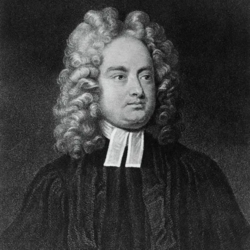
Jonathan Swift, the author of Gulliver’s Travels, the greatest satire in the English language.
The 300th anniversary of the greatest satire in English literature is worth celebrating on its own, but we are living in a world in 2026 that gives us a more important reason for reconsidering Gulliver’s Travels. We still need Jonathan Swift. There’s no need to resort to the “timeless universal truths” cliché about literature, which Swift would have rolled his eyes at anyway. He wrote from a position of deep, dissenting engagement with the unique problems of his own place and time. But it’s undeniable that 300 years later, Swift’s satire still hits hard. For Americans, and for right now.
Among its other innovations, Gulliver’s Travels is arguably the first science fiction novel. Swift didn’t need outer space in the eighteenth century because much of the “new world” was still unmapped and unexplored by Europeans. Gulliver has astonishingly bad luck with transportation, a recurring affliction for science fiction protagonists: there’s a series of shipwrecks, abductions by monstrous creatures, and hastily constructed escape vessels. Gulliver’s first stop is, most famously, in Lilliput, where he passes out after a shipwreck and wakes to find that six-inch people have strapped him down to the beach and begun construction on an elaborate mechanism to drag him to the city. Adventures and mishaps ensue, including the hilarious plot twist that he’s accused of having a love affair with the Treasurer’s wife. Woof!
There are, of course, many layers to the satire here, including a controversial take on the trivial reasons for the violence between Catholics and Protestants, still an Irish issue 300 years later. But what stands out in the age of Donald Trump is the central idea that small (in every way) narcissistic men complement themselves with the chintzy trappings of power and massively inflated delusions of grandeur. The official title of the six-inch Emperor is:
GOLBASTO MOMAREN EVLAME GURDILO SHEFIN MULLY ULLY GUE, most Mighty Emperor, of Lilliput, Delight and Terror of the Universe, whose Dominions extend five Thousand Blustrugs, (about twelve Miles in Circumference) to the Extremities of the Globe: Monarch of all Monarchs: Taller than the Sons of Men; whose Feet press down to the Center, and whose Head strikes against the Sun: At whose Nod the Princes of the Earth shake their Knees; pleasant as the Spring, confortable as the Summer, fruitful as Autum, dreadful as Winter.
A Trump cabinet meeting with his sycophantic amateurs culled from Fox News outdoing one another with the most obsequious flattery was foretold by the Emperor of Lilliput appointing people to government positions by their public performance of “leaping and creeping” above and below a stick arbitrarily held by the Emperor. Also, “When a great Office is vacant, either by Death of Disgrace, (which often happens) five or six of those Candidates petition the Emperor to entertain his Majesty and the Court with a Dance on the Rope; and whoever jumps the highest with falling, succeeds in the Office. Very often the chief Ministers themselves are commanded to shew their Skill, and to convince the Emperor that they have not lost their Faculty.”
Any reading of Book I, the Lilliput section, is incomplete without also appreciating its inverted mirror image in Book II, where Gulliver ends up six inches tall in Brobdingnag, the land of the giants. Together, the sections deliver a powerful dose of today’s most controversial biblical sentiment: empathy. You never know when you may end up walking a mile in someone else’s shoes—and those shoes might end up being ones you can either barely see or move into as a mobile home. It’s a reminder that others will see you as you see others.
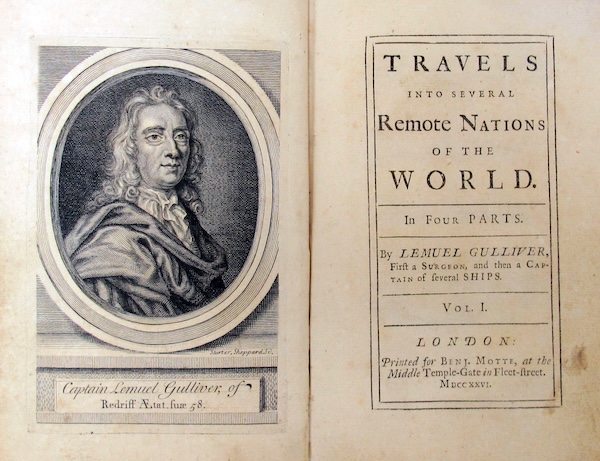
The first edition of Gulliver’s Travels.
Swift probes, in graphic detail, a theme that recurs in his poetry and in contemporary horror films like The Substance: our revulsion at the aging human body. He would have plenty to say about today’s body-alteration industry: extreme plastic surgery, “looksmaxxing,” false eyelashes, clawlike fingernails, piercings, and tattoos. Forced to contemplate the giants of Brobdingnag in extreme close-up, Gulliver discovers that the pursuit of beauty—especially by women—can magnify the very flaws it seeks to conceal. Swift makes the point with merciless relish when the Maids of Honor treat their captive audience of one to a strip show:
I am sure, to me was very far from being a tempting Sight, or from giving me any other Motions than those of Horror and Disgust. Their Skins appeared so course and uneven, so various coloured when I saw them near, with a Mole here and there as broad as a Trencher, and Hairs hanging from it thicker than Pack-threads; to say nothing further concerning the rest of their Persons.
One “frolicksome Girl of sixteen” used Gulliver for “other Tricks, wherein the Reader will excuse me for not being over particular.” If a movie of Book I could be directed by Peter Jackson, the director of a Book II movie would call for the cinematic talents of a David Cronenberg.
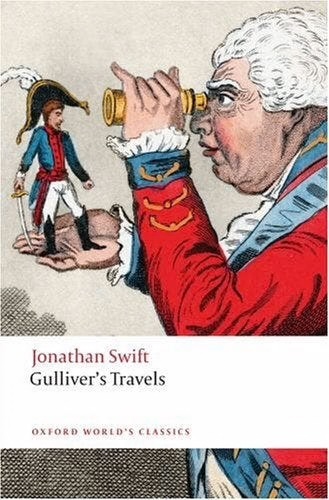
However, the lasting impression of Book II for me is not the repulsiveness of the smelly human body or the cruelty of treating another person as a toy (the protagonist is tormented by a 30-foot-tall jealous “dwarf”). It is the gentle friendship between Gulliver and his caretaker, a nine-year-old girl named Glumdalclitch. She treats him like a loved pet, builds him a dollhouse, and does her best to keep him out of danger. It’s hard to imagine a person more different from Gulliver in every way, but they develop a relationship of mutual affection and respect. It can be done. And, when it comes to surviving in an overpowering world that ruthlessly dominates “the little guy,” such as ours, Swift shows us that it must be done.
Book III is Swift’s science fiction miscellany, where the satire aggressively (but very wittily) bombards us from all directions. Gulliver has a series of journeys to the adjacent islands of Laputa, Balnibari, Luggnagg, Glubbdubdrib, and (give him a break here; not much was known of the Far East in Swift’s time) Japan. Swift satirizes topics that could fill a whole season of The Daily Show: soulless STEM education, absent-minded academics, the absurd use of government research grants (you may have heard the phrase “extracting sunbeams from cucumbers”), drone warfare, propaganda rewrites of history, and the self-defeating vanities of trying to cheat your natural death. I’ll isolate just one episode. (Remember, this was written 300 years ago.)
In Lagado, Gulliver meets a professor employing his 40 students in the construction of a great mechanical device “which took up the greatest Part of both the Length and Breadth of the Room,” convinced “the World would soon be sensible of its Usefulness; and he flattered himself, that a more noble exalted Thought never sprang in any other Man’s Head.” The machine has 256 cubes of wood, all attached by wires and gears, with words attached on all six sides of each cube. A turn of the handles spins all the words around, “and where they found three or four Words together that might make Part of a Sentence, they dictated to the four remaining Boys who were Scribes.” Eventually, after doing this for six hours a day for however long it takes, the students would assemble the broken sentences into “a compleat Body of all Arts and Sciences; which however might be still improved, and much expedited, if the Publick would raise a Fund for making and employing five Hundred such Frames in Lagado.”
Tech bros building data centers for large-language-model AI, anyone?
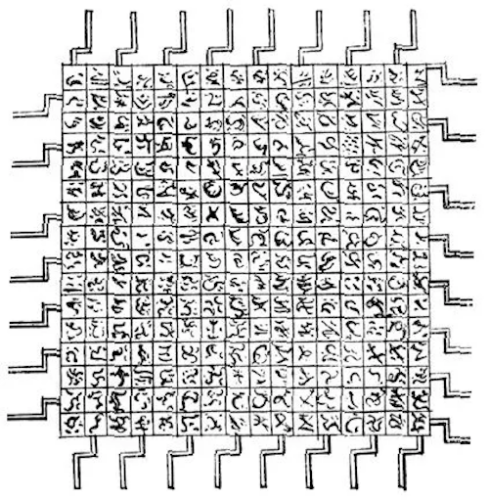
Illustration from the first edition of Gulliver’s Travels.
Book IV, where Gulliver travels to the land of the Houyhnhnms, does not have many specific connections to 2026. This is because it applies just as powerfully to 1726, 1826, and 1926 and will continue to do so for 2126, 2226, and 2326.
You shouldn’t go into Book IV lightly. It’s the kind of satire you need to prepare yourself for and perhaps will need to schedule some therapy sessions to deal with the experience afterwards. As in Book II, with its warty, hairy, and smelly giants, Swift unleashes his disgust at physical bodies as a metaphor for the hypocrisies of refinement and “civilization.” But Swift’s scathing vision of haplessness expands exponentially to encompass human nature itself. His target is what the generation before Swift called “the great chain of being,” what the generation after him would call “Darwinian evolution,” and what our generation would call the existentialist crisis of the individual in a godless and indifferent universe.
Gulliver finds himself in the land of talking horses, the Houyhnhnms. (Since horses were everywhere in the eighteenth century as the primary mode of transportation, you might consider the present-day equivalent to be something like the Land of Talking Hondas.) The Houyhnhnms are unable to do the familiar “live long and prosper” hand formation because of their hooves, but otherwise, they are much like the Vulcans on Star Trek. They are creatures of pure logic, efficiency, and intellect, an embodiment of Enlightenment (or “Age of Reason”) values pushed to extremes. No irrational emotions are spared, even for children, spouses, or the elderly. Swift gives no one a free pass, however, and we grow to understand that the application of this pure logic, in time-tested colonialist fashion, can lead to the possibility of slavery and genocide.
After everything he has been through, Gulliver’s mind has been weakened by hard-earned cynicism. He venerates his host, his “Houyhnhnm Master,” as a variety of philosopher king. The Master asks Gulliver to describe his own homeland, and Swift uncorks it, cataloging pages and pages of the manifest hypocrisies, stupidities, and cruelties of England in his era. At last, Gulliver feels at home—not because of what he has found, but because of what he has escaped. One of the lists reads like what you’d find during an hour of flipping through an average American TikTok feed:
I enjoyed perfect Health of Body, and Tranquillity of Mind; I did not feel the Treachery or Inconstancy of a Friend, nor the Injuries of a secret or open Enemy. I had no Occasion of bribing, flattering, or pimping, to procure the Favour of any great Man, or of his Minion. I wanted no Fence against Fraud or Oppression: Here was neither Physician to destroy my Body, nor Lawyer to ruin my Fortune: No Informer to watch my Words and Actions, or forge Accusations against me for Hire: Here were no Gibers, Censurers, Backbiters, Pickpockets, Highwaymen, Housebreakers, Attorneys, Bawds, Buffoons, Gamesters, Politicians, Wits, Splenetics, tedious Talkers, Controvertists, Ravishers, Murderers, Robbers, Virtuosos; no Leaders or Followers of Party and Faction; no Encouragers to Vice, by Seducement or Examples: No Dungeon, Axes, Gibbets, Whipping-posts, or Pillories; No cheating Shopkeepers or Mechaniks: No Pride, Vanity, or Affectation: No Fops, Bullies, Drunkards, strolling Whores, or Poxes: No ranting, lewd, expensive Wives: No stupid, proud Pedants: No importunate, over-bearing, quarrelsome, noisy, roaring, empty, conceited, swearing Companions: No Scoundrels raised from the Dust upon the Merit of their Vices; or Nobility thrown into it on account of their Virtues: No Lords, Fiddlers, Judges or Dancing-masters.
Imagine spelling out the sound a horse would make as it shakes its head in disgust. With a half snort, half sneeze, the sound might be something like “yahoo.” Swift invented the word. (Alas, someone beat me to my requested email address of [email protected].) It’s the Houyhnhnms’ name for the other occupants of the island. Over 100 years before the first Neanderthal skulls were discovered, Swift’s acidic imagination created some of the most horrific creatures in British literature: caveman-like animals that are somewhere between a rabid orangutan and a Cornell frat boy. The satire is bitter, vicious, and hard to take, even today. As expected, Swift emphasizes the nauseating appearances and practices of their grotesque physical bodies.
Gulliver gets his first clue to his predicament when a female Yahoo pursues and then grabs him while he’s naked, taking a bath in the river. Soon thereafter, his myriad indictments of his barbaric homeland lead to an inescapable rational judgment from the Houyhnhnm council: he must be banned from the island as an irredeemably uncivilized Yahoo. A “gentle Yahoo,” as the Houyhnhnm Master calls him, but a Yahoo nevertheless.
I’ll just throw this in here: “We have people coming into the country, or trying to come in, we’re stopping a lot of them. And we’re taking people out of the country, you wouldn’t believe how bad these people are. These aren’t people, these are animals.” You know who. (And he’s orange.)
Swift splits the aspects of the human mind that have been seen (at least by some) as innate to our species: Yahoos represent animalism and aggression; Houyhnhnms stand for pure reason. Swift places Gulliver between these polarities — he is a kind of tortured hybrid, trying to find his way back home but no longer as certain as he once was where exactly that is.
Swift wrote the words of his own gravestone, which you can see at St. Patrick’s Cathedral in Dublin:
Swift has sailed into his rest;
Savage indignation there
Cannot lacerate his Breast.
Imitate him if you dare,
World-Besotted Traveller; he
Served human liberty.
If human liberty is to survive for 300 more years, we will need more writers to take up Swift’s dare to imitate him. In the meantime, we will always have Gulliver’s Travels.
Allen Michie has a PhD in English literature from Emory University, and he has taught eighteenth-century fiction at Coastal Carolina University, Wake Forest University, and Iowa State University.
Tagged: Allen Michie, Donald Trump, Eighteenth-Century Literature, Gulliver’s Travels, Human Nature, Irish Literature, Jonathan Swift, Literary criticism, artificial intelligence, political satire, satire