
Book Review: A Color That Won’t Stay Neutral
By Lauren Kaufmann
In A Dead White, Wendy S. Walters blends memoir and cultural history to question the ubiquity—and presumed innocence—of white paint.
A Dead White: An Argument Against White Paint by Wendy S. Walters. Simon & Schuster, 352 pages, $30
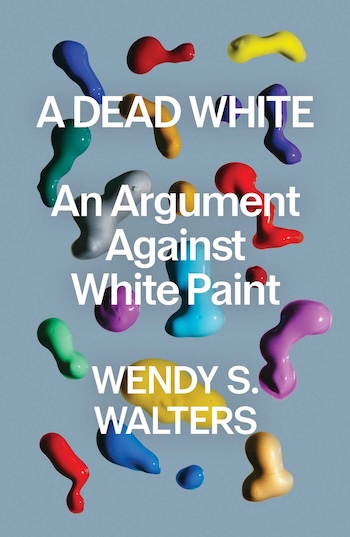 Wendy Walters is intrigued, annoyed, and sometimes infuriated by white paint. In A Dead White: An Argument Against White Paint, she investigates why we coat our homes, offices, public spaces, and even faces in white—and what follows from that seemingly innocuous choice.
In her Author’s Note, Walters observes that, apart from plants and animals, relatively few things are naturally white: chalk, pearls, rice, limestone. She then poses the book’s central question: if white paint is an invention rather than a natural occurrence, what does it represent?
For inspiration, Walters turns to William Blake’s belief that the physical and spiritual worlds belong to the same system. She looks beneath white paint’s surface, asking what its uses reveal about the beliefs and desires of those who apply it.
The investigation begins with a visceral response to her son’s newly renovated school. Dropping him off on his first day back, Walters is overwhelmed by the brightness of its white walls. On her second visit, her chest tightens. The walls are “blisteringly bright and icy.”
What unsettles her is not whiteness itself. She has long appreciated the beauty of Queen Anne’s lace, fresh coconut flesh, seagulls, and newly fallen snow. The distinction between those natural whites and the paint on the school’s walls becomes a starting point for her inquiry.
As she examines her reaction to the white paint at her son’s school, Walters notes that she had not previously been bothered by the color white. She expresses her appreciation for the intrinsic beauty of Queen Anne’s lace, the meat of a fresh coconut, seagulls, and freshly fallen snow.
A pivotal moment comes during Walters’s visit to an exhibition of Agnes Martin’s paintings at the Guggenheim Museum. She admires the large geometric works, with their lines and white paint layered over pale colors, but the museum’s bright white walls unsettle her. Afterward, she resolves to document every encounter with white paint.
That decision leads her to a telling dispute between the Guggenheim’s architect, Frank Lloyd Wright, and its director, James Johnson Sweeney. Wright urged Sweeney not to paint the interior walls white. In a letter to the museum, he called white paint “devastating,” warning that it would turn the building into a shroud for art. A white room, he argued, resembled a tomb. He proposed ivory, with its warmer undertone. Sweeney had the walls painted a dead white.
Walters draws firm boundaries around her inquiry: this is neither a study of color and its gradations nor an examination of whiteness as a racial identity. Instead, she ranges through art, architecture, history, literature, and personal experience, searching for clues to white paint’s ubiquity and significance. She pursues the subject fiercely, uncovering fascinating—and sometimes disturbing—connections among white paint, ideals of beauty, and aesthetic standards we rarely question.
Its history stretches back millennia. Walters notes that Aboriginal peoples have used white ocher for more than 60,000 years; the artists of the Lascaux caves in southern France used crushed white calcite nearly 19,000 years ago; and Lapita potters in Melanesia applied white calcium carbonate to the interiors of their pots 3,500 years ago.

Essayist, poet, and literary journalist Wendy S. Walters. Photo: Anna Letson
Walters traces the use of white cosmetics back to 220 BCE, when Chinese women powdered their faces with rice, possibly to signal wealth. By the seventh century, Japanese women were using a white powder called oshiroi to enhance their faces in dimly lit homes. In medieval Europe, women applied white paint to improve their marriage prospects: its costly ingredients advertised their wealth to potential suitors. But the practice also aroused suspicion. Some feared that cosmetics left women vulnerable to the devil, and one Spanish doctor urged the church to regulate their use.
The term “dead white” in Walters’s title describes a white without warm undertones. She links it to white lead, a pigment ground into powder and mixed with oil to produce an exceptionally bright paint. Prized for its opacity and smooth finish, white lead was hazardous to manufacture. Exposure could cause convulsions, paralysis, and death. In late-nineteenth-century English paint factories, young women mixed the toxic substances and carried large containers of liquid white lead, splashing it onto their clothes and inhaling or swallowing its dust.
Walters turns from industrial poisoning to deliberate cruelty in her account of “white room” torture. Iranian dissidents confined to white cells wore white clothing under unrelenting white light. Sensory deprivation and constant illumination inflicted both psychological and physical trauma. In Iran and Venezuela, Walters reports, authorities used these rooms to break prisoners’ resolve. Here, white becomes not merely an aesthetic choice but an instrument of coercion.
Throughout, Walters interweaves history with her own uneasy encounters with white paint. Her husband’s question about the beauty of Santorini’s white houses leaves her troubled at bedtime. Neither has visited the island, but both know the photographs: brilliant white buildings set against the blue Aegean. Behind that familiar beauty, Walters finds a public-health measure. She recounts how, during a cholera outbreak in 1938, the Greek prime minister ordered island homes whitewashed in the belief that the treatment would disinfect them. The white surfaces also helped keep homes cool in the summer heat.
Sixteen color plates punctuate the book. Some illustrate passages in the text; others offer further examples of white paint in art and architecture. A striking photograph of a child in the snow in New York City’s Riverside Park provides a welcome counterpoint: a lamppost casts a warm yellow glow over a scene of snow-laced branches. Here is a white that invites delight rather than unease.
Near the end, Walters reveals that she has been diagnosed with photophobia, an unusual sensitivity to light. Could it explain her response to white paint? Only partly, she concludes. The diagnosis may help account for her physical discomfort, but it cannot settle the historical and symbolic questions her inquiry raises. What begins as a private aversion becomes a searching examination of an aesthetic choice too often taken for granted.
Wendy S. Walters will be in conversation with WBUR’s Emiko Tamagawa at the Harvard Book Store on October 28 at 7 p.m.
Lauren Kaufmann has worked in the museum field for the past 14 years and has curated a number of exhibitions.
Tagged: A Dead White, Aesthetics, Art and Architecture, Color, Cultural History, Harvard Book Store, Lauren Kaufmann, Wendy S. Walters, book-reviews, memoir, nonfiction