
Book Review: “The People’s Paper” Offers a Rollicking Account of New York’s Daily News and Its War with the New York Post
By Dan Kennedy
Founded as a sensational tabloid with right-wing, racist sensibilities, the city’s white working-class voice tried to go upscale — and lost to Rupert Murdoch’s sleazier competitor.
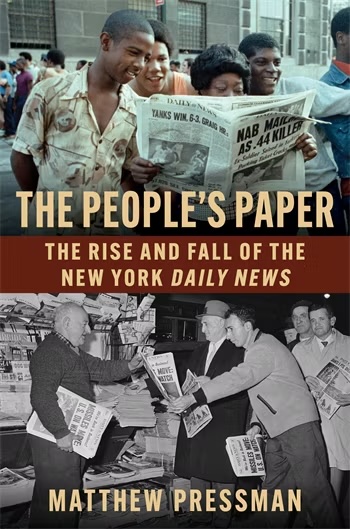
The People’s Paper: The Rise and Fall of the New York Daily News by Matthew Pressman. Columbia University Press, 344 pages, $28 (paper)
 One recent Friday morning I picked up both of New York’s tabloids. The contrast was instructive.
The Daily News featured a grotesque murder on the front page. Inside was a mixture of local political news, more crime, and a smattering of national and international coverage from The Associated Press. The New York Post led with a goofy photo of state attorney general Letitia James, who — at least according to a whistleblower — had pursued a prosecutorial crusade against Donald Trump despite having no evidence. That was followed by page after page of celebrities, MAGA-friendly content zeroing in on familiar targets like Abdul El-Sayed, and manufactured outrages such as the rising price of Halloween candy and private-school teachers who must be getting paid too much because they wear expensive clothes.
As for which formula is more successful, that was settled a long time ago. The Daily News on the day I looked at it comprised 48 pages, whereas the Post was a relatively robust 68. The News’s print circulation is a paltry 29,000 on weekdays and 48,000 on Sundays, according to the Alliance for Audited Media. The Post’s: 112,000 on weekdays and nearly 125,000 on Sundays. But in this post-print era, it’s online where the comparison is the starkest. The Daily News’s website receives fewer than 5 million visits each month, reports the analytics firm SimilarWeb. The Post, meanwhile, has grown into a behemoth, with nearly 96 million visits a month — good for a spot in the top 10 among news websites, says Press Gazette, a British-based publication that reports on digital journalism.
The story of how the Daily News grew into a phenomenon only to fall apart at the hands of cultural and demographic change, bad ownership, and more nimble competition is told by Matthew Pressman in The People’s Paper, a history of the News from its founding in 1919 to its current enfeebled state. Pressman, an associate professor of journalism at Seton Hall University, has written a rollicking tale that’s loaded with details ranging from the significant to the merely entertaining. It was all I could do to refrain from dog-earing and taking notes on every one of its 250 pages.
The story of the Daily News’s long, losing struggle with Rupert Murdoch’s Post will probably be of the most interest to readers. As Pressman tells it, from the moment Murdoch bought the sleepy liberal paper in 1976, the Post had a clear identity as a sensationalistic rag whose editors have never worried about stooping too low. The News, meanwhile, has veered back and forth between its own yellow-journalism roots and periodic quests for respectability. Even during times when it wallowed in the muck, its newsroom leaders weren’t willing to get quite as down and dirty as their rivals.
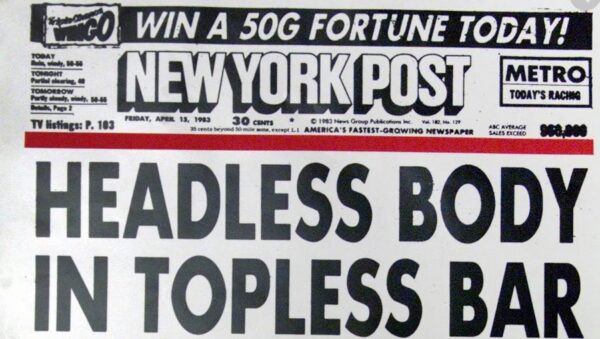
Consider, for example, the two papers’ most famous headlines. In 1975 the Daily News greeted President Gerald Ford’s announcement that the federal government would not bail out the ailing city’s finances with a front page that blared “Ford to City: Drop Dead.” As Pressman observes, “At a time when New York City was struggling, the Daily News was its steadfast champion.” The Post’s moment of tabloid immortality came seven years later with “Headless Body in Topless Bar.” The News spoke to the rage of its working-class readers over their impotence against forces more powerful than they. The Post merely appealed to their voyeurism.
Not to wallow in nostalgia. The Daily News has its own sordid history, and Pressman doesn’t stint on the particulars. The News was the first American newspaper to adopt the tabloid format, with an emphasis on photography over text (it was long billed as “New York’s Picture Newspaper”) and on lurid tales from the city’s streets over stodgy coverage of public affairs.
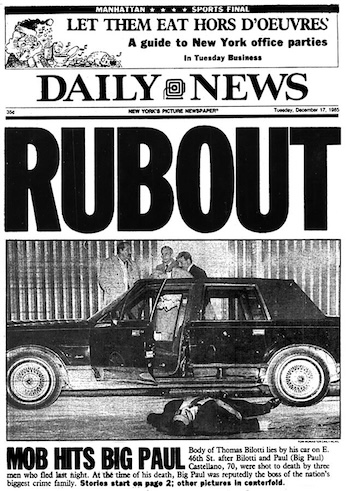 The News created a sensation in 1928 when photographer Tom Howard snuck a camera into the execution chamber where a woman named Ruth Snyder was to be electrocuted for murdering her husband. The camera was strapped to his ankle, and as the deadly current surged through her, he managed to get a picture and rush back to the city room. The blurry photo was splashed on page one beneath the headline “DEAD!” Years later, in a commemorative book marking the paper’s 50th anniversary, the News claimed that the photo “focused public attention on capital punishment and likely was a factor in its virtual abolition over the years.” Perhaps, but that clearly was not what motivated Howard and his editors. Then, too, the “virtual abolition” of the death penalty proved to be more a temporary reprieve than a permanent state of affairs.
The founder of the Daily News was Joseph Medill Patterson, a cousin of Robert McCormick, the far-right publisher of the Chicago Tribune. Patterson was a socialist who later became a liberal and, finally, a right-winger who morphed from a supporter of Franklin Roosevelt into a bitter enemy. Although Patterson declined an invitation to join the America First Committee, the isolationist movement whose best-known member was Charles Lindbergh, he supported its views, including its virulent antisemitism. One of his star columnists, Joseph O’Donnell, was regularly denounced as a “Naziphile.” He proved the point by referring to the Nuremberg trials as “so-called judicial proceedings” and a “sadistic farce.”
Despite this, the Daily News thrived. At its peak in the late 1940s, the paper’s paid circulation was 2.4 million on weekdays and 4.7 million on Sundays, making it the largest circulation paper in the country — a distinction it would not relinquish until 1979, when it was passed by the Wall Street Journal.
By the early 1950s, the Daily News had settled into a prosperous middle age. Pressman describes the paper’s “split personality” during those years. On the one hand, its news pages were those of “a great newspaper offering a great public service. It was accurate, accessible, entertaining, and useful.” On the other hand, there was a “sinister side” to the News, especially on its editorial page, but also in news stories that indulged in racism and fearmongering.
Much of The People’s Paper is devoted to the Daily News’s long, slow slide, which coincided with its mainly white working-class audience moving out of the city and a perceived need to appeal to a more upscale audience. In pursuing this goal, the paper had to thread a needle between what its traditional readers wanted and the truly upscale audience that read the New York Times, which was besting the News in advertising revenues even though it lagged in circulation. From the 1960s on, the News cycled through a variety of approaches, bringing in a top editor, Mike O’Neill, who tried haphazardly to tamp down the racism and sexism that pervaded both the paper’s reportage and its newsroom culture. One of O’Neill’s missteps was to hire a high-profile magazine editor, Clay Felker, to create an afternoon paper called Tonight in order to attract a more affluent readership. Felker spent profligately and failed utterly.
During the Daily News’s waning decades, the paper lurched between upscale (well, middle-scale) and downscale, between racism and attempting to atone for racism. It was a revolving door through which a dizzying array of owners and editors came and went. One of those owners, Robert Maxwell (the father of Ghislaine Maxwell), arrived with an open checkbook only to die by suicide beneath a mountain of debt, which landed the paper in bankruptcy. Real-estate developer Mort Zuckerman brought some stability to the owner’s suite, but he hired and fired editors on a whim. (Among them: Kevin Convey, a former editor of the Boston Herald.) I wish Pressman had done a better job of unsnarling this ball of confusion, but, in fairness, there was a lot to unsnarl.
In the end, the Daily News landed back in the hands of the Chicago Tribune, where it had started. Tribune Publishing was hilariously renamed tronc (for Tribune Online Content). The newsroom was shut down, with reporters forced to work at home, in libraries, coffee shops, or whatever. And then came the final blow: In 2021, Tribune Publishing’s newspapers (the tronc name had been quickly retired) were acquired by Alden Global Capital, a New York-based private-equity firm that is reviled for hollowing out newspapers. The Daily News was spun off from Tribune Publishing and is today run as its own entity. By early 2026, the newsroom employed just 40 journalists.
So what is the legacy of the Daily News? In Pressman’s assessment, it is largely positive. “While it sometimes pandered to readers or led them astray,” he writes, “it also kept them informed with accurate and original in-depth reporting. It was engaging, accessible, and fun — and devoid of the exploitative cynicism that characterizes so much of today’s partisan and populist media.”
But Pressman adds an important caveat: “As the story of the Daily News shows, media succeed by forging connections with their audience and feeding into their sense of identity. Sometimes this can be healthy, and sometimes it can lead to dark places.” I’m reminded of the communications theorist James W. Carey’s observation that media serve a “ritual” function, bringing people together “in fellowship and commonality.” In other words, one purpose of journalism is to reinforce a sense of tribal identity, as with cable news outlets such as Fox News on the far right or MS NOW on the center-left. We are not better off as a result.
For many decades, the Daily News served as a daily ritual for mostly white working-class New Yorkers, providing them with a common language, a common culture, and a common list of grievances. Usually, the paper exercised that power responsibly, publishing the news and information they needed to govern themselves in a democracy. The News had its detractors, and they were not wrong. But given the toxic mediasphere in which too many of our fellow Americans wallow today, we can only lament its collapse into irrelevance.
Dan Kennedy is a professor of journalism at Northeastern University and the author of four books, most recently What Works in Community News: Media Startups, News Deserts, and the Future of the Fourth Estate, with Ellen Clegg. His blog, Media Nation, is online at dankennedy.net.
Tagged: Columbia University Press, Dan Kennedy, Matthew Pressman, New York City, New York Daily News, New York Post, Rupert Murdoch, journalism, media criticism, media history, newspaper history, tabloids
