
Musician Interview: Gilla Band’s Alan Duggan Talks “Pugnello,” Pedals, and Post-Punk Possibilities
By Robert Duguay
The Dublin post-punk experimentalists bring their dark new album to Brighton Music Hall, where guitarist Alan Duggan reflects on the band’s evolving creative process, headphone-oriented textures, and his personal connection to Boston.
Over the past 15 years, Dublin has produced a host of bands pushing musical boundaries—groups making strange, forceful sounds with unapologetic intensity. Among them is Gilla Band, whose post-punk is noisy yet somehow abstract. The group released its new album, Pugnello, on September 25 via Rough Trade Records and is now touring in support of it, with a stop at Brighton Music Hall in Boston’s Allston neighborhood on October 17. Vancouver hardcore punks Piss open at 8 p.m.
Ahead of the show, I spoke with Gilla Band guitarist Alan Duggan about the challenges of making the new album, his childhood connection to Boston, and why he hears a song’s rhythms and textures before its lyrics.
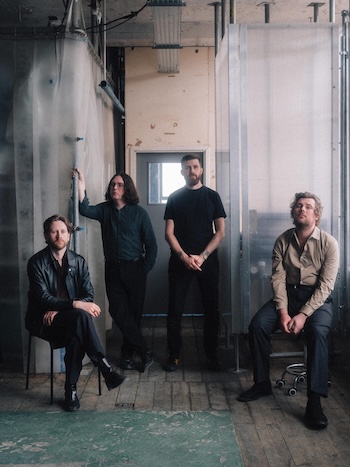
Gilla Band. Photo: El Hardwick
The Arts Fuse: What was it like making Pugnello? The vision here is darker, heavier than on earlier albums.
Alan Duggan: We last released a record in 2022 and we basically handed that record to the label and started working on the next one immediately. There weren’t any plans to change what we were doing or to rethink the creative process. It was more about looking to write more music. The singer, Dara [Kiely], and I started working on some material together between 2021 and 2023. I was buying a lot of older drum machines, older synths, and stuff like that. So we started using more of this kind of equipment, which we hadn’t used before. Previously, it was live drums and live guitars, so we started getting a little bit more into that other world while trying to put our own spin on it.
AF: Ahead of the album’s release, you released a video for the single “Alogia.” It features black-and-white images of forests and urban landscapes. How did you gather the footage? Did you collaborate with a director or an editor? Or is this an assemble footage you shot on the road?
AD: A little bit of both. The video was done by Cuan Roche and Chanthila Phaophanit. We don’t come up with a lot of ideas for our videos. We take suggestions and find what we think is cool. They both came up with the concept and showed us a rough draft of what they had. A lot of it was footage we had from being on the road. I actually had a ton of footage from both touring and holidays I’d been on, which were quite similar. So did our bass player, Daniel [Fox]. He had a lot of footage like that as well.
We sent that all over, and they mixed it with different painted elements on top — so the final result was very much their thing, even though they were using some footage we had made.
AF: Pugnello is your fourth album and your second since changing your name from Girl Band to Gilla Band in 2021. With two albums under each name, do you see any sonic, artistic, or aesthetic distinction between those periods?
AD: We don’t really think of it so much as a before and an after as far as the creative process of writing a record or writing music goes. We see it as riding on a bus, and each album is like a bus stop. We’re still taking the same routes and directions, but there are these little transformations we’ve made along the way. When I think back to when we made [our debut] Holding Hands with Jamie, we were really into sound design while being very instrument-specific. I was very invested in what I could do on guitar while making it not sound like a guitar, while Daniel was into what he could do on bass while making it not sound like a bass, etcetera, etcetera.
As we’ve continued as a band, it’s become more important that we make each track more of a headphone experience. We’ve gotten deeper into the world of sound design, but the core of the group’s vision is still there.
AF: It does. Dublin bands often have a special relationship with Boston, given the strong Irish cultural presence here. U2, for example, played one of their first U.S. shows in Boston. As a musician who calls Dublin home, how do you feel about returning to perform here?
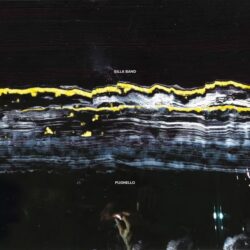
Pugnello‘s cover art
AD: I’m really excited. I remember the first time we ever came to Boston, I was very excited because the place felt like home. I was there when I was a child, either eight or nine years old. I was part of a traditional Irish group — there were like 15 of us — and we came over to Boston to do performances around St. Patrick’s Day. We made a number of stops, and one experience I’ll always remember is that we went to a nursing home where there were a lot of Irish people. They were people who were born and raised in Ireland and immigrated to the United States in the ’50s or ’60s, or whenever it might have been. It was really, really heavy because we were playing these old trad songs, and here were people in their late 80s or their 90s who were really moved by these young kids playing all this music from Ireland.
That always stuck with me, and whenever I go back to Boston, I feel that real, deeper connection. The last time we played there, I got a few drinks with some people who were at the show afterward. They all have Irish heritage, and it’s just so cool because it’s so different but so familiar. Someone will tell me that they have family from [County] Clare and southern Ireland, and so do I, so it really feels familiar and nice. Boston is a special place to go.
AF: When people listen to Pugnello, what do you hope they take away from the album? Does it have a message?
AD: people can take different things from the record. I find that a lot of people listen to music in one of two ways: they’ll either listen to the music or the rhythms first, or they’ll listen to the lyrics and then everything else after. The way I listen to music is to listen to its rhythms and texture first. The lyrics come a little bit later to me. For the band, we set out to write music that will impress each another. Once we’ve done that, or once we’re happy with it internally, then hopefully some people who might be into it are into it. It’s out of our hands at that point.
AF: Has it been a challenge to make a cohesive live set — intertwining the new material from Pugnello with the older songs?
AD: We haven’t played a lot of live shows with the new material just yet. For this run, the set is very much going to be focused on the new material, along with a few songs from the other records. It’s fun when you have more albums and more stuff to choose from. But one of the restrictions for us is the gear we are able to bring, because the music is so reliant on the addition of pedals, effects, and different specifics. There are structural considerations we need to take into account, so we’ve continuing to figure out the whole set.
Rob Duguay is an arts & entertainment journalist based in Providence who is originally from Shelton, CT. Outside of The Arts Fuse, he has also written for DigBoston, Aquarian Weekly, Providence Journal, Newport Daily News, Worcester Magazine, New Noise Magazine, Manchester Ink Link, and numerous other publications. While covering mostly music, he has also written about film, TV, comedy, theater, visual art, food, drink, sports, and cannabis.
Tagged: Alan Duggan, Allston music, Boston music, Brighton Music Hall, Dublin music, Gilla Band, Irish music, Irish post-punk, Pugnello, Rough Trade Records, concert preview, experimental rock, musician interview, noise rock, post-punk
