
Theater Review: In SpeakEasy’s “Covenant,” the Devil Is in the Desires
By Susan Saccoccia
In this taut Southern Gothic thriller, thwarted longing and the promise of escape turn a Georgia household into a cauldron of suspicion.
Covenant by York Walker. Directed by Dawn M. Simmons. Staged by SpeakEasy Stage at Boston Center for the Arts in the Roberts Studio Theatre, 527 Tremont Street, Boston, through October 17.
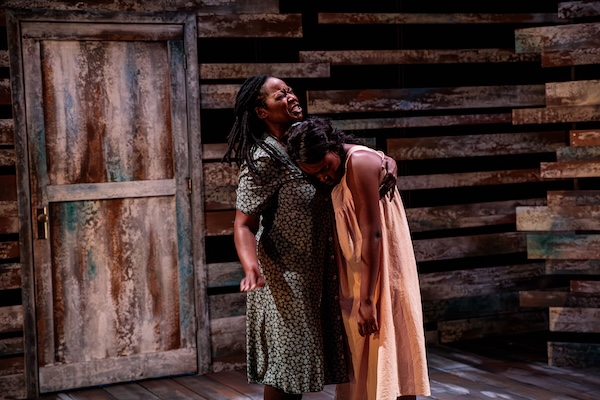
Crystin Gilmore as Mama (left) and Deannah “DRIPP” Blemur as Avery (right) in a scene from the Speakeasy Stage Company production of Covenant. Photo: Benjamin Rose Photography
Just in time for Halloween, SpeakEasy Stage Company opens its 36th season with the New England premiere of York Walker’s Southern Gothic thriller Covenant. Directed by Dawn M. Simmons, the taut, entertaining production locates its deepest terrors not in supernatural forces but in the harm people inflict on one another.
Walker’s subject is desire that will not take no for an answer. In a small Georgia town in 1936, superstition and rumor feed on thwarted longing, and the promise of escape only tightens the bonds of those left behind.
The title suggests a solemn, binding agreement—a pledge of redemptive love and mercy or, in the Gothic tradition, a deal with the devil. Either way, a covenant demands payment. There is no easy way out.
Simmons turns the stage into a seething cauldron of suspicion, fear, half-truths, and obsessive desire. Working with scenic designer Sakia Martinez, lighting designer Kevin Dunn, and costume designer Danielle Domingue Sumi, she uses spare, potent means to conjure a hellish town, its misery concentrated in one family’s joyless home.
Floor-to-ceiling weathered planks suggest a rural house; the actors carry a wooden bench, table, and chairs on and offstage. Dunn’s lighting plunges the theater into darkness or casts giant shadows across its walls, extending the set into the surrounding space. With equal precision, it isolates the actors’ expressive faces and gestures. Small details carry as much dramatic weight as the engulfing darkness: a match struck to read a letter slipped under a door; flowers offered by a daughter and rejected by her mother.
The excellent five-member cast gives Walker’s web of dreams, desires, and dread an unsettling intimacy. The four women, in particular, embrace their characters’ emotional extremes without losing sight of the vulnerabilities beneath them.
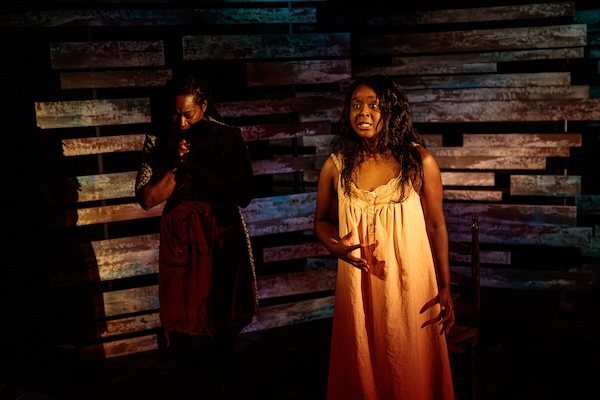
Crystin Gilmore as Mama (left) and Deannah “DRIPP” Blemur (right) in a scene from Speakeasy Stage Company production of Covenant. Photo: Benjamin Rose Photography
Ruthie emerges from the opening blackout, a teenager in a plain dress with large pockets. Kayla Sessoms gives her an authority beyond her years and a disarming ease that only makes her harder to read. Devoted to her black cat, with little companionship beyond her friend Violet, Ruthie announces, “Everybody got a secret”—less a confidence than a challenge to the audience to confront its own hidden darkness.
Alicia Jackson brings an aching vulnerability to Violet, who considers Ruthie her best friend and adores her older sister, Avery. Wearing a bright pink dress and the yellow ribbon Avery gave her, Violet clings to the sister who supplies the affection their mother withholds.
Crystin Gilmore makes Mama both fierce and haunted. Neither her delicate lace scarf nor her homey gingham dress softens her dominance over a loveless household. When she leads Violet and Ruthie in mealtime prayer, their arms raised in unison, the devotional ritual takes on the look of a witches’ coven.
Deannah “Dripp” Blemur’s gentle Avery stands apart from the household’s simmering resentments. She dotes on Violet and submits to Mama, but longs for a life beyond the town.
That possibility arrives with Johnny, a childhood friend returning after a long absence. He left with a stammer and little apparent talent for singing or playing guitar. Johnny “Honeycomb” James has returned with an achingly beautiful voice, no trace of a stammer, and guitar chops finely honed in juke joints. His next stop is Chicago, and he wants Avery—the girl he has loved since childhood—beside him.
In a brown fedora and jacket, a guitar slung over his shoulder, Anthony T. Goss makes Johnny sexy and soulful: a gentle heartthrob, not a slick ladies’ man. The power of his warmth and sincerity makes the suspicions that accumulate him all the more unsettling. As he courts Avery, he must contend with Violet and Mama, who fear his newfound gifts have cost him his soul. Johnny also has to fend off the wily Ruthie, who wants to tag along.
Simmons sustains the tension as disturbing events accumulate, each casting fresh doubt on who wants what—and how far they might go to get it. The production’s force lies in the uneasy gap it creates between Johnny’s apparent goodness and the darkness others sense they see in him. The satisfyingly unexpected conclusion gives the title’s binding promise its force: these characters long for escape, but a covenant makes demands of its own.
Susan Saccoccia is a recipient of NEA Arts Journalism fellowships in theater, dance, and music. She is an independent arts journalist who reviews visual and performing arts in the US and overseas.
Tagged: Alicia Jackson, Anthony T. Goss, Boston Center for the Arts, Boston-theater, Covenant, Crystin Gilmore, Dawn M. Simmons, Deannah “Dripp” Blemur, Kayla Sessoms, Roberts Studio Theatre, Southern Gothic, SpeakEasy Stage Company, psychological thriller, theater review