
Film Review: “Never After Dark” Can’t Stand the Light of Day
By Peter Keough
Dave Boyle’s atmospheric ghost story raises intriguing questions about sisterhood and the afterlife, then buries them beneath slasher-film carnage.
Never After Dark, written and directed by Dave Boyle. At AMC Boston Common and the Alamo Drafthouse Cinema Seaport.
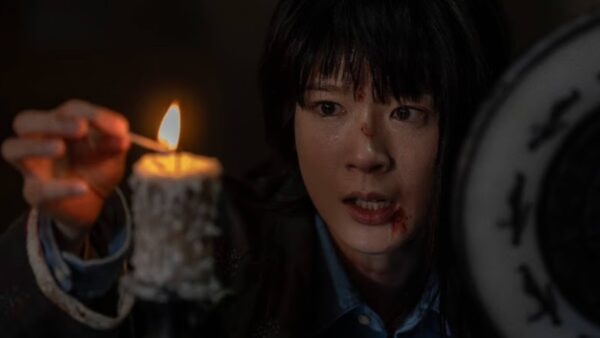
A scene from Never After Dark. Photo: Courtesy of Magnolia Pictures
Dave Boyle’s stylish, atmospheric—but contrived and derivative—ghost story opens on the aftermath of generic carnage: a bloody axe, a burning candle, an ominous grandfather clock, and assorted diabolical debris in a dark, empty room. We know we’ll be back here by the end: the tableau all but announces a time loop. Such is the fate of the deluded dead—or, as latter-day Ghostbuster Airi (Moeka Hoshi) explains to her “Big Sister” and sidekick Miku (Kurumi Inagaki), “If you die clinging to worldly things you can’t move on. You’re stuck in a loop, like Sisyphus.”
An intriguing theme—but, like much else in the film, barely explored and left unresolved. Ironically, Miku is herself a ghost, killed as a child in a murky episode that left Airi guilt-stricken and Miku vowing never to leave her younger sister’s side. Now that Airi is an adult, Miku dispenses advice from her privileged post-mortem perspective and supplies most of the requisite fake scares. Together, they cross the thin boundary between worlds, coaxing spooks to relinquish their mortal obsessions and move on to whatever comes next.
Their new case seems routine. Teiko (Tae Kimura), the flighty new owner of an abandoned lodge deep in the woods, has spotted a specter and received growly-voiced phone calls. The place is a cross between the Overlook Hotel and the mansion in Parasite (2019), minus the former’s oneiric mystery and the latter’s class conflict. Teiko wants the intruder identified and evicted, but she also craves company and attention. Her real estate investor son Gunji (Kento Kaku) scoffs at her superstitions, yet her portrait of the phantasm—a bloody-mawed demon, Dorian Gray by way of Francis Bacon—may be the film’s scariest effect. Airi pockets the cash and sets up her gear to enter the spirit world and put another errant soul on the right path, brushing aside the semi-hysterical Teiko, the skeptical Gunji, and, more troublingly, Big Sister’s uneasy warnings
Her unorthodox mediumistic apparatus includes the candle seen earlier and a mirror ringed by a rotoscope depicting a prone figure repeatedly releasing a spirit-like essence. In use, the mirror spins, becoming a window into the other world. It reminded me of the Magic Mirror on the ancient TV show Romper Room, though this one lets Airi leave her body to investigate the haunting. Her first foray ends in a fright and a few bruises. Undaunted by either—or by Miku’s increasingly urgent warnings—she plunges blithely, perhaps self-destructively, ahead, expecting to wrap up the case without further fuss.
She even gets drunk with Gunji, briefly raising the prospect of a screwball detour: the offbeat ghosthunter and the straitlaced realtor tumbling into an opposites-attract romance. Instead, Boyle grafts a slasher thriller onto his half-baked haunting, surrendering the final third to the grisly antics of a serial killer with a thing for human teeth. Could the killer be connected to the sisters’ troubled past? It scarcely seems to matter. Lost in the carnage are the film’s more intriguing questions about trauma, sibling bonds, compulsive repetition, and what lies beyond the thin border between life and death.
Peter Keough writes about film and other topics and has contributed to numerous publications. He was the film editor of the Boston Phoenix from 1989 to its demise in 2013 and has edited three books on film, including Kathryn Bigelow: Interviews (University Press of Mississippi, 2013) and For Kids of All Ages: The National Society of Film Critics on Children’s Movies (Rowman & Littlefield, 2019).
Tagged: "Never After Dark", Dave Boyle, Ghost Stories, Kurumi Inagaki, Moeka Hoshi, horror films, slasher films