
Classical Album Review: Steve Reich at 90 — The Pulse Still Holds
By Jonathan Blumhofer
ECM New Series’ reissue of the composer’s seminal early recordings restores their bite, rigor, and uncommon spiritual warmth.
Euterpe, the Muse of music, doesn’t usually grant long life to her most prominent servants: Mozart died at 36, Gershwin at 37. Buddy Holly, Jimi Hendrix, and Janis Joplin didn’t make it out of their 20s.
But Steve Reich is among a special elect. Ninety years old on October 3rd, the Minimalist pioneer isn’t just still with us but actively so: In All Your Ways, an 18-minute score for winds and percussion, received its world premiere in Edinburgh last August and makes its U.S. debut at Carnegie Hall this fall.
If a Reich concert in that storied place reminds us that he’s no longer an outsider looking in—his 1973 debut at the venue, with Michael Tilson Thomas and the Boston Symphony Orchestra, provoked a near-riot—that’s not entirely a bad thing.
True, it’s been a while since the composer has produced something that evinces the freshness of a new day—not since 1988’s Different Trains, probably. Even so, there’s much in Reich’s language, with its eschewal of traditional developmental techniques and embrace of historical and geographic extremes—12th-century polyphony and West African rhythmic practices among them—that makes early complaints that it was just simplistic, repetitious stuff read, especially now, as lazy and uncurious.
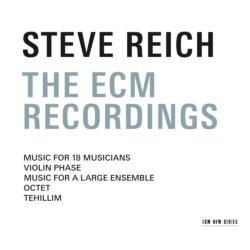
And though it’s challenging to recreate just how his voice landed in the context of the new-music world of the 1970s and ’80s, ECM New Series’ rerelease of its seminal recordings of some of the composer’s early works—out digitally as well as in a 3-LP format—recaptures much of their biting energy and sense of novelty.

Composer Steve Reich. Photo: Jennifer Taylor
The original recording of Music for 18 Musicians, played (as are all these selections) by members of the Steve Reich Ensemble, hits with the crispness of a bright autumn morning. This is music that’s as visceral for its textures and thematic gestures as for its slowly morphing structure, with the lucidity of the performance and presence of the collective’s sound more than compensating for some distracting breaks—at least in the digital version—between the through-composed score’s sections.
That last complaint is, thankfully, not an issue on the set’s remaining items.
Music for a Large Ensemble and Octet capture much of the brilliance of Reich’s style: a mix of processes grafted onto larger-scale architectural designs. Both works—but especially the latter—have a kind of landscape quality to them: think of driving across the Dakotas, with their long stretches of discreetly shifting rolling hills, only to make a turn and suddenly be confronted with the Badlands.
Violin Phase, on the other hand, is among the purest of Reich’s process pieces. The performance by Shem Guibbory, with the violinist playing with and against phased multitrack recordings of his part, remains definitive.
The unspoken spiritual aspect of much of Reich’s music here—it requires time to unfold and be heard; cutting in and out comes with a price, while its rewards can be profound and lasting—emerges in fuller, more formalized shape in Tehillim, the composer’s setting of verses from the Book of Psalms. Again, the clarity of the performance—of the original, chamber-sized version of the work—underlines the music’s rhythmic and textural vigor. The results are immediate and vivifying, a reminder that, among other things, the imperative to “make a joyful noise” remains in effect in both good times and bad.
Jonathan Blumhofer is a composer and violist who has been active in the greater Boston area since 2004. His music has received numerous awards and been performed by various ensembles, including the American Composers Orchestra, Kiev Philharmonic, Camerata Chicago, Xanthos Ensemble, and Juventas New Music Group. Since receiving his doctorate from Boston University in 2010, Jon has taught at Clark University, Worcester Polytechnic Institute, and online for the University of Phoenix, in addition to writing music criticism for the Worcester Telegram & Gazette.
Tagged: "Music for 18 Musicians", ECM New Series, ECM Records, Music for a Large Ensemble, Octet, Recordings on ECM, Steve Reich and Musicians, Steve-Reich, Tehillim, album reissues, classical recordings, contemporary classical music, minimalism, minimalist music