
Visual Arts Review: Arthur Jafa’s Images of America on Fire
By Robert Israel
At the New Museum, I Am Tony turns film, music, violence, memory, and Black creativity into a searing visual reckoning.
Arthur Jafa: I am Tony, edited by Gary Carrion-Murayai, and others. Phaidon, New York.
Arthur Jafa: I am Tony, an exhibit at the New Museum, New York, Sept. 24 to Jan. 3, 2027.
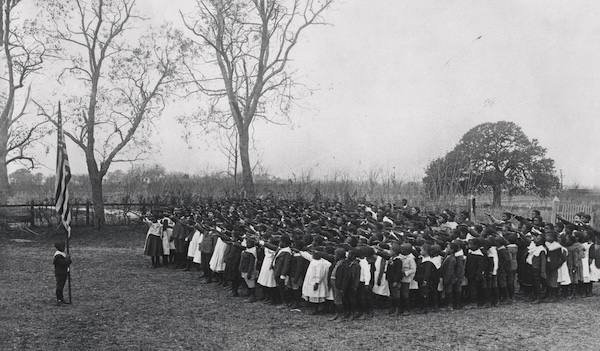
Arthur Jafa, Pledge of Allegiance, 1899, 2017. © Arthur Jafa. Courtesy of the artist and Gladstone
It may be the most excruciating seven minutes you will ever watch on YouTube. Titled Love Is the Message, The Message Is Death, the 2016 film by visual artist Arthur Jafa chronicles, through color and black-and-white film clips spliced together, a horrific montage of the chaos and violence that has beset Black lives in America. Yet, as painful as it is to view, the footage draws the viewer in with a force few films achieve. Why? It is the force of its unapologetic message: our country cannot overcome its past—and therefore cannot move into the future. Love Is the Message, The Message Is Death runs seven minutes and 25 seconds and is set to Kanye West’s “Ultralight Beam.”
The cumulative force of this film and Jafa’s broader oeuvre lies not simply in their assault on the eye, but in their power to infiltrate the mind. Their deliberate, pulsating rhythms tighten like a chokehold. The film confronts viewers with racism, murder, police brutality, and lynching: the accumulated humiliations imposed on Black Americans from the republic’s founding investment in slavery to the Black Lives Matter movement—and beyond.
Yet Jafa also sets these earthly atrocities within a cosmic, unceasing frame, lingering on a solar flare as it bursts from the sun. Juxtaposed with fires consuming American cities and towns—evidence of a racism that refuses to be extinguished—the image turns the film into an intergalactic journey toward the solar system’s core. It evokes both James Baldwin’s The Fire Next Time and the opening stanza of Bob Dylan’s prophetic “It’s All Over Now, Baby Blue”:
Yonder stands your orphan with his gun
Crying like a fire in the sun
Look out, the saints are comin’ through
And it’s all over now, Baby Blue.
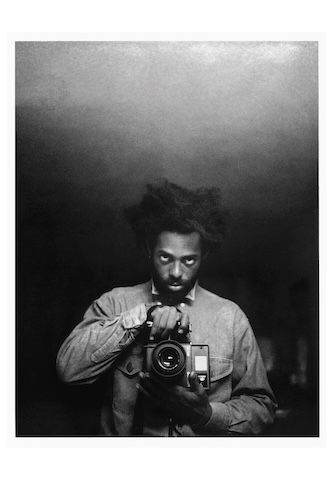
Arthur Jafa, Monster, 1988, printed 2017. Gelatin silver print. © Arthur Jafa. Courtesy the artist and Gladstone
Arthur Jafa (pronounced JAY-fah), born in 1960 and raised in Tupelo, Mississippi, came of age at the close of the civil-rights era. He has described that upbringing as “somewhere between The Brady Bunch and The Color Purple”—a formulation that suggests both the seductions of middle-class American normalcy and the violence beneath it. Over a wide-ranging career, Jafa has collaborated with filmmakers including Stanley Kubrick and Spike Lee and mounted major exhibitions in the United States and abroad.
I Am Tony, the most comprehensive survey of his work to date, also functions as a career-spanning catalogue raisonné. Its title honors the late drummer Tony Williams, the Boston-raised virtuoso best known for his work in Miles Davis’s Second Great Quintet. Images and references drawn from jazz and rock recur throughout the exhibition—among them Davis and David Bowie—underscoring music’s central place in Jafa’s visual and intellectual world.
To encounter Jafa’s work is to be unsettled. His purposeful juxtapositions do not merely demand attention; they scramble the senses and implicate the viewer. Once we allow them into our minds, they compel us to confront parts of our shared history that we might prefer to leave unexamined.
But this unease is reflective of our current reality in the United States.
In a recent NYTimes interview, Jafa said: “The whole Trump, the whole MAGA thing, is such a willful attempt to disremember. I like to hope that the arc of the moral universe bends toward justice, but that doesn’t mean that we’re not going to go through some horrifying times.” The artist’s New Museum exhibition is described by the institution as the first U.S. museum survey to encompass the full range of his practice.
Love Is the Message includes voices and images associated with hope and uplift: the late Rev. Dr. Martin Luther King Jr., for instance, and President Obama singing “Amazing Grace.” Yet Jafa does not linger over these emblems of redemption or the movements that sought to build political momentum through a gospel of love. As a political strategy in the United States, nonviolence never took root as the broad social movement Gandhi envisioned in India, nor did it secure the ultimate goals for which King fought. America continues to fester with old wounds and older hatreds.
There are flashes of comic release amid the brutality—Michael Jackson dancing in the backseat of a limousine, for example. But they cannot offset the film’s relentless images of cruelty. In Jafa’s reckoning, the violence overwhelms everything else.
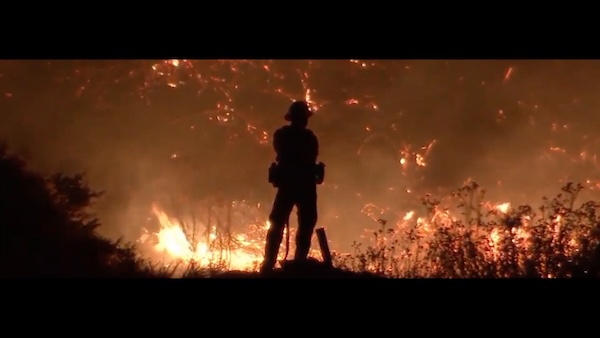
Arthur Jafa, akingdoncomethas, 2018. Video, color, sound. © Arthur Jafa.
Courtesy the artist and Gladstone
Even as I Am Tony and its accompanying catalogue take stock of his career, Jafa—now 65—has his sights set on a different medium. “I really want to make movies,” he recently told The New York Times. One project he hopes to pursue concerns the late Larry Levan, the gay Black DJ whose boundary-breaking sets at Manhattan’s Paradise Garage helped reshape dance music. Levan, like Jafa, understood disruption and innovation as creative imperatives.
As the country approaches a midterm election that will again test competing visions of its future, Jafa’s work offers an urgent reckoning with the past—and a cogent warning about where the nation may be headed.
Robert Israel, an Arts Fuse contributing writer since 2013, can be reached at [email protected].