Theater Interview: Paula Plum Finds Eleanor Roosevelt’s Indomitable Voice
By Tim Jackson
In Central Square Theater’s production of the solo drama Eleanor, the acclaimed actor channels a historic First Lady’s activism, marital complexities, and enduring call to civic action.
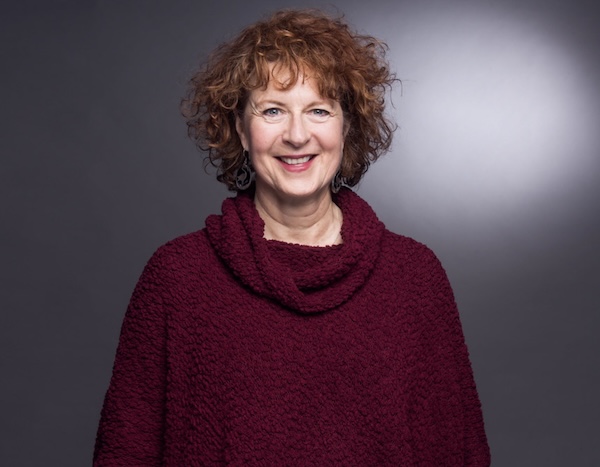
Actor Paula Plum — an enduring force in New England theater. Photo: courtesy of Central Square Theater. Photo: T. Charles Erickson
For more than four decades, Paula Plum has been a mainstay of New England theater, performing with nearly every major Boston company. Her many honors include Elliot Norton Awards for Outstanding Actress in 2007 and 2017, as well as the 2004 award for Sustained Excellence. A founding member of the Actors’ Shakespeare Project, she has also worked extensively as a director and acting teacher.
Beyond the stage, Plum has appeared in films including Irrational Man, Mermaids, Malice, Next Stop Wonderland, Prozac Nation, and Fourth of July, along with numerous television and voice-over roles. She frequently performs with her husband, actor Richard Snee, and estimates that she has appeared in “nine or 10” one-woman shows.
She is currently starring as Eleanor Roosevelt in Central Square Theater’s staging of Eleanor. Directed by Bryn Boice, the production is running through October 11. In Mark St. Germain’s solo play, Plum portrays Eleanor as well as a number of other characters. I sat down with her to talk about the play and her approach to acting.
On the Role of Eleanor Roosevelt
Arts Fuse: How much of you, and how much of Eleanor, is in the creation of the character?
Paula Plum: Oh, wow. That’s a really good question. Any actor tries to achieve invisibility if they’re portraying someone as iconic as Eleanor Roosevelt. My feeling about my own performance is that it’s a real blend. If you took strawberry ice cream and vanilla and mixed them together, you’d see a swirl. So I think it’s a swirl.
But I play 12 characters in this play, so it isn’t just Eleanor. I find myself switching from voice to voice: [imitating Winston Churchill] “How do you do, Mrs. Roosevelt?” — as well as Franklin. Mostly, I play Eleanor. I am trying to achieve some kind of accurate authenticity with the voice.

Adrianne Krstansky & Paula Plum in the Lyric Stage Company’s 2018 production of The Roommate. Photo: Mark S. Howard
Arts Fuse: How much research did you do?
Plum: I started in May, memorizing. I went to Rock Creek Cemetery, where the play is set. She is a ghost who has come to resolve some issues — her relationship with Franklin and with her father. I went to the FDR Library for primary research, where I looked at a lot of home movies filmed by an assortment of the characters who populated the White House, which was like a hotel when Franklin and Eleanor were there.
Everyone stayed at the White House or lived there: Louis Howe, his political adviser; Lorena Hickok, her lesbian lover. FDR had a suite. Madame Chiang Kai-shek was one of Eleanor’s good friends. When she needed surgery, Eleanor insisted that she consider the White House her convalescent home. The doors were open to everyone. Her life achievements were absolutely gargantuan. I’ve read books and books and books.
I also went to Rock Creek Cemetery, the FDR Library in Hyde Park, and Val-Kill, which is just down the road from Hyde Park. That was where she had her own cottage and created an enterprise, Val-Kill Industries — a literal cottage industry for women. People who didn’t have jobs could come and be taught how to use machinery, with all sorts of education going on during the Depression. It was all her idea.
Franklin could escape to Top Cottage, in Hyde Park, which was another cottage. He also had Warm Springs, Georgia, which became a prime center for polio rehabilitation.
Called the “First Lady of the World” by Harry Truman, she was the first woman delegate to the United Nations. She helped draft and pass the Universal Declaration of Human Rights. John Kennedy appointed her to the National Advisory Committee of the Peace Corps. She went to Russia. She spoke with Khrushchev and took children to Russia to tour the Kremlin. She never stopped. She was indefatigable.
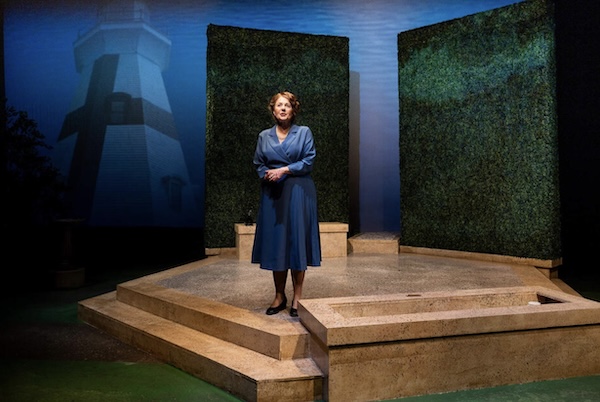
Paula Plum in Eleanor. Photo: Nile Scott
Arts Fuse: There are different models of what a First Lady is. Today we have — what’s the word I’m looking for?
Plum: The nadir of First Ladies? The nadir. The crummiest of crummy. Quote me. That’s fair. I don’t care.
It’s all just too strange. There’s too much strange. I couldn’t even start. It’s so bizarre. History will have some amazing books written and movies created, but today is almost so far out of the realm of reality that it feels surreal. It feels like a satire of a presidency.
The last thing in the show is that I come out as Eleanor and ask for donations — I always think it’s more effective if the actor does this — and then, as Eleanor, I say: “The future belongs to those who believe in the beauty of their dreams. And please remember to vote on November 3.” That gets the biggest applause of the night.
Arts Fuse: She shows what women can achieve politically.
Plum: Yes. I like to call it compassionate leadership, as opposed to narcissistic, self-centered leadership. Her life was driven by concern and care for anyone in trouble. She wrote a daily column, “My Day,” which was syndicated across the country. If you wrote to Eleanor Roosevelt and she didn’t answer, her secretary, Malvina “Tommy” Thompson, did. They stayed up until one in the morning answering the letters that came in.
Arts Fuse: What was Franklin’s relationship to her while she achieved all this?
Plum: He needed her when he got polio. When he became president, there was no way he could make speeches all over the country. She went for him. There’s a line in the play: “You’ve been my legs, Eleanor. Now I need you to be my eyes and ears as well.”
She was regularly on the radio. She wrote the “My Day” columns and traveled the country. She drove her own car and overruled the Secret Service so that she could drive herself. She was fiercely independent and full of ideas about how things could be fixed.
She came to Franklin with this, this, this — and scolded him about such things as the outrageous wartime internment of Japanese Americans, the treatment of Black sailors, and the effort to allow 100,000 Jewish children into the country. They had fights. But as Louis Howe says, “How many times have the two of you argued?” And she says, “Too many to count.” He says, “How many times has he told you not to speak your mind?” Silence. There’s your answer: never.
She was able to represent and talk about things he could never say: the need for birth-control programs, pregnancy education, and racial justice. He couldn’t publicly take positions on those issues because Southerners occupied strategic places in the Senate and House, and they would block every bill he tried to pass if he came out in support of them. So she played the other half of the argument. It was a brilliant partnership.
Arts Fuse: And at the time, was there pushback?
Plum: She did get criticized, because she was breaking ground. She was cruelly represented in cartoons with a horse face and buck teeth. That’s a quote from a letter.
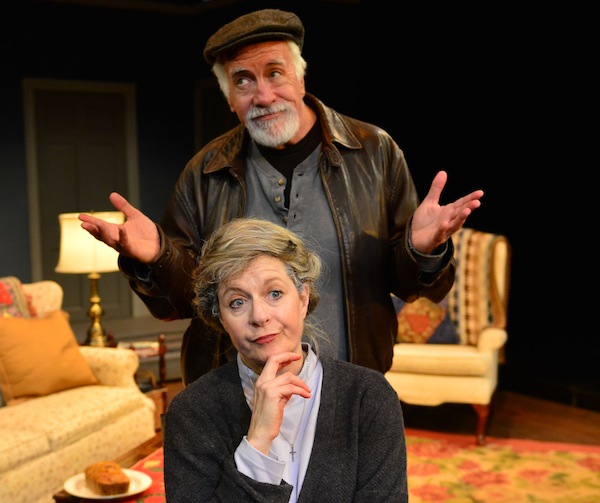
Richard Snee and Paula Plum in Gloucester Stage’s 2014 production of Jack Neary’s Auld Lang Syne. Photo: Gary Ng
On Acting
Arts Fuse: How long do you spend every day memorizing?
Plum: An hour. With Eleanor, I started on May 23. We opened September 11. It was an hour every day for 45 pages. And then I also had my research ID from the library. It was immense. I said to Richard [Snee, her husband], “This is my last Mount Everest.”
Arts Fuse: Do you have superstitions or rituals about going onstage?
Plum: I always summon my angels. And the older you get, the more angels you have. So I take certain people onstage with me: my brother, my mother-in-law, who was an incredible human being. Sometimes I carry relics in my undergarments. I have a first-class relic of Padre Pio — now Saint Pio.
I believe that we are helped in this world when things are hard. And I’m a meditator. I’ve been meditating since 1971. I’m not a religious person, but I believe in the spirit. I feel that you connect with something inside you that is a reliable source of energy.
Of course there are nerves. I feel terror. I’d wake up in the middle of the night and go, “Oh my God, what am I doing? Why did I think I could do this at this age?” And then, on September 10, when I had the first show, it was like: “Oh, this is familiar terror. I’ve done this so many times.”
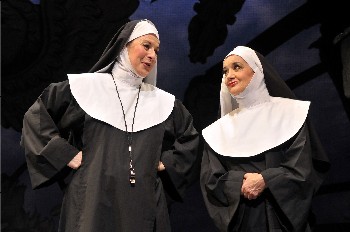
Paula Plum (left) and Kathy St. George (right) in a scene from SpeakEasy Stage Company’s 2011 production of The Divine Sister. Photo: Craig Bailey
Arts Fuse: Do you have models, favorites, or people from whom you learn?
Plum: I love Olivia Colman to death. I’m fascinated by Tilda Swinton, but I don’t relate to her as a human being. But I’ll watch anything Cate Blanchett is in. I love Allison Janney.
My acting guru was Rose Schulman, as were Alfre Woodard, Karen MacDonald, and Joe Gifford. Those people changed my life in terms of opening the heart — the heart-opening experience of understanding a character.
Arts Fuse: What do you tell a person starting out?
Plum: Persistence exceeds talent. Put one foot in front of the other and just keep going. I have a pin that says, “Keep going.” Eleanor’s advice was, “You must do the thing you think you cannot do.”
It takes bravery to introduce yourself to people, keep the conversation going, self-market, and do all those things. I used to say, “Pummel them with postcards,” or have a good website. It’s called show business, not show talent or show art. You have to be a businessperson.
Arts Fuse: What has been your most ecstatic experience onstage?
Plum: I’ve done nine or 10 one-woman shows, many of them up in Vermont. I can’t even remember all their titles, but one might have been Plum Pudding. I also did The Italian Lesson, by Ruth Draper. And then there was another piece that I can never do again because it’s now politically incorrect. It was called Sidekick, and it was, for me, beyond any kind of experience I’ve ever had.
Arts Fuse: What do you see for the future?
Plum: Vacationing in Maine? I’m working on a show about Edna St. Vincent Millay and turning it into a one-person piece. Dream big, Paula. I’d also love to get with a theater company that’s going to Europe. I’d like to do a film in France. I’d love to do all those things.
Tim Jackson was an assistant professor of Digital Film and Video for 20 years. His music career in Boston began in the 1970s and includes some 20 groups, recordings, national and international tours, and contributions to film soundtracks. He studied theater and English as an undergraduate, and has also worked helter-skelter as an actor and member of SAG and AFTRA since the 1980s. He has directed four feature documentaries: Chaos and Order: Making American Theater, which is about the American Repertory Theater; Radical Jesters, which profiles the practices of 11 interventionist artists and agit-prop performance groups; When Things Go Wrong: The Robin Lane Story, and Marblehead Morning: Daring & Stahl: 50 Years in Harmony. He has made two short films as well: Joan Walsh Anglund: Life in Story and Poem and The American Gurner. He is a member of the Boston Society of Film Critics. You can read more of his work on his substack.
Tagged: "Eleanor", Bryn Boice, Central Square Theater, Eleanor Roosevelt, Paula Plum