
Visual Arts Review: Gloucester Light, Lasting Friendship — Avery, Gottlieb & Rothko
By Mark Favermann
The Cape Ann Museum’s revelatory exhibition shows how Milton Avery, Adolph Gottlieb, and Mark Rothko turned the Gloucester shore into a language of abstraction.
Avery, Gottlieb & Rothko: By the Sea at the Cape Ann Museum, 27 Pleasant Street Gloucester, through September 27. It then travels to the Phillips Collection in Washington, D.C., from October 24 through January 24, 2027.
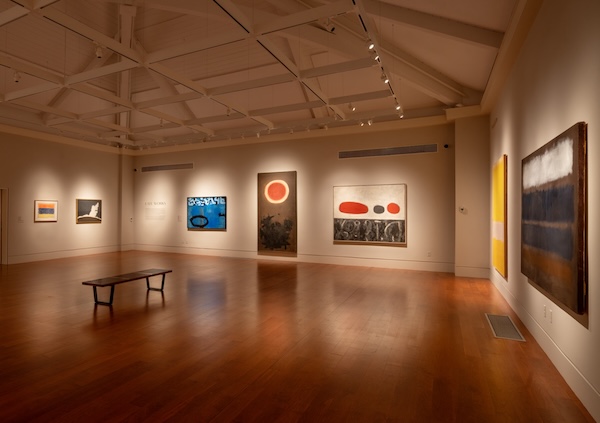
Avery, Gottlieb & Rothko: By the Sea. Installation view at Cape Ann Museum. Photo: Mark Favermann
Natural light has long been understood as essential to daily energy and well-being. Gloucester, Massachusetts—a quaint, inviting seaport city—has it in abundance. So it is understandable that, for generations, the distinctive radiance of Cape Ann has fostered extraordinary artistic expression. That light is now the subject, medium, and atmosphere of Avery, Gottlieb & Rothko: By the Sea, a remarkable exhibition at the newly renovated Cape Ann Museum.
Beautifully installed, aesthetically accessible, and sensitively illuminated, the show explores the artistic bond among three pivotal 20th-century American painters: Milton Avery (1885–1965), Adolph Gottlieb (1903–1974), and Mark Rothko (1903–1970). Their shared summers in Gloucester—beginning in the 1920s and continuing into the mid-1940s—had a profound and lasting effect on their individual development as artists.
Guest curated by Eliza Rathbone, chief curator emerita at the Phillips Collection, the show brings together 82 works from 26 lending institutions, including artists’ estates, public museums, and private collections. Many of the paintings, drawings, and watercolors have never before been publicly exhibited. The result is a compelling selection of artistic treasures—and an unusually vivid account of friendship, influence, and the unpredictable routes by which artists arrive at mature styles.
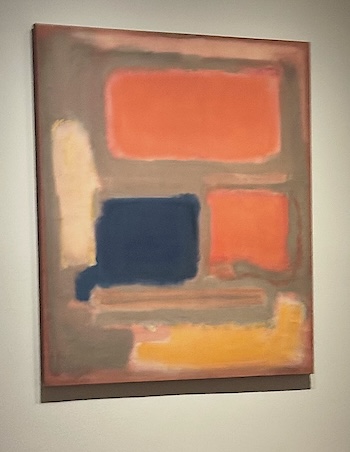
Mark Rothko, No. 20, 1949, Photo: Mark Favermann
In New York during the 1930s, Avery, the eldest of the three, became a friend and mentor to the younger Gottlieb and Rothko. All three began with a strong commitment to landscape, although each would eventually take a different route toward abstraction. Avery’s simplified forms, compressed spaces, and glowing fields of color proved especially important to Gottlieb and Rothko, both of whom would later transform color into a primary vehicle for conveying feeling and meaning.
Gloucester’s shifting skies, working harbor, rocks, wharves, water, and coastal atmosphere supplied more than picturesque subject matter. They gave the painters a place in which to work side by side, talk, experiment, and compare their different perspectives on the visible world. Over the course of the 1930s and 1940s, the three artists returned to the area repeatedly, absorbing the play of light across the sea and the forms along the shore. By the late 1940s, as their work evolved decisively toward abstraction, Provincetown became another important destination. But Gloucester remained a formative landscape: a site where observation gradually became color, rhythm, atmosphere, and memory.
The exhibition follows the trio’s development across nearly four decades. The early pictures frequently retain a representational, even neo-Impressionist character, touched occasionally inflected by the earthy social realism associated with the Ashcan School. Yet the Gloucester light steadily changes the terms of the work. Color grows more liberated, forms become increasingly distilled, and landscape begins to dissolve into an emotional language of sea, sky, tide, and radiance.
One can almost imagine the three artists talking as they drew and painted along the Gloucester shore. Gottlieb was particularly responsive to biomorphic Surrealism; he developed a symbolic vocabulary marked by buoyant shapes, pictographs, and a narrative impulse. Avery and Rothko, meanwhile, found increasingly resonant equivalents for the abstractions of sky and water. Their paintings make the visible world feel both immediate and elusive—seen, remembered, and transformed.
Rathbone’s curatorial work, developed over five years, has produced a consistently strong presentation that has drawn on early works of special historical and visual interest. The show makes it abundantly clear that the mature achievements of all three painters did not come from nowhere. They emerged after years of looking, sharing ideas, revising methods, and responding to the same coastal environment.
Among the early standouts are Milton Avery’s redolent Gloucester Dawn (1921), oil on board; Adolph Gottlieb’s Gloucester Street (1934), oil on linen mounted on board; and Mark Rothko’s View of a Pier (1934), watercolor on construction paper. Avery’s Harbor at Night (1932), Gottlieb’s Rockport (1932), and Rothko’s Untitled Wharf (1934) are similarly evocative works. Rothko’s watercolor was donated to the Cape Ann Museum by the artist’s son, Dr. Christopher Rothko, adding a particularly meaningful local connection to the exhibition.
The early pictures here are not merely preliminary chapters. They contain a freshness and curiosity, a sense of exploration; these three painters are testing what landscape can do. In them, Gloucester appears as a working harbor, weather, architecture, rock, human activity, and light. But early on the place also begins to exert a distinctive pressure on the artists’ imaginations—a geography the inspires them to release color from just descriptive function.
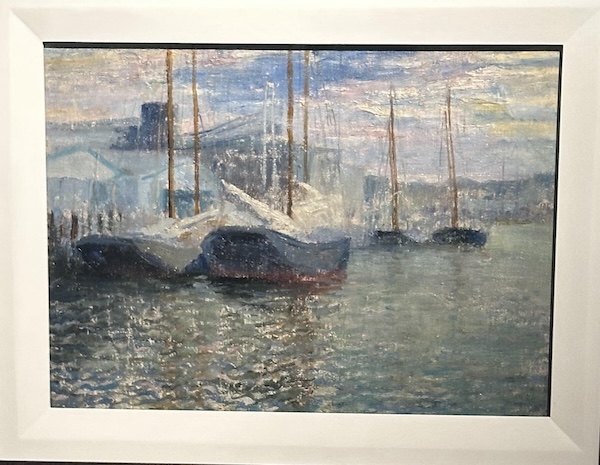
Milton Avery, Untitled (Harbor Scene), 1921-22, Photo: Mark Favermann
Several later works create the feeling of being in the presence of genuine greatness. Avery and Rothko offer deeply moving examples of their mature achievement, but Gottlieb’s later paintings may come as a surprise to some. Their strength, exuberance, scale, and coloristic assurance make a forceful case for Gottlieb as more than a supporting figure in the history of postwar American painting.
Avery’s The White Wave (1956), Black Sea (1959), and Red Sky, Blue Sea (1958) trace his movement from representation toward a poetic, highly distilled abstraction. He reduces sea, weather, and landscape to their essential visual and emotional elements. The paintings are spare but never empty; they are rich with atmosphere.
Rothko’s No. 20 (1949), Untitled (1949), and Untitled (Yellow and Pink, Yellow on Light Pink) (1955) demonstrate how blocks of color could be transformed into immense emotional experiences. In these dramatic paintings, color does not illustrate feeling; it produces feeling. The soft-edged rectangles seem to hover, breathe, recede, and advance, inviting viewers into an encounter at once visual, physical, and inward.
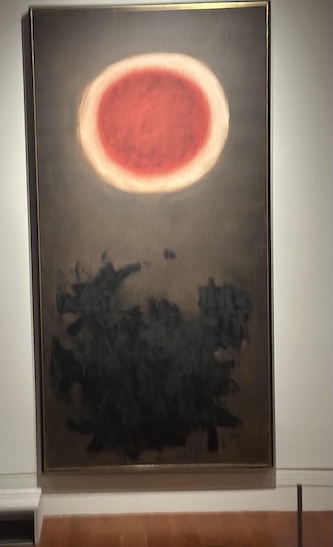
Adolph Gottlieb, Over and Under, 1959, Photo by Mark Favermann
Gottlieb’s large Sea and Tide (1952), Blue at Night (1957), and Over and Under (1959) are astonishing. Their bold pictorial structures, vibrating color, and animated forms demonstrate how far Gottlieb had moved beyond direct observation of landscape and how fully he had tapped the elemental forces of sea, sky, darkness, movement and, of course, light.
The exhibition is also an opportunity to experience the Cape Ann Museum’s major architectural restoration and expansion, undertaken as part of the institution’s 150th-anniversary celebration. Designed by the Boston architectural firm designLAB, the renovation improves accessibility and circulation while expanding the museum’s ability to present its distinguished holdings in art, local history, fisheries, granite, and archives.
A redesigned suite of three Fisheries Galleries explores Cape Ann’s maritime industry, past and present. A newly opened rear stairwell improves visitor movement through the museum’s fisheries, granite, and archival collections. The renovation also enhances access to the Library & Archives Center and Education Studio, while a refurbished auditorium and reimagined atrium courtyard bring the spirit of the outdoors inside through displays of Cape Ann granite and sculpture.
The updated Education Studio supports greater hands-on engagement, multimedia presentations, and interactive displays. Reconfigured gallery space for 20th- and 21st-century art accommodates the museum’s growing collection and evolving institutional priorities. New adjustable walls and state-of-the-art lighting make it possible to display more of the Cape Ann Museum’s significant historical and artistic holdings.
The exhibition is accompanied by a handsome, 224-page catalogue, Avery, Gottlieb & Rothko: By the Sea, published by Rizzoli Electa. The book contains more than 200 images and examines the artists’ friendships, working methods, and creative exchanges. It also considers Avery’s special role: roughly two decades older than Gottlieb and Rothko, he was both mentor and peer. More significantly, the publication—and the exhibition itself—argues persuasively for the importance of community, place, and sustained artistic friendship. Gloucester was not simply a summer retreat for Avery, Gottlieb, and Rothko. Its light, shore, water, and atmosphere became part of a shared vocabulary that inspired each artist’s individual original voice.
Mark Favermann’s firm, Favermann Design, was one of five design consultancies chosen from 481 to design the 1996 Centennial Olympic Games in Atlanta. He is an urban designer specializing in strategic placemaking, civic branding, streetscapes, and retail settings. In 2024, he was awarded the Journalism and Communications Award by the American Planning Association/Massachusetts for his decades of writing on the built environment. In 2025, the Mass Cultural Council awarded him a Creative Individual Award for Sculpture.
Tagged: "Avery, Adolph Gottlieb, Cape Ann Museum, Eliza Rathbone, Gottlieb & Rothko: By the Sea", Mark Rothko