Visual Arts Review: Picasso, Miró, Dalí—Between Their Pages
By Lauren Kaufmann
The MFA exhibition brings viewers close to the remarkable printed books in which Spanish modernists and French writers fused art and literature.
Picasso, Miro, Dali: Unbound at The Museum of Fine Arts, Boston, On view through January 24, 2027
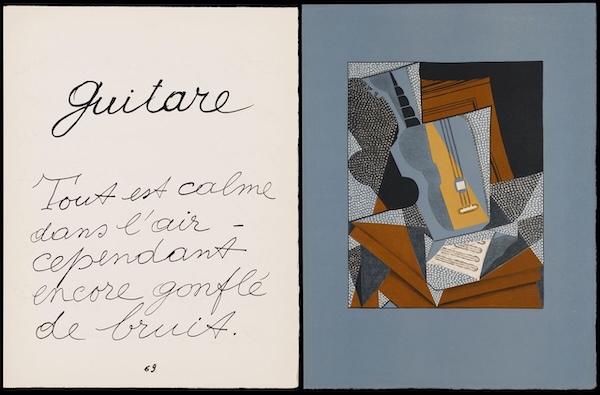
Au Soleil du plafond (Ceiling Sunlight), 1955, Juan Gris and Pierre Reverdy. Photo: courtesy of the MFA/Boston.
Picasso, Miró, Dalí: Unbound occupies a rich intersection of visual art and literature. The exhibition invites close looking—not only at images but at the relationship between words, typography, paper, and printmaking. Because the works are displayed unframed, viewers encounter them with unusual immediacy. Glass doesn’t separate viewers from the pages, so the show conveys something of the intimate, tactile experience of reading an artist’s book.
Despite the major names in its title, the exhibition does not center on Picasso’s, Miró’s, or Dalí’s celebrated paintings. Instead, it examines their work in drawings, prints, etchings, engravings, and lithographs, emphasizing the livre d’artiste, or artist’s book. The term can refer to a hand-produced book, often conceived as a complete artistic object. Livres d’artistes, more specifically, were frequently issued in editions incorporating original prints; rather than being conventionally bound, they were often housed in cases or linen-covered boxes. Alongside works by Pablo Picasso, Joan Miró, and Salvador Dalí, the assemblage includes projects by several other Spanish artists.
Claire Howard, one of the exhibition’s four curators, explains that the modern French artist’s book emerged around 1900 and reached its height in the 1940s and 1950s. Artists’ books remain vital today, though contemporary examples are often made by a single artist rather than through the collaborative model represented in this exhibition. Many of the works on view required the combined expertise of artists, writers, typographers, designers, printers, and publishers.
Although the livre d’artiste flourished in France during the early twentieth century, Picasso, Miró, Dalí: Unbound highlights the contributions of Spanish artists who worked in conjunction with French writers and poets. The pairing makes historical sense. At the end of the nineteenth century and into the early twentieth, French language and culture held enormous international prestige. Paris was widely regarded as a center of artistic experimentation and intellectual life, drawing artists from throughout Europe and beyond. Picasso, Miró, Dalí, and many of the other artists represented in the exhibition all spent significant periods living and creating there.
The exhibition’s wall texts lucidly explain specialized terminology, printmaking techniques, and typographic conventions. Less fully developed, however, is the larger cultural context: the extraordinary influence that France exercised over literary and artistic life during this period. A deeper consideration of French cultural authority would have strengthened the exhibition’s account of why Spanish artists so often entered into creative partnerships with French writers.
Several projects on view demonstrate how artists’ books responded to political upheaval and war. Domaine (1942), a collaboration between the Spanish Surrealist Óscar Domínguez and writer Robert Ganzo, consists of eight etchings accompanied by poetry. Produced in German-occupied Paris during the Second World War, the book is a striking example of artistic production completed under extraordinary conditions. Domínguez’s etchings have a fantastical, almost sculptural quality. Though they do not always directly illustrate Ganzo’s poems, their imaginative force and subtle whimsy make them compelling in their own right.
Poésie et vérité (Poetry and Truth, 1947), another team effort involving Domínguez, pairs 33 etchings with writing by the French poet Paul Éluard. The book includes Éluard’s famous poem “Liberté,” written in 1942 as a call to resistance. During the Nazi occupation of France, copies of the poem were printed on leaflets and dropped from British aircraft over occupied territory. In the context of the exhibition, the work underscores the political power literature and art can assume during wartime.
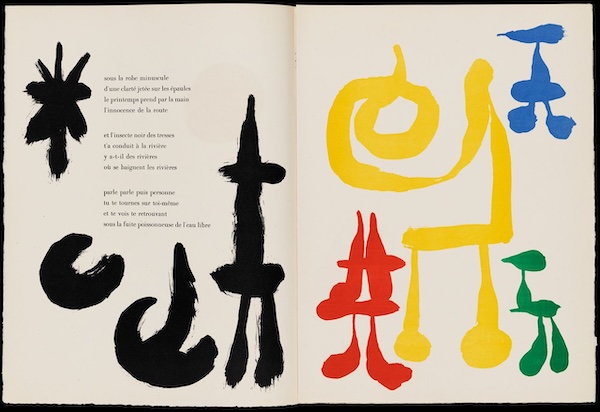
Parler seul (Only Speak), 1948-50, Joan Miro and Tristan Tzara. Photo: courtesy of the MFA/ Boston.
War also shaped the long-delayed realization of Au Soleil du plafond (Ceiling Sunlight, 1955), which pairs twelve lithographs by Juan Gris with poems by Pierre Reverdy. The project was initially conceived in 1915, but the First World War interrupted its production. It was finally published four decades later, long after Gris’s death. Reverdy’s concise poems address familiar objects—a lamp, a book, a guitar, a pipe, a coffee grinder, and sunlight on the ceiling. The belated publication gives the work a distinctive historical resonance: it is both a modernist collaboration and a recovered project from an earlier cultural moment.
The exhibition is particularly rewarding because it reveals lesser-seen dimensions of canonical artists. For Le paradis perdu: Quatrième Chant (1974), Dalí produced ten drypoints illustrating the fourth canto of John Milton’s epic poem Paradise Lost. The passage depicts Satan’s first view of the Garden of Eden, material well suited to Dalí’s fascination with mythology, religion, and metaphysical drama. Created by scratching directly into a copper plate, Dalí’s drypoints feel loose and spontaneous—markedly different from the polished, dreamlike Surrealist paintings for which he is best known.
Miró’s collaboration with the Romanian-born poet Tristan Tzara, Parler seul (Only Speak, 1948–50), comprises 72 lithographs accompanied by poetry. The project took Miró two years to complete. Even though its visual and textual elements were printed at different times and on different presses, they appear remarkably attuned to one another. The resulting pages feel less like illustrations paired with poems than like simultaneous acts of visual and verbal invention.
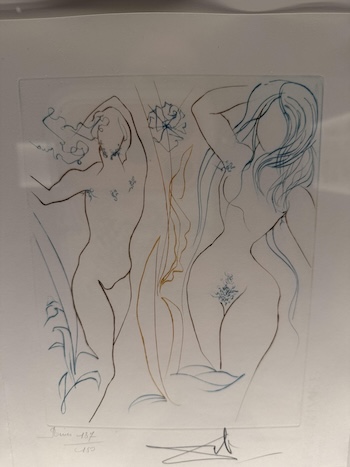
La paradis perdu: Quatrieme Chant (Paradise Lost: Canto 4), 1974, Salvador Dali. Photo: Lauren Kaufmann.
Picasso’s Chevaux de minuit (Midnight Horses, 1956), produced with the Ukrainian poet Roch Grey, similarly demonstrates the expressive possibilities of typography as well as image. Grey’s poem, written in 1936, evokes an era in which horses remained a principal form of transportation. Picasso’s elegant engravings offer multiple views of horses in motion, while the type itself shifts across the page: words angle diagonally, scatter irregularly, or appear in vertical arrangements. That playful compositional energy echoes the movement, speed, and unpredictability of the horses themselves.
Some of the books in the exhibition grew out of direct partnerships between artists and writers; others were initiated by publishers, who brought together authors, artists, printers, and designers. In each case, the finished object reflects a convergence of singular talents. The exhibition consequently encourages viewers to see the book not merely as a container for text or imagery, but as a carefully made work of art in its own right.
The popularity of the livre d’artiste also recalls the status of French literature during the late nineteenth and early twentieth centuries—the era of Gustave Flaubert, Émile Zola, and Marcel Proust—and a broader cultural moment in which publishing, typography, illustration, and printmaking could be understood as closely connected arts. The show offers a vivid glimpse of this fertile overlap between literary and visual culture.
The show’s concentration on prints and drawings also provides a welcome corrective to the dominance of painting in the public reception of Picasso, Miró, and Dalí. Each was an accomplished draftsman, and the etchings, lithographs, engravings, and drypoints on view illuminate an equally persuasive dimension of their work. These pieces foreground line, touch, process, and the material qualities of printing—attributes that can be less apparent in the artists’ better-known paintings.
The exhibition’s texts are predominantly in French, posing a significant obstacle for visitors without strong command of the language who wish to engage fully with its literary dimension. English translations would have added further visual density to an already layered presentation, but they would also have opened the poems and prose to a broader audience and deepened viewers’ encounter with the books. Howard said the curatorial team ultimately decided against including them: much of the writing is fragmentary, and translations presented in isolation, she explained, risked conveying little coherent sense of the texts.
That choice is understandable, but it underscores a central challenge of exhibiting artists’ books: these works derive their force from the interplay of language, image, sequence, and material form, while museum display necessarily removes individual pages from their original reading contexts. Even so, Picasso, Miró, Dalí: Unbound succeeds admirably in making an exacting, specialized genre accessible.
The MFA last devoted an exhibition to livres d’artistes in 1961. As Howard observes, the genre often falls between the institutional mandates of museums and libraries, and it can seem to demand a patient viewer willing to linger at the intersection of art and text. Yet that hybridity is also its great strength. For readers, print lovers, and admirers of modern art, Picasso, Miró, Dalí: Unbound offers a rare chance to encounter books as tactile, collaborative, and intellectually ambitious works of art.
Lauren Kaufmann has worked in the museum field for the past 14 years and has curated a number of exhibitions.