Local Author Interview: Tom Perrotta on “Ghost Town,” Grief, and the Perils of Nostalgia
By Preston Gralla
In a new novel set in a 1970s New Jersey suburb, the Belmont-based author revisits childhood, racial segregation, masculine stoicism, and a past that cannot be remembered honestly without its shadows.
In this ongoing Arts Fuse series of interviews with Boston-area authors, I talked with Tom Perrotta, whose newest novel is Ghost Town, set in a New Jersey town much like the one he grew up in. Perrotta has written 11 novels, including Election and Little Children, both of which were made into Oscar-nominated films, and The Leftovers, made into a Peabody Award-winning HBO series. He’s also written screenplays including co-writing Little Children’s, which received an Oscar nomination. He lives in Belmont.
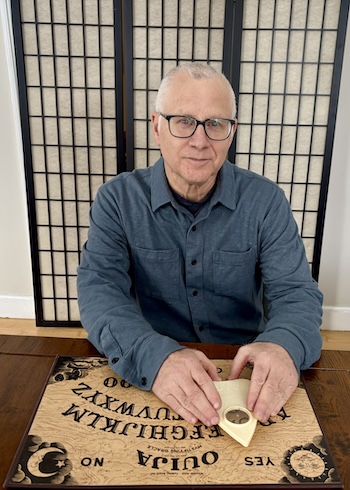
Author Tom Perrotta with oujia board. Photo: courtesy of the artist
Arts Fuse: Why did you write this novel, and why now?
Tom Perrotta: The book is about a boy whose mother dies. It’s a kind of a chronicle of a grief-stricken summer. I was inspired by a very different kind of grief, because my mom died during the pandemic. She was in her late 80s, was starting to decline and needed a lot of help. She was a very strong and independent person and I think she found it very difficult. I was going home from Boston a lot to the place in New Jersey where I grew up and trying to help her out. I was sleeping in the same bed that I slept in as a teenager and was so aware of the way the past kept bubbling up through the present and how much I remembered about my life then, my mother back then, saw all the life in that house and now it was this quiet, somewhat melancholic place. And I saw the changes in the town over 50 years.
AF: When you were writing about the boy’s grief and what he goes through that summer, were you channeling your own emotions or were you looking at it from a writerly distance?
TP: It was definitely an outlet for some of the sadness, which I wouldn’t say was grief. There is something fundamentally different about someone dying at the age of 40 with a 13-year-old child at home than about someone dying in her early 90s, a grandmother who had lived a good long life. It was sad, but it wasn’t a shattering experience. It was in the realm of the natural order of things.
But still, there was that particular sadness of watching somebody decline in a way that makes life really difficult. I think I found an outlet for the sadness and the sense of loss that I was feeling. But I was also playing that fictional what-if game. What if me and my siblings had lost her back then? I knew some people who had lost parents when they were young and I think I’d only come to understand just what a life-changing traumatic event that was. So I think on the one hand, I was using my own emotions, and on the other hand, I was doing what fiction writers do, which was imagine myself in the mind of somebody going through an experience that I never did.
AF: Novels used to be at the center of what some people call the cultural conversation. They are no longer. How does that make you feel as a novelist?
TP: I feel the diminishment. I remember one of the things that pushed me into writing for TV in a serious way was when maybe 20 years ago I was at a barbecue with a lot of writers and they weren’t talking about the latest Philip Roth novel. They were talking about Breaking Bad. There was the assumption that everyone had seen Breaking Bad and everyone had an opinion about it. And the fact was I liked Breaking Bad too and I liked film. To me it’s another long-form narrative.
At that point TV had become more novelistic. They were telling long-form stories and it seemed like some power of the novel had been transferred to it. That seems to have changed now a bit, because TV isn’t as bold as it was at that point.
On the one hand, I am saddened by the marginalization of the novel and specifically of reading in general. On the other hand, there’s some part of me that is trying to survive a shift in cultural context. I’ve found a pretty satisfying second career or complementary career in the world of TV and film, where some of that novelistic power went. Now I think it’s podcasts, social media. Oral culture is taking over, as are short pops of imagery.
AF: One of the issues at the center of this book is endemic racism in the suburbs. Do you think novelists have a responsibility to confront moral issues like this in their writing?
TP: I don’t know if it’s a responsibility. I think this is a moment where our politics are so dire that I see in novels a fair amount of shying away from darkness and complexity and a willingness to tap into the escapist nature of narrative. You look at the bestseller list and there’s a ton of fantasy and romantasy and they may have moral conflicts and dilemmas in them, but they’re more distant from the world that we live in and maybe implicate the reader less.
I always think a work of moral fiction should have the reader looking inward and examining his or her own values and maybe shifting their perspective. We’re having such a polarized moment and the forces of Trumpism seem so evil and undemocratic that it is a challenging moment to write political fiction.
AF: What makes it harder, I think, is that what Trump has done is so extreme and horrific, so far beyond what any of us imagined would ever happen in the United States, that if someone had written a novel about it ahead of time, it would have seemed too over-the-top to publish.
TP: Yeah, Philip Roth was saying back in the Nixon era that you can’t write satire that is wilder than the actual story of the Nixon administration and their blatant corruption. And of course, Roth didn’t know what was coming. His denunciation of Nixon was an amazingly funny and articulate one, but I would say his 1970s insight is five times as true now as it was then.
That may be one of the things that pushed me back toward writing about the ’70s. I didn’t mean Ghost Town to be a nostalgic book — it’s clear that there are elements of that world that we would look at and say good riddance. The town in it is all white and segregated, not legally, but informally in such a powerful way that it’s effectively segregated. And so in that sense, I would say it’s not a nostalgic book.
But I wanted to write about what it was like to grow up in a world without phones, where people weren’t tracked every moment of their lives, where adventure for good and bad was possible every time you walked out the door. It’s very different from the surveilled and hyperconnected world that we’re in right now.
AF: Nostalgia can be dangerous. I think back to when Ronald Reagan on the campaign trail praised Bruce Springsteen’s song Born in the USA as being a message of hope, when in fact the song is the exact opposite, bitterly critical about the way we treated Vietnam War veterans.
TP: I think nostalgia is a very simple emotion. We take what we want from it and we block out what we don’t. Often we’re remembering the best days of a life that has many days and that’s totally fair. But when it comes to our public history, there’s a real danger in that. You see it in the Trump administration. You see them saying, let’s not talk about slavery. Let’s not talk about Jim Crow. Let’s not say things that make white Americans feel bad about themselves and how they behave. Well, if there are things in our history that we need to be ashamed of, then let’s go through that process and tell the true story about it.
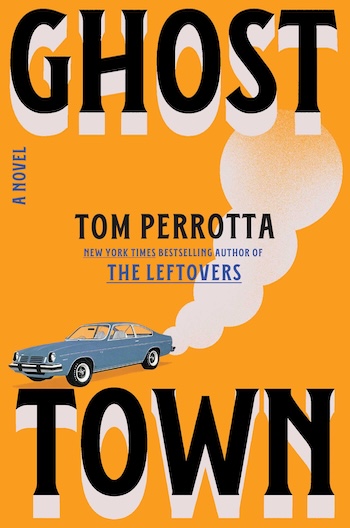 AF: In Ghost Town you didn’t pull any punches about how Blacks were treated in the town, which you’ve said is based on the town you grew up in, Garwood, New Jersey. Is it still that way?
TP: Somewhere in the late ’80s, early ’90s, Garwood stopped being a segregated town. And the neighborhood I grew up in, it looked so different from the way it had when I was a kid. During the Obama administration, I had this feeling of, well, actually we got past that.
Then when my mom needed help during the pandemic, it was the George Floyd moment and I had a whole different feeling. I realized it wasn’t just my good memories in the ’70s that were pushing through the surface of my life, it was the memories of what wasn’t so good. I’d see Trump signs around and I realized there are people who are actively nostalgic for the most shameful part of that world. I think that part of the whole project of the book is to look at the past and put the good and the bad in focus and not do that nostalgic act, which is to just remember this and forget this stuff that taints our good memories.
AF: The scene I found most moving in the book is when Jimmy’s father brings out a photo album and shows his son photos of his wife, Jimmy’s mother. Jimmy discovers things about his parents’ relationship he never knew because his father hadn’t been able to talk about them. Men of that era weren’t exactly forthcoming about their emotions and their lives. Do you think that’s changed today?
TP: Oh yeah. I can see it just in the three generations in my own family. My dad was a very stoic working-class guy. I think his true goal was to never show any emotion. He loved sports. But he did not root for a team. He’d say, “I’m rooting for a good game,” which is something that I’ve inherited from him. I think he did that because if he rooted for a team, he’d have to be happy or unhappy depending upon the outcome. It was a way for him to retain his utterly stoic stance.
He grew up in an atmosphere that said to men, “Don’t complain. Do what you have to do.” He worked his whole life. He didn’t like his job, but he did it. I think he just went through life feeling like he didn’t have a lot of choices. And if you’re going to go through a life where you don’t have a lot of choices, maybe having a lot of emotions about it isn’t that useful because those emotions are anger or frustration. Not to say there wasn’t pleasure in his life, but I think his working life didn’t give him a lot of pleasure.
My dad also had a very traditional, blue-collar, Italian-American idea of gender roles. I remember when I was changing one of my kid’s diapers, he said, “Oh yeah, I did that once. It wasn’t for me.”
I’ve tried to change all that when I raised my kids. But I feel I’m a transitional figure. My son is way more a person of this moment. He’s very expressive and his emotions are right there. I’m somebody who has to make an effort to do it, but I want to make that effort.
AF: One final question. Samuel Johnson said, “No man but a blockhead ever wrote except for money.” If you didn’t get paid, would you still write novels?
TP: Novels demand a certain kind of exclusive dedication. I was amazed when I heard that when Scott Turow was working as a lawyer he did his writing on the train. I think he wrote Presumed Innocent that way.
I’d like to think that I would be one of those writers who figured out a way to keep going. I think novel writing is so hard to do as a hobby because it demands so many hours. But I know very serious musicians who make no money at their music, but they love to play. And I do love to write. There’s a kind of feeling of total focus that I don’t find anywhere else. And so I would hope that even if I were doing it as a kind of second job or avocation, that I would find some place for it.
Note: This interview has been edited for length and clarity.
Preston Gralla has won a Massachusetts Arts Council Fiction Fellowship and had his short stories published in a number of literary magazines, including Michigan Quarterly Review and Pangyrus. His journalism has appeared in the Los Angeles Times, Dallas Morning News, USA Today, and Boston Globe Sunday Magazine, among others, and he’s published nearly 50 books of nonfiction which have been translated into 20 languages.