September Short Fuses — Materia Critica
Compiled by Arts Fuse Editor
Each month, our arts critics — music, book, theater, dance, television, film, and visual arts — fire off a few brief reviews.
Books
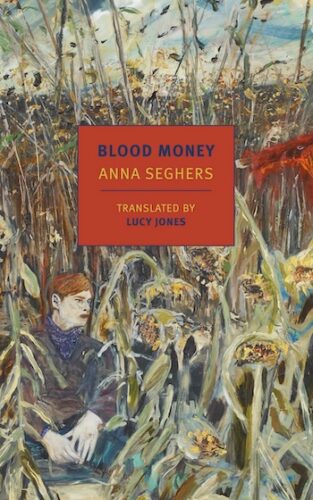
A powerful novel about the rise of fascism in Germany, the German-Jewish writer Anna Seghers’s Blood Money (1933) turns a suspenseful premise to incisive sociopolitical ends. After he kills a police officer during a riot, a young communist, Johann Schulz, has a price on his head and flees to Oberweilerbach, a small village on the Rhine. But the narrative quickly expands its focus beyond his predictable fate, anatomizing the moral and spiritual decay of a struggling, small-minded farming community. Poverty, fear, jealousy, greed, cowardice, and misogyny flourish there — conditions that nourish the brownshirts’ gradual yet inexorable appeal. It becomes clear that the community itself has been profiting from multiple kinds of “blood money,” from accepting slave labor to tolerating a husband who drives his wife to suicide in order to obtain her inheritance.
The wheeling and dealing of this rural society, vividly dramatized through the novel’s large cast, reflects the passivity and self-interest bred by a feudal mentality. The villagers jockey for advantage, a lucrative marriage, or a little more dominance; they are not Hitler fanatics or committed ideologues. Yet the young drift toward National Socialism, sensing in it the promise of a future built on profitable bloodletting — one that indulges their antisemitism, anticommunism, and appetite for collective violence.
Trenchantly translated by Lucy Jones, Blood Money dissects the villagers, victims and victimizers, with clear-eyed severity, exposing how opportunism hardens into sheepish complicity. Of National Socialism’s victory in the fateful 1932 elections, Seghers writes:
“They all regretted what they had done in the same way that they regretted making a deal they could no longer back out of. They were surprised at the huge change that had taken place that Sunday, since all their labor, backbreaking work, and sins committed in desperation the whole year long had been worthless.”
The author offers no consolation: a bad bargain has been made — but it is impossible to back out.
— Bill Marx
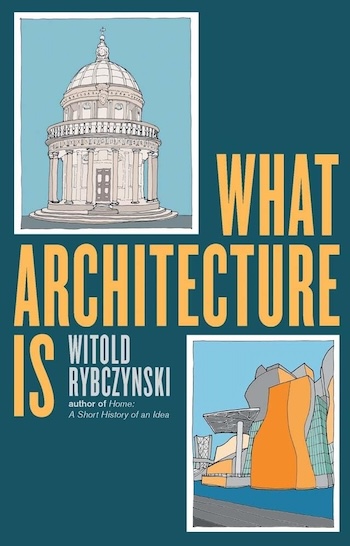
His Polish name may be a bit difficult to pronounce, but Witold Rybczynski is widely regarded as one of the finest architecture critics writing in English today. His essays and award-winning books are unfailingly lucid, and his learned and engaging writing style benefits both professional architects and general readers.
Rybczynski’s latest volume is What Architecture Is, and it is a pleasure to read. Like Home: A Short History of an Idea (1986), A Clearing in the Distance (1999), and The Story of Architecture (2022), the sensibility on display is witty and invitingly personal. Drawing on illuminating references and providing carefully articulated historical and contemporary context, he asks what elevates an ordinary structure into a work of art. Rybczynski’s multipart response explores issues of form, function, materiality, resilience, and our shared humanity. This is a slim book — fewer than 200 pages — that addresses very large ideas. Salient anecdotes, and the author’s own illustrations, add a valuable visual and personal dimension to the text.
Rybczynski answers his central question through discussions of the past, order, ornament, meaning, beauty, drawing, and sense of place. He also explores the nature of architecture through a comparative analysis of celebrated buildings and undistinguished structures. Rejecting the cookie-cutter construction embraced by too many cities, he offers an immersive, insightful, and opinionated reflection on historical and modern architecture and urban planning. What makes the book so effective is its essayistic approach, one of the qualities that makes Rybczynski’s work so distinctive: He doesn’t lecture.
I recently spoke with Rybczynski and asked, in light of his former service on the US Commission of Fine Arts, what he made of the Trump administration’s various proposals for Washington. He answered with a line attributed to William S. Burroughs: “I don’t protest, I expect the worst.” Then he added an old Yiddish saying: “Man plans, God laughs.”
— Mark Favermann
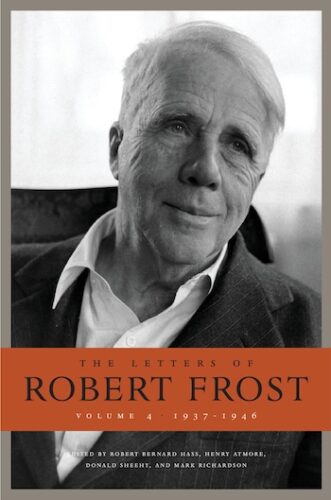
The Letters of Robert Frost, Volume 4, 1937–1946 (edited by Robert Bernard Hass, Henry Atmore, Donald Sheehy, and Mark Richardson) is not for the faint of heart — or weak of arm. At 932 pages, one does not want to “drop it on one’s foot,” as Newsweek’s Jack Beatty cautioned in his review of James Michener’s novel Chesapeake. Nor, I learned, does the dilettante Frost fan want to dive into it. This book has much to offer the serious scholar, but it is off-putting to the casual reader.
If this collection does not contain the entirety of Frost’s correspondence between 1937 and 1946 — his secretary, Kathleen “Kay” Morrison, destroyed many of his letters to her — it comes close. It encompasses the output of a tremendously successful poet and academic: organizing the details of readings and prospective publications, commenting on political events with friends, and interacting with his large and complex family. The letters are arranged chronologically and extensively footnoted.
Perhaps if I had read the three previous volumes, the names and in-jokes would have seemed more familiar and amusing. The four editors made decisions about spelling and grammatical corrections that made sense to them but often left me confused. Why not add commas to lists? Why not modernize spelling? The footnotes, while informative, both interrupt the narrative flow and sometimes muddle the sequence of events.
For an academic or researcher, this volume will be indispensable. Legible, indexed, and carefully contextualized, it offers an unparalleled view of the life, business affairs, and family of a talented and successful man. But it can also be too much. Those who love “The Death of the Hired Man” or “The Pasture” might prefer to reread North of Boston and revel in the author’s literary brilliance.
— Anne Leamon
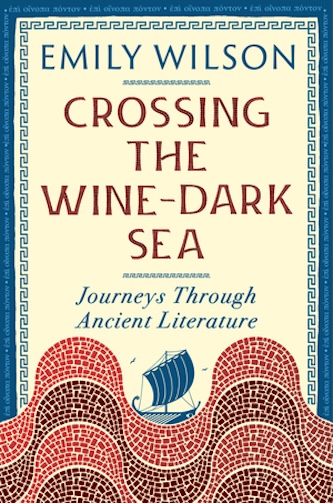
Given the dust-up between the defenders of Odyssey translator Emily Wilson and fans of director Christopher Nolan’s film version of Homer’s epic, it seemed to me worth taking a look at the scholarly detractor’s essay collection Crossing The Wine-Dark Sea: Journeys Through Ancient Literature, which examines Greek (Sappho, Aristophanes, Homer) and Roman (Catullus, Plautus, Terence) literature, focusing on issues rooted in the splendors and difficulties of translation, as well as the need to interpret antiquity with a judicious but sharp political eye. I am glad I did — it is a smart, humorous, and polemical assemblage. Particularly pleasing was its explication of the virtues of a couple of my favorite unconventional translators, Anne Carson and Christopher Logue.
Sometimes Wilson’s resolutely textual/historical approach has its limits. For example, in her essay on Aeschylus’s Oresteia, she rightfully points out that, in the final play, The Eumenides, patriarchal powers dictate the ethically dubious outcome of the trial, which is decided “because legislative and political institutions are thought to depend on the subordination of female to male.” Orestes, for the good of male-governed society, must beat the charge of matricide, ending a cycle of murderous vengeance. But, on stage, at least in my experience, the Furies — like all supernatural personages — are theatrical powerhouses. They may lose a rigged court case, but their plea for justice resonates with considerable passion; in some productions, it even overshadows the power of the “legit” verdict.
But when the text is the thing, Wilson is always informative and incisive, particularly throughout the volume’s longest essay, which compares English translations of passages in the Odyssey, drawing on Chapman, Pope, and contemporary versions, including those of Robert Fitzgerald, Robert Fagles, and Wilson herself. It is an illuminating and, at times, feisty exercise in nuanced comparison, forceful evaluation, and thoughtful justification. In her critique of the popular American expositor of Greek mythology, Edith Hamilton, Wilson concludes that scholars of classical studies need, like the best-selling Hamilton, to know how to write. They also need to know how to think critically, and Wilson does that exceptionally well.
— Bill Marx
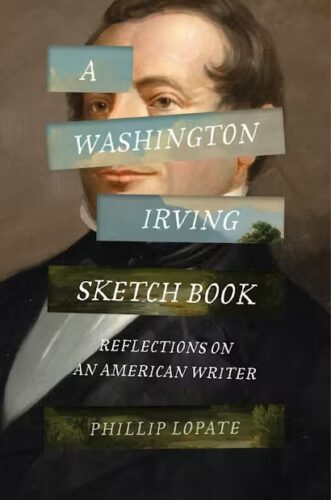
In his sympathetic, if insufficiently critical, case for looking beyond Washington Irving’s canonical tales, Phillip Lopate argues that the man many consider America’s first professional author deserves to be read for more than “Rip Van Winkle” and “The Legend of Sleepy Hollow.” A Washington Irving Sketch Book charts the career ups and downs of a successful writer who emerges as an urbane, resourceful, politically connected company man: an admired author on both sides of the Atlantic, whose prose was smoothly polished; whose satire was more pleasing than biting; and whose biographies — of Christopher Columbus and George Washington, among others — were diligently researched efforts by a skilled storyteller.
Aside from a fizzle of a chapter in which he visits places where Irving lived in New York City, Lopate proceeds with bullish lucidity through Irving’s oeuvre — aside from panning Bracebridge Hall (1822) — and his modestly lucrative career. It is downright refreshing, then, when he quotes a snapback from William Hazlitt: “Mr. Irving’s writings are literary anachronisms.” Lopate raises salient points from Irving’s detractors, including reservations expressed by his major biographer, only late in the volume.
The last Irving work I read was A Tour on the Prairies (1835), decades ago —a travel chronicle I recall as pleasant but antiseptic, hemmed in by the polite, idealized social assumptions of Irving’s class and background. The quotations Lopate offers from that book and others suggest that curious Americanists may have good reason to revisit Irving. I am less convinced that the rest of us need do so.
Irving is admired for his amiable sensibility. Open to the era’s sentimentality, he was alert to the risks of making waves and usually adept at avoiding them. Lopate, by contrast, dismisses James Fenimore Cooper as “a hater.” Cooper was certainly a vituperative man, and he could write clumsily. Mark Twain’s hilarious demolition of The Leatherstocking Tales remains devastating — yet it also testifies to Cooper’s stature. Twain considered him a sufficiently big target to fire at. The genial Irving was not worth the ammunition.
Cooper’s writings confront America’s class conflicts in a way Irving’s never does. Cooper raged from a conservative point of view, but Balzac did so too, from his own reactionary vantage. D. H. Lawrence admired The Deerslayer and defined Cooper’s prototypical frontiersman, Natty Bumppo, with incisive severity: “The essential American soul is hard, isolate, stoic, and a killer. It has never yet melted.” That judgment suggests what endures in Cooper’s imagination. The equitable Irving is of antiquarian interest; Cooper, for better and worse, remains our contemporary.
— Bill Marx
Jazz
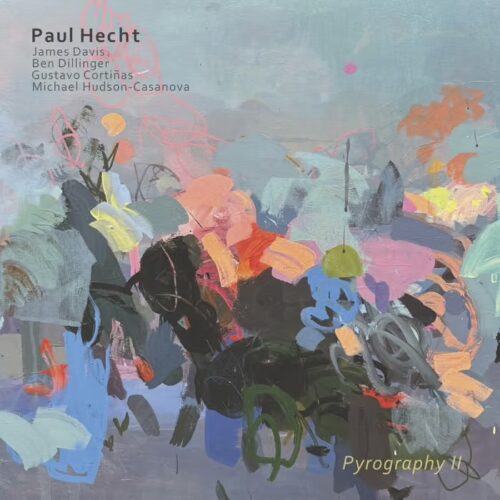 Pianist Paul Hecht studied with Yusef Lateef at Amherst, but he also has an MFA/PhD in poetry from Cornell. It’s not hard to hear long-form poetry in his compositions: sharp images fall into place within complex structures, and romantic lyricism reinforces the abstract narrative of what each piece and solo communicates.
Pyrography II is a follow-up to 2024’s Pyrography with the same working band of James Davis on trumpet, Michael Hudson-Casanova on alto sax, Gustavo Cortiñas on drums, and Ben Dillinger on bass. All but three of the 10 tracks are by Hecht. As beautiful as Hecht’s playing is — it’s in that spare, lyrical Bill Evans/Keith Jarrett style — it’s trumpeter James Davis who carries the album, is featured on every track, and makes the strongest impression.
The lesser-heard Rogers & Hart standard “My Chromatic Romance” is a good place to hear everyone’s strengths. Davis has a warm, middle-register sound, perhaps influenced by Dave Douglas but with a richer tone. Hecht is unobtrusively supportive. The tempo ebbs and flows, sometimes disappearing entirely, with the gravity of the tides coming from Cortiñas on drums.
Other tracks are more conventional and stay in their post-bop groove. “Like Someone in Love” is even a straight-down-the-middle swinger. More typical is Hecht’s knotty composition “Seriously,” with its appealing drive and forward momentum. The piece challenges the assumption that angular rhythms need to be associated with louder volumes, and the group improvises freely while the rhythms of the melody remain spying from the shadows.
Coltrane’s “Countdown” shows an interesting approach — the band lines out the chords with root notes first rather than going straight into the melody, as if to call attention to just how challenging these chords are going to be to solo over. There are overlapping statements from trumpet and alto, improvising together, with the famous melody sneaking up on them until they give into it in unison.
This is intelligent and original contemporary jazz from pros worth seeking out. And keep an eye out for that trumpeter James Davis, especially if you’re in Chicago, where he gigs often.
— Allen Michie
Alternative Music

Now 79, Haruomi Hosono has moved through numerous incarnations: folk-rock with Happy End; synth-pop as the bassist and keyboardist of the hugely influential Yellow Magic Orchestra; and soundtrack work, including music for Hirokazu Kore-eda’s Shoplifters. Before Light in the Attic began reissuing Hosono’s solo recordings, American listeners paid far more attention to his work with YMO than to his own albums.
Hosono has long cherished sounds that others might dismiss as kitsch. In 1984, he produced an album that incorporated music from Namco arcade games, including Pac-Man, Xevious, Dig Dug, Galaga, Mappy, Bosconian, and Pole Position. Other work from that period developed his idiosyncratic version of “world music,” freely combining styles from across the globe.
His latest album, Yours Sincerely (Ghostly International), is immediately welcoming. Its music is warm and unforced, as if one were hearing Hosono play in a small café. Acoustic instruments dominate: guitar and marimba sit at the record’s center. The songs yearn for a healthier relationship with nature, imagined as benevolent and maternal. That nurturing impulse can also be metaphorical: on “Note of Mothership,” children sing, “We are mothers.”
Yours Sincerely draws its textures from the routines of ordinary life. “Rojiura (Walking Vibration)” follows the rhythm of an extended stroll, with stone flute, handclaps, and castanets evoking the pitter-patter of footsteps. The 90-second “To a Wild Life” features a girl declaring, “I want to live in a beautiful world,” while Hosono hums Franz Liszt’s “Liebestraum.” “Figlio Perduto” interpolates motifs from the second movement of Beethoven’s Seventh Symphony. On “Sincerely,” Hosono turns toward bossa nova; “Ayurveda” might find a spiritual home in a French cabaret. The album closes with the silent-film organ of “Anemo Wheel,” a sonic accompaniment to the record’s imagined end credits.
Rather than dwell on humanity’s ongoing destruction of the planet, Hosono offers constructive ways of imagining a different future. It is a peaceful, affirmative vision — one that leads by example.
— Steve Erickson
Classical Music
 There aren’t many happy musical developments to have emerged from the pandemic (does anyone recall those stitched-together Zoom concerts recorded to a click track fondly?). But at least a couple of decent individual works materialized from those difficult few years. Derek Bermel’s Spring Cadenzas (Orchid) is one of them.
Written for the violinist Midori in 2021, the score was originally intended for remote performance between the violinist and youth orchestras. Since then, it’s been presented live and now has got its debut recording, in which the Japanese virtuosa teams up with a couple of notable local groups, A Far Cry and Project STEP.
Cadenzas is organized around a series of solo violin episodes that seemingly appear out of the ether and, just as quickly, dissolve back into it; blink, for a couple of them, and they’ve disappeared. The writing runs a gamut of virtuosic devices that showcases Midori’s craft but never loses track of its first purpose to develop a meaningful (and rather hopeful) conversation between soloist and ensemble.
The latter’s contributions are similarly broad, sometimes taking the thematic lead, at others offering commentary on the cadenzas or conjuring atmosphere. Across it all, the musical content is idiomatic and appealingly self-contained. At just about 15 minutes, Spring Cadenzas is also a bit short, and one can easily imagine Bermel pulling a Schumann by adding a couple of movements to make it the first section of a full-blown concerto.
Be that as it may, this recording is invigorating. The Criers and Project STEP players anchor the proceedings with color and vim — the shapely, shivering textures in Cadenzas’ “wake, butterfly” section are particularly well done — while Midori’s playing remains a model of style and taste. She navigates Bermel’s often involved writing with impressive ease and an inviting sense of direction.
— Jonathan Blumhofer
Tagged: "Crossing The Wine-Dark Sea", "Pyrography II", "The Letters of Robert Frost Volume 4", "What Architecture Is", Emily Wilson, Haruomi Hosono, Paul Hecht, Robert Frost, Witold Rybczynski