Opera Album Review: Stenhammar’s “Tirfing” Emerges as a Scandinavian Wagnerian Treasure
By Ralph P. Locke
Arnold Östman’s first complete recording makes a powerful case for Wilhelm Stenhammar’s long-neglected Norse opera—despite the intrusive directorial alterations preserved from Malmö Opera’s 2011 staging.
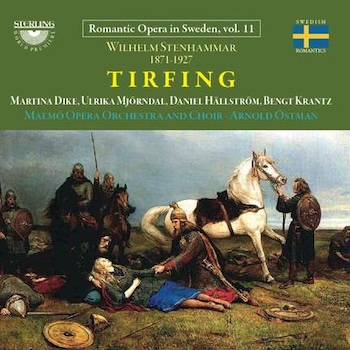
Tirfing, Wilhelm Stenhammar
Martina Dike (Hervor, disguised as Hervardur), Ulrika Mjörndal (Gullväg), Daniel Hällström (Shepherd and Vidar), Bengt Krantz (King Angantyr and King Gudmundur), Jakob Högström (Bard).
Malmö Opera Orchestra and Choir, cond. Arnold Östman
Sterling 1134-5 [2 CDs] 128 minutes.
Click here to order or to try any track.
 The renowned conductor Arnold Östman has presided over some famous Mozart-opera recordings that tried to bring back elements of 18th-century performance practice. Here, however, in a recording from 2011 (made available on disc for the first time), he brings us a major work by Wilhelm Stenhammar (1871-1927), a Swedish composer roughly contemporary with Sibelius and Nielsen. It’s Tirfing, an opera named after a legendary Norse sword (though the name looks like an English gerund, analogous to, say, shopping or eating).
Stenhammar is appreciated today for his string quartets, piano sonatas, concertos, symphonies, choral works, and songs, works that have been recorded in recent years, sometimes more than once. But his two operas are much less known or even written about. Stenhammar was a major pianist, renowned for his Beethoven, and his music has been compared to that of Brahms, Wagner, and Bruckner, with, some feel, touches of local Scandinavian color. In this, his second and last opera, he sounds—to my ear—like dozens of different composers from one scene or even moment to another. This may be thought a disadvantage, given our tendency to want to define the stylistic fingerprint of a composer. But it can also work wonders, as it often does in this case, allowing each character, each scene, and each situation to have its own particular stamp or expressive quality.
If one reads the libretto, which makes frequent use of alliteration, one expects a fully Wagnerian epic here. The plot derives from a Norse saga, and certain names are mentioned that will sound familiar to people who know Wagner’s Ring Cycle (Nifelheim, for example, and a certain Mimer, whose sons are here said to have forged the opera’s titular sword).
But the characters are all different from those in the Ring, because this libretto—by a female visual artist and sometime author, Anna Boberg, who also designed the original costumes and sets for the opera’s 1898 premiere—tells the story of a brave warrior-woman named Hervor, who dons male disguise (as Hervardur) and goes off to fight on behalf of King Gudmundur. The disguise is required by her (dead) father, in exchange for granting her permission to lay hold of his powerful sword, Tirfing. (All of this takes place in the half-hour-long “Prologue.” The rest of the work consists of two full acts, plus a 12-minute “Epilogue.”)
Hervor/Hervardur develops amorous feelings for the king’s son Vidar, but the daughter, Gullväg, is, alas, smitten with Hervardur (not realizing that “he” is a woman). The king poses a riddle to the three Viking warriors, all of whom are seeking Gullväg’s hand in marriage. They fail, but Hervor/Hervardur manages to solve the riddles, yet she declines (for reasons that she cannot reveal) to wed Gullväg.
Vidar, furious at this insult to his sister, challenges the warrior to a duel. Hervor/Hervardur kills Vidar with the invincible sword Tirfing. But Tirfing also carries a curse: the person who slays with it must likewise die. Hervor now reveals her true identity to Gullväg, then (in the Epilogue) brings the magical weapon back to Angantyr’s grave and there laments and dies.
In some ways, Stenhammar’s music does resemble that of Wagner. There are a dozen or more distinctive themes and short motives that recur in different scenes, mostly in the orchestra, while the voices declaim more freely above them. Some of these themes and motives have a clear “named” referent; others (such as a processional-like passage for winds and brass) seem to be extensions of the general mood or action at the moment.
There are passages that recall a specific memorable bit in Wagner, such as the “Magic Fire” music in Die Walküre or Erda rising out of the ground near the end of Das Rheingold. There are also stretches of music that meditate on a chord (in a way analogous to the opening of Das Rheingold) or that rock back and forth between two chords. In stretches that have a slow harmonic rhythm, the music is often activated by vivid or even slashing figurations in the string sections.
But the music moves and shifts much more quickly than it tends to in Wagner operas. The very opening of the work lets us hear an English horn piping a folklike improvisation, which is immediately interrupted by a passionate, downward-thrusting passage for full orchestra, with syncopated rhythms that might have come from a Rachmaninov orchestral work. This passage is followed by an evocative ballad sung by the opera’s main character, Hervor, who is looking for her father’s grave so she can find his powerful sword.
Elsewhere there is an agitated, repeated, four-note descending scalar motive, and, when riddles are mentioned, an eerie motive consisting of three slow two-note chords (in the bassoons) that seem to form a purposely puzzling major-minor “set.” (These mystically hovering thirds reminded me of some moments in Messiaen’s colorful “Turangalîla” Symphony, 1946-48.)
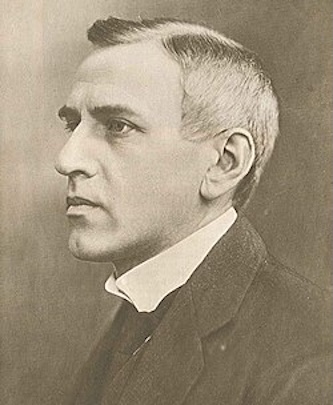
The composer Wilhelm Stenhammar (1871-1927). Photo: Wikimedia
There are moments that evoke, say, Berlioz (for example, a single chord repeated rapidly in the woodwinds to build tension). And Act 1 (that is, the act after the wonderful, involving Prologue) includes a gorgeous folklike chorus (in duple meter) for Gullväg and her female attendants; plus, soon after, a quicker ballad (in 6/8 meter) in which Vidar tries to cheer his sister up and interest her in his heroic and remarkably attractive friend, whose name he is not yet revealing (and whose real sexual identity, as I said, he does not know).
In general, the vocal lines are very singable, not wildly leaping about, and they seem to set the Swedish text quite naturally, allowing me to catch many words that resemble ones in German or English: “jungfrun” is “maiden,” “ringen” is a “ring,” “lilla syster” is “little sister,” and “Fader vak upp!” is, yes, “Father, wake up!”
The booklet includes a brief, clear synopsis; the libretto (in the modernized and at times rewritten Swedish version used in the production, plus a clumsy but largely comprehensible English translation); a first-rate essay by musicologist Anders Wiklund (who edited the score) about the work’s successful original production in 1898; and a separate essay (in particularly lumpish English) by Per-Erik Öhrn, the stage director of the 2011 production in Malmö. The recording was made during one performance of that production (October 15, 2011).
Öhrn explains various of his alterations and additions. For example, he preceded the work with a wordless scene in which Hervor is gang-raped. (The recording captures footsteps and frantic grunting, plus a low-pitched electronic background noise.) This dumbshow, entirely invented by Öhrn, provides, he posits, “an explanation to the desire [of Hervor] for revenge … and [her] unwavering demands for respect and justice.”
The production also brought onto the stage an actress silently portraying the opera’s librettist, Anna Boberg, and showed her completing a painting about the opera’s story. For some reason, an actor dressed as Boberg’s husband (an architect) made a similarly silent appearance with her. Such are the habits of our own day: the production team must intervene maximally, adding layer upon unnecessary layer to an already-unfamiliar work, thus confusing the audience but drawing attention to the genius of the stage director.
Worse, a description of the mimed gang-rape of Hervor has been included in the first stage direction in the booklet, as if it were something that Boberg herself intended. This is unworthy of Sterling, the otherwise splendid recording company that has brought so many Scandinavian and other forgotten operas to the attention of the musical world. (See my praise for Per August Ölander’s 4-act opera Blenda and my even more emphatic welcome of Swiss-born Joachim Raff’s superb, autumnal comic opera Benedetto Marcello.)
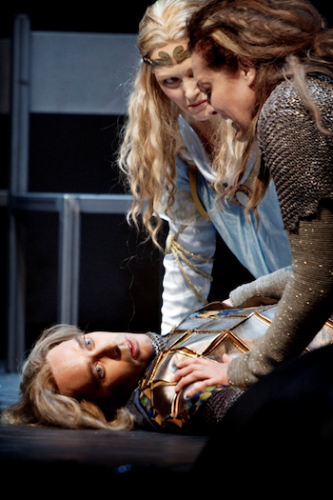
Hervor/Hervardur (Martina Dike, foreground) and Gullväg (Ulrika Mjörndal, rear), stunned at the murder of Vidal (Daniel Hallström). Photo: Malin Arnesson
To these anachronistic accretions one must add the director’s claim that Vidar’s friendship with Hervardur is one of the plot’s several “queer elements” that caused the work to be “viewed with consternation by some reviewers.” I would believe this more if he cited one such objection. After all, artistic genres have their distinctive norms: operagoers and music critics were long accustomed to the practice of a female character taking male disguise, as in Beethoven’s Fidelio, or, indeed, a female singer playing a male role, such as Mozart’s Cherubino, Strauss’s Oktavian, and (to take an instance from an opera that is in no way comical) Arsace in Rossini’s Semiramide.
Back to Stenhammar’s wonderful contribution here! I rarely tired or grew impatient listening to this work, and I often found myself wondering how such beautiful and alertly varied music has escaped me for so long. The least persuasive section, I’d say, is the second act, with the three suitors and three riddles. This scene, written as somewhat comical, goes on a long time, as does a song for the Bard (with excessive repetitions of a few by-then-familiar orchestral motives) earlier in the same act. Puccini handled a riddle scene (though with only one suitor) far more grippingly in Turandot.
Since I mentioned Puccini, I should add that Tirfing often did remind me of that composer—not in musical style, but because, like, say, La Boheme, it can be enjoyed uninterruptedly regardless of whether one understands the words or has even looked at a plot summary. Wagner, at his best, achieved something similar, but of course on a vaster time scale—and he did not always avoid the trap of having to fill out long passages with workable music (using motives he had already presented) because his libretto demanded that they be there (and, in the case of the Ring, the libretto was already published).
The main roles are for a mezzo (Hervor/Hervardur), a soprano (Gullväg), and various baritones and basses; there is no main tenor. The singers all sound healthy—no wobbling—and are word-aware but don’t resort to shouting. Vidar (Hällström) is sung with unvarying affect—he surely should show more tenderness toward his male/female buddy. And the Bard’s thin, reedy voice (Högström) added to my impatience with his “harp”-accompanied song in Act 2. But the chorus and orchestra sound fine throughout, as one would expect in Sweden, and are miked (are we now supposed to write “mic-ed”?) as well as can be expected in a recording made from a staged performance.
Sterling previously released a recording of excerpts from Tirfing (c. 2000), with three stellar singers (Ingrid Tobiasson, Carina Morling, Jesper Taube) and a conductor (Leif Segerstam) who is sometimes more passionate than Östman. That recording was made in the studio, and the orchestral sound is richer than here. (It’s on YouTube and other streaming services.) But only half of the opera is represented, mainly through long sections for one or another of the main characters, thus giving little sense of the fascinating interactions between Vidar, Hervor/Hervardur, and Gullväg that stand at the work’s core, and no sense at all of the communal life surrounding them.
The new recording makes a stronger case for Stenhammar’s important work, which I hope will soon get the sensible staging that it deserves, a staging that will be captured on video for the sake of opera lovers around the world. In the meantime, if you want to get a sense of this opera, there’s a video of the Malmö production on YouTube, from a TV broadcast. The video is posted as three separate files, ending, respectively, “del” (part) 1, 2, and 3. But you may prefer to listen and not watch, so as not to be distracted by the directorial (dictatorial?) shenanigans.
I should add that the half-hour-long Prologue is relatively self-contained and would make a wonderful one-act opera on its own. It would even come across well if performed unstaged and without costumes, as has been done rather often with Act 1 of Die Walküre. Like that Wagner act, it requires only three characters.
The British musicologist Hugh Macdonald has completed a life-and-works study, the first-ever in English, on Stenhammar, to be published soon by Boydell Press. I thank him for sharing with me his wonderful Tirfing chapter, which is rich in musicodramatic insights.
Ralph P. Locke is emeritus professor of musicology at the University of Rochester’s Eastman School of Music and Senior Editor of the Eastman Studies in Music book series (University of Rochester Press), which has published over 200 titles over the past 30 years. Six of his articles have won the ASCAP-Deems Taylor Award for excellence in writing about music. His most recent two books are Musical Exoticism: Images and Reflections and Music and the Exotic from the Renaissance to Mozart (both Cambridge University Press). Both are now available in paperback; the second, also as an e-book. Locke also contributes to American Record Guide and to the online arts-magazines New York Arts, Opera Today, The Boston Musical Intelligencer, and Classical Voice North America (the journal of the Music Critics Association of North America). His articles have appeared in major scholarly journals, in Oxford Music Online (Grove Dictionary), and in the program books of major opera houses such as Santa Fe (New Mexico), Wexford (Ireland), Glyndebourne, Covent Garden, and the Bavarian State Opera (Munich).
Tagged: "Tirfing", Arnold Östman, Malmö Opera Orchestra and Choir, Sterling