Classical Music Album: Radius Ensemble’s Spirited “Carnival”
By Jonathan Blumhofer
On its lively new recording, the Boston chamber group gives buoyant, colorful, and sharply characterized performances of three works by a longtime MIT composer.
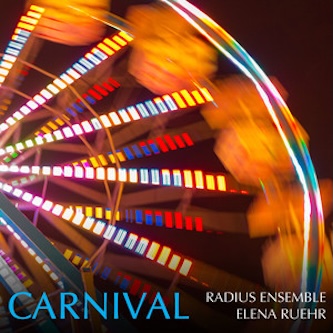 Though it’s short, Radius Ensemble’s recent album Carnival is well-named: this collection of chamber works by Elena Ruehr is a blast.
That probably shouldn’t come as a surprise. Ruehr has been a fixture in Boston musical circles for a long time now, having recently retired following a 35-year teaching stint at MIT. Her music is consistently well-written and agreeable, facts that emerge with abundant clarity across all three works featured on the present release.
The title track, a woodwind quintet written for Radius and premiered by them in 2025, is a case in point. Drawing on formative childhood memories of a traveling show that came once a year to the composer’s town in rural Michigan, its three movements are each broadly evocative and idiomatic.
“Whirligig’s” swirling, vigorous figurations recall (fleetingly, at least) Petrushka, though the larger impression suggests the quintet playfully dancing with itself. Throughout, there are inviting tonal and instrumental combinations—the writing for flute and bassoon in octaves comes out particularly strongly—and the sense of joy that permeates the music is completely unfeigned.
A kaleidoscopic grasp of color marks the central “Haunted House,” with its mischievously eerie melodic lines unfolding over an ostinato. Meantime, “Ferris Wheel with Fireworks and Stars” delivers closing thoughts that are, on the main, more reflective than explosive.
Ruehr’s trio, Walk Through a Strange Landscape, takes as its instrumental model Charles Martin Loeffler’s Two Rhapsodies. The peculiar scoring—oboe, viola, and piano—crafts a landscape of its own and, though the musical content doesn’t quite live up to the title, it at least offers some vistas of real interest.
There’s a bit more acid in Walk than in Carnival, and this provides the score with a measure of its structure. Basically, two types of music—one motoric, the other lyrical—alternate; the latter, a bit more chromatic than not, periodically becomes texturally leaner as the journey proceeds. Throughout, Ruehr’s writing is highly conversational. Radius oboist Jennifer Montbach and violist Noriko Futagami navigate their parts with conspicuous élan, while pianist Sarah Bob makes invigorating work of the keyboard’s boogie-ish riffs.
The album is anchored by Broadway Boogie Woogie, Ruehr’s 2023 commission for Radius’s full complement. Inspired by Piet Mondrian’s eponymous painting, this is a work that traffics in a pert, whimsical vein that the composer does very well.
Its opening movement is snappy and energetic—there’s an impish edge to Radius’s playing that means even the music’s feints at slowing down are infused with energy. “Ghost Song,” on the other hand, provides a moment of respite, with Montbach’s dulcet solos leading the way through Ruehr’s touchingly crafted woodwind writing.
The last two parts return to a sassier disposition. “Blue Rag” seems to make a couple of sly nods to William Bolcom (he was one of Ruehr’s teachers), while the closing “Tiny Parade” suggests a mashup of the Radetzky March with Ibert. All in all, it’s a fresh affair that rewards repeated listening.
Unique among the album’s program, Broadway Boogie Woogie was taped live, and the audience’s enthusiastic response can be read as an endorsement of the larger recording. Extraneous noise in that one is at a minimum—and completely absent from the other items, which were recorded in beautifully robust, balanced sound at WGBH’s Fraser Studios.
Jonathan Blumhofer is a composer and violist who has been active in the greater Boston area since 2004. His music has received numerous awards and been performed by various ensembles, including the American Composers Orchestra, Kiev Philharmonic, Camerata Chicago, Xanthos Ensemble, and Juventas New Music Group. Since receiving his doctorate from Boston University in 2010, Jon has taught at Clark University, Worcester Polytechnic Institute, and online for the University of Phoenix, in addition to writing music criticism for the Worcester Telegram & Gazette.