Book Review: “Bad Energy” Makes a Forceful Case Against Green Capitalism
By Ed Meek
Joshua Frank offers an incisive account of the environmental and human costs of “green” development — even if his sweeping skepticism leaves readers wondering what practical climate action should look like.
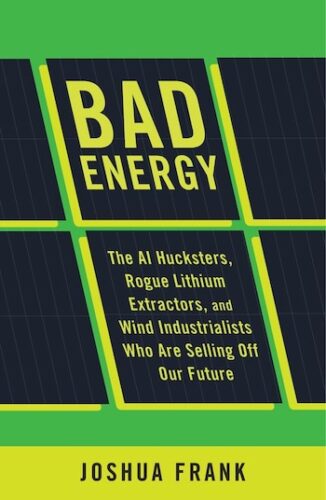
Bad Energy: The AI Hucksters, Rogue Lithium Extractors, and Wind Industrialists Who Are Selling Off Our Future by Joshua Frank. Haymarket Books, 296 pp., $19.95.
One complication in the fight against climate change is the movement’s internal fractiousness. Dealing with the degradation of the global environment is complex. There are groups like the Sierra Club that focus on nature, rain forests, and rewilding, while organizations, the World Wildlife Fund among them, prioritize animals, birds, whales, fish, and coral reefs. Indigenous people and their allies want to preserve sacred grounds, tribal lands, and natural habitats. High-powered engineers (and their tech-bro sponsors) insist that the climate crisis is an energy problem that can be solved with the right technology. There are anti-nuclear groups and anti-ocean-turbine groups. The internecine battling might even be worse than what’s going on in the Democratic Party.
Scientist Saul Griffith says all we need to do is electrify. Bill McKibben, the eternal optimist behind 350.org, argues that we need to transition to green energy and that, with popularist political will, it still can be done. Andreas Malm and Wim Carton, in The Long Heat and Overshoot, say we must focus on mitigation because there is not much else we can do at this point. Naomi Klein claims that capitalism is at the root of the problem; we must scale back our consumer-or-bust lifestyles. Kōhei Saito and others advocate for “degrowth” because, they insist, economic growth without reasonable limits is unsustainable.
In Bad Energy, Frank devotes a chapter to various aspects of the climate-crisis movement: precious metals, solar farms, wind turbines, water resources, nuclear power, and the oceans. Frank claims that Trump, Big Oil, and AI companies are intent on exploiting the green-energy moment as a way to profit from mining precious metals — such as lithium and copper — which are essential to make electric vehicles, batteries, wind turbines, and solar panels. The results of this greed-driven strategy include open-pit mines that not only ruin beautiful areas but exploit Indigenous workers in Africa, the American Southwest, Bolivia, and elsewhere. Frank also opposes solar farms, which harm an area’s biodiversity and encroach on Indigenous sacred grounds.
This stance, while principled, paints Frank into a corner. He will accept solar panels, the fastest-growing source of energy in the world, but only if they are installed on big-box stores and people’s houses. That said, he might have a problem when the panels have to be replaced and thrown away.
Frank argues that Trump’s interest in Greenland is about claiming the precious metals there. But Trump also wants to dominate the Western Hemisphere, which means controlling the country’s trade routes and military presence to counter Russia and China. And why not, once the climate warms, make money from all the spanking new breach front real estate? Trump calls green energy a scam, but he obviously believes in the climate crisis. His focus on fossil fuels is all about making money from the earth’s misery.
Bad Energy often appears to argue against green energy, dismissing EVs as an elitist non-solution that’s powered by lithium. “Yes, we can still prevent the apocalypse, but we’ll never do so by driving a Tesla.” Well, no, but transportation is responsible for about 25 percent of global warming. Combustion engines are terribly inefficient, sending 75 percent of the energy gasoline generates into the air, whereas EVs convert roughly 90 percent of electrical current into power for a car. Electric cars are a first step; eventually, all transportation can be electrified. Although lithium batteries are not ideal, they will likely be replaced by solid-state batteries in the next few years.
A chapter on water resources and dams delves into the growing problem of water scarcity. “More than half of the world’s rivers and two-thirds of its lakes are drying up. …” As a result, governments are turning to dams to capture the water they need to serve the public. In addition, the Intergovernmental Panel on Climate Change recommends dams as a source of hydroelectricity. Yes, but water is being vaporized by increased global warming. On top of that, dams are also causing conflicts between countries and displacing local peoples.
Frank is also skeptical about nuclear power. Can we really trust the superrich behind it? And mining the oceans for precious metals wrecks their ecosystems.
Bad Energy is very well researched. The strength of this book lies in how well it states what is wrong with our current approaches. Frank backs up his claims for the harms being done and those to come. But he is a little fuzzy on where we go from here: how can we prevent an ongoing environmental meltdown that is only going to become increasingly worse in the decades to come. One implied thesis of Bad Energy: we need public regulation of the transition to green energy. We cannot rely on Big Oil or corrupt politicians like Trump to confront the problem — they are only interested in self-enrichment.
Frank has aligned himself with those who oppose capitalism and and respect the rights of Indigenous people. He would agree with Henry David Thoreau, who preaches that we must “Simplify! Simplify! Simplify!” Frank’s skepticism also resonates with the suspicion of futuristic schemes in Elizabeth Kolbert’s Under a White Sky, which exposes the unintended consequences of some proposed high-tech climate interventions, especially those proposed by scientists funded by giant banks and their billionaire clients. Her title refers to a plan for launching particles into the air to block the sun, which would purportedly mitigate global warming. What could go wrong?
Frank would also find common ground with Vaclav Smil, who explains in How the World Really Works just how convoluted the climate crisis is, given our extensive dependence on fossil fuels. Bad Energy does not have fixes for the problems he identifies, but he gives the reader plenty to think about as we nonchalantly accept the destabilization of our world’s fragile ecosystems.
Ed Meek is the author of High Tide (poems) and Luck (short stories).