Classical Album Review: Duo Gazzana plays Prokofiev, Pärt, and Schnittke with Bracing Insight
By Jonathan Blumhofer
The sisters’ new ECM recording catches the volatile interplay of lyricism and menace in a compellingly programmed set.
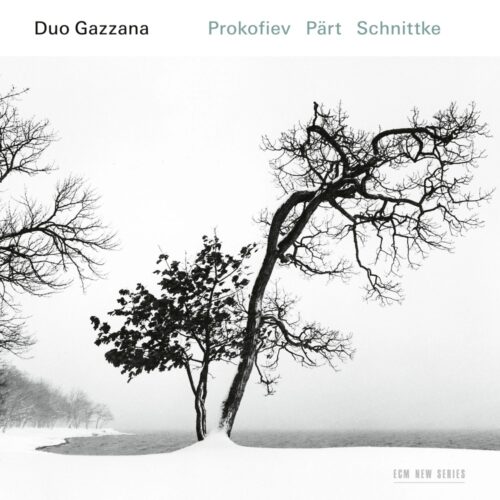 The image of the artist as dissident is understandably alluring. When done right, too, the concept can lead to revealing programming. That’s just what Duo Gazzana manages in their latest recording for ECM New Series, which pairs music by Sergei Prokofiev with shorter but hardly insubstantial filler by Arvo Pärt and Alfred Schnittke.
Prokofiev’s Violin Sonata No. 1 dates from one of the darkest eras of Soviet history. Begun in 1938 it wasn’t completed until ’46, after which the work netted its composer a Stalin Prize. The last is an ironic little footnote for a score that doesn’t always seem to toe the Social Realist line: Prokofiev described the slithery violin scales in the outer movements as depicting wind whistling through a graveyard and the Allegro brusco’s attacks are almost unrelentingly crunchy.
The Duo—comprised of sisters Natascia (violin) and Raffaella (piano) Gazzana—takes a decidedly vigorous approach to the last, which has the effect of emphasizing the fleeting sense of refuge that section’s shorter, lyrical turns possess. Similarly, their navigation of the finale’s exuberant opening culminates later on in a wild breakdown of the music’s interrelated themes and motives.
Their interpretation is likewise well attuned to the sonata’s shifting levels of intensity. The Andante assai’s quiet textures (including, but not limited to, those ghostly violin runs) are absorbing, while the finale’s coda unfolds with haunting, prayerful focus. In the midst of the score’s tumult comes a reading of the luminous Andante that is as delicate, tender, and vulnerable as the second movement is iron-clad.
The cumulative result is aptly striking: this may not be music of overt protest, but the Duo’s performance limns a world of emotional and expressive complexity that mere slogans don’t often capture. Theirs is a thoughtful, intelligent take on a piece that amply rewards such an approach—and an unsettling reminder that the line between beauty and horror, excitement and terror, wit and violence is closer than we might think.
Prokofiev’s Five Melodies deliver somewhat more of the same, at least in terms of sweeping lyricism holding its own against countervailing musical forces. The Lento’s contrast between the violin’s pure melodic line floating over the keyboard’s rockier figurations emerges strongly. So do the crisp articulations in the middle section of the finale.
Still, the Melodies aren’t exactly a model of musical resistance (among other things, Prokofiev composed them while on a tour in California). Pärt’s Spiegel im Spiegel, on the other hand, comes closer to fitting that bill.
Born in Estonia, the composer’s early progressivism and open avowals of religious faith put him at odds with Soviet authorities. A creative crisis and deepening ties to Eastern Orthodox Christianity resulted in the development of his tintinnabular style, of which Spiegel im Spiegel is an early example. One of Pärt’s most performed works, it’s not hard to understand its appeal from the Duo’s reading, which is pure and pristine.
Like Pärt’s 1978 effort, Schnittke’s Gratulationsrondo delivers tunefulness and seeming harmonic simplicity with ease. Here, though, a bit more grit finds its way into the wheels, and that provides the score with a welcome measure of brashness. As in the Prokofiev selections, this is music in which the mood can turn on a dime, and part of its fascination (as well as charm) lies in how effectively the players straddle that short distance between light and shadow.
The Grazzanas manage the latter ably, in the process infusing Schnittke’s subversive voice with style and enduring resonance.
Jonathan Blumhofer is a composer and violist who has been active in the greater Boston area since 2004. His music has received numerous awards and been performed by various ensembles, including the American Composers Orchestra, Kiev Philharmonic, Camerata Chicago, Xanthos Ensemble, and Juventas New Music Group. Since receiving his doctorate from Boston University in 2010, Jon has taught at Clark University, Worcester Polytechnic Institute, and online for the University of Phoenix, in addition to writing music criticism for the Worcester Telegram & Gazette.
Tagged: Duo Gazzana, ECM New Series, Natascia Gazzana