Film Review: “Coyote vs. Acme” Gives Wile E. Coyote His Day in Court
By Betsy Sherman
This lively live-action/animation hybrid turns the Road Runner cartoons’ eternal loser into a surprisingly moving plaintiff—and takes sharp aim at corporate impunity along the way.
Coyote vs. Acme – Directed by Dave Green. Opens today at Coolidge Corner Theatre, Apple Cinemas Cambridge, Alamo Drafthouse Cinema Boston Seaport, AMC Boston Common 19, AMC Assembly Row 12, and others.
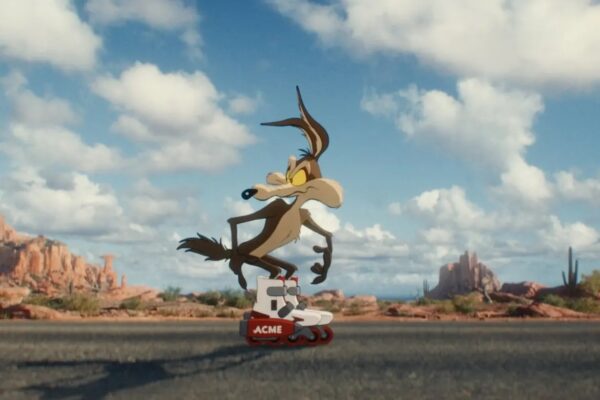
A scene with Wile E Coyote from Coyote vs. Acme. Photo: Ketchup Entertainment
One of the most elegant and recognizable settings in American cinema is the Southwestern desert landscape, bisected by a highway, in Warner Bros.’ Road Runner cartoons. Created by the great Chuck Jones in collaboration with writer/storyboard artist Michael Maltese, the ’toons were in production from 1949–63, as the interstate highway project rolled out across the United States. Its stars, the eponymous bird and Wile E. Coyote, the carnivore determined to catch and eat him, have lived on in Looney Tunes’ smaller-screen media and cinematic revivals. Their nonverbal chase scenario has universal appeal, given the fascinating codependence between the frustrated, foolhardy predator and the agile, insouciant prey, who never actually becomes prey.
There’s one written word that dominates the craggy landscape: “Acme,” the company from which Wile E. orders countless products with which he tries, and fails, to gain an advantage over his meal on wheels. The name has become associated with useless—and dangerous—consumer goods. This dynamic became fodder for New Yorker humorist Ian Frazier, whose 1990 piece Coyote v. Acme took the form of an attorney’s opening statement in a lawsuit against the Acme Company, seeking compensation for the personal injuries and mental suffering inflicted on his client, Mr. Coyote. The piece sparked interest in Tinseltown and, decades later, was expanded into a new Looney Tunes feature film.
In a year that’s already been pretty good for comedies, Coyote vs. Acme is a fun, clever outing that mixes slapstick antics with unexpectedly dramatic interludes. It’s family-friendly, with a bit of naughtiness—there’s a reference to Porky Pig’s proud pants-lessness—and chock-full of in-jokes for cartoonophiles. Briskly directed by Dave Green, the live-action/animation hybrid takes a swipe at corporate callousness. There’s no little irony in the fact that corporate giant Warner Bros. cut the film loose, only for it to be picked up by a smaller distributor. But more about that later.
The Road Runner is a foil to Wile E. Coyote rather than his enemy, and he is not often seen in the movie. The spotlight is on the fallible, delusional, oft-humiliated, eminently human Wile E. The filmmakers have composed, with affection and care, an integrated world of people, animals, and cartoons. Much of the animation was created through traditional, tangible processes, so the characters don’t have that inflated computer-graphics look. Hats off to animation supervisor Keith Roberts. The voice work was performed by established artists—Eric Bauza, Candi Milo, and Jim Cummings—who carry on the work of Warner Bros. cartoon originators such as Mel Blanc and June Foray.
Coyote vs. Acme opens with a tone of intrigue. In a corporate laboratory in the 1990s, a scientist who is a cartoon caricature of actor Peter Lorre is caught committing a transgression. Pursued by security guards—who are live actors—he falls, perhaps to his doom. The action switches to the present day, on the outskirts of Albuquerque, New Mexico. A full-course Road Runner–Coyote cartoon chase is served up. Things go awry for Wile E., despite—or because of—the Acme products he uses: defective rocket-powered skates and a magnetic glove. What’s new is that Acme has joined the military-industrial complex, with branded fighter planes.
Wile E. retreats to his lair. As he draws up the next day’s battle plans, he notices a TV commercial in which a human personal-injury lawyer tells a cartoon clientele that victims of defective products can receive damages. The coyote resolves that Acme has let him down for the last time. The law firm, by the way, is called Avery, Jones and Maltese—a tip of the hat to legendary cartoon director Tex Avery and the aforementioned Road Runner creators.
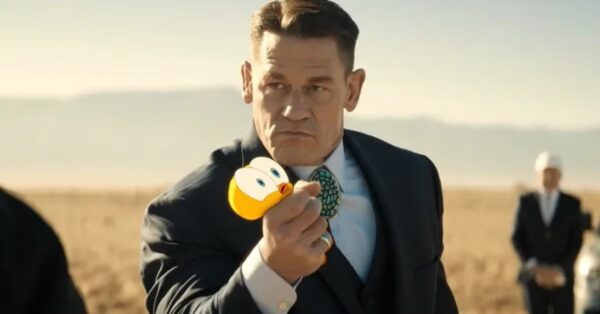
John Cena and Tweety Bird in a scene from Coyote vs. Acme. Photo: Ketchup Entertainment
Will Forte stars as Kevin Avery, the public face of a strip-mall law office. Lana Condor plays his niece, Paige Avery, who is interning at the firm before going to Oxford. The law student is ambitious and enthusiastic; those qualities have drained out of Kevin, who is sliding toward the demeanor of Tex Avery’s Droopy Dog. Professionally, Kevin aims low, securing small settlements for cartoon clients who have, for example, been crushed by wrecking balls. Wile E. arrives at the office, causing a hubbub. Non-speaking, he makes his points through the rapid-fire use of picket signs or, when action speaks louder than words, explosives. With some trepidation, Kevin agrees to take on what would be a groundbreaking lawsuit against Acme.
The conference at Acme headquarters, with a pop-culture figure entering the business world, is reminiscent of Barbie. The case brings Kevin face-to-face with a former law-school classmate who has hit the big time. Acme’s chief legal counsel, Buddy Crane, wears a snappy suit and a bolo tie so large that it must imply something. Massachusetts’ own John Cena gives a gem of a comic performance in the role. In the boardroom, Buddy, calling Kevin a “billboard lawyer,” offers a settlement that makes Kevin happy and Wile E. furious. The coyote sets the document on fire. See y’all in court.
The movie’s society is like our own, but with surreal, elastic boundaries. People seem familiar with cartoons’ physical properties, but there isn’t much socializing between humans and animated characters. “My clients go boom and two seconds later they’re fine. Nobody cares,” Kevin laments as he tries to maintain momentum for the suit. The courtroom scene gives a good sense of the community’s mix. Judge Troppogrosso (Luis Guzmán) is human, but he uses his cartoon gavel for this case. The jury is mostly human but includes the cartoon hen Miss Prissy, who finds the studly Buddy quite stimulating. Nevertheless, it’s hard to imagine cartoon justice going smoothly when the bench must contend with participants such as Wile E. and Acme executive the Tasmanian Devil. Disruption is in their nature.
Dr. Lorre is out of sight but not forgotten. Warner Bros. used Lorre’s likeness as a mad scientist in two ’40s cartoons. He was trying to blow the whistle on an outrage perpetrated by Acme. Now another mysterious figure is dropping clues. While Kevin is busy wrangling Wile E., Paige does some productive sleuthing. Looney Tunes/Merrie Melodies pals caught up in this web include Bugs Bunny, Daffy Duck—confined to a “rest home”—Tweety, Granny, Foghorn Leghorn—wouldn’t you know it, the bossy rooster is an Acme bigwig—and Senator Elmer Fudd, who holds a hearing on whether Acme products are a danger to society. Both Kevin and Buddy think the Road Runner’s testimony at the hearing—provided they can catch him and take him to D.C.—will favor their side.
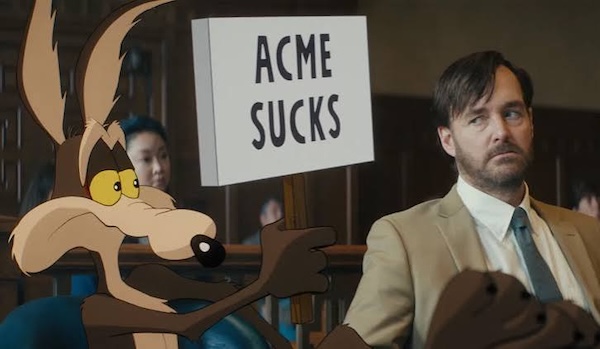
Wile E. Coyote and Will Forte in Coyote vs. Acme. Photo: Ketchup Entertainment
The acme—meaning the highest point of achievement or development—of Green’s film is its characterization of Wile E. Coyote. Canis latrans’s body, whether in short-lived bouts of confidence or mangled defeat, assumes forms familiar from the Jones years, while the nuances of his facial expressions, especially in his big yellow eyes, are fresh and impressive. No one hopes he will devour the Road Runner, but Wile E.’s self-imposed struggle evokes Sisyphus. As Wile E. and Kevin move from an attorney-client relationship to a friendship, the coyote reaches the end of his arsenal of signs: “Limited number of signs” means he cannot express his emotions. His vulnerability as he admits that downright put a lump in my throat.
We know that Will Forte can ace both comedy (SNL, etc.) and drama (Nebraska). His reactions to Wile E.’s impulses are priceless, and he makes Kevin—whose eyes are opened to the coyote’s virtues—a character to root for. Lana Condor’s Paige is sharp and sure-footed. The actual law-firm partners, Tone Bell as Sal Maltese and Martha Kelly as Dottie Jones, do not have much to do, although Kelly is always a welcome presence. And oh my God, John Cena’s dressing-down of Tweety—whom he has working for him under threats to a loved one—is jaw-droppingly funny and will surely make the actor’s highlights reel. Cena also delivers a key line while on the phone with the state’s governor: “The law is on our side, because we wrote the law.” How’s that for relevance to the real world?
If I may nerd out further: Seeing Foghorn Leghorn step before a U.S. Senate committee gave me a thrill, since the rooster’s voice and attitude were lifted from the Senator Beauregard Claghorn character, played by Kenny Delmar, in the Allen’s Alley bit on Fred Allen’s comedy radio show, launched in 1942.
Screenplay and screen-story credits go to Samy Burch (May December, Late Fame), with Jeremy Slater receiving co-screen-story credit. Those who follow the movie business may have seen the film’s title crop up over the past few years. The project passed through the hands of other screenwriters before Burch’s screenplay was shot in 2022. From there, the film languished on the shelf, as Warner Bros. considered deep-sixing it to claim a tax loss. After a strong outcry from industry insiders and fans, the studio let the filmmakers shop the film around. The release comes thanks to Ketchup Entertainment—talk about Sisyphean. That story is chronicled elsewhere. Now is the time to celebrate the theatrical release. See you at the movies!
Betsy Sherman has written about movies, old and new, for The Boston Globe, The Boston Phoenix, and The Improper Bostonian, among others. She holds a degree in archives management from Simmons Graduate School of Library and Information Science. When she grows up, she wants to be Barbara Stanwyck.
Tagged: "Coyote vs. Acme", Chuck-Jones, Dave Green, Foghorn Leghorn, John Cena, Wile E. Coyote