Book Review: “The Eighth Wonder” Traps a Drifting Man in a Dream of Doubt
By David Mehegan
In Vlady Kociancich’s newly translated Argentine novel, an indecisive Buenos Aires lawyer wanders through Berlin, cinema, erotic fantasy, and a reality that may be entirely of his own making.
The Eighth Wonder by Vlady Kociancich. Translated from the Spanish by Jessica Seqeuira. Seven Stories Press. 319 pp. Paper, $21.95
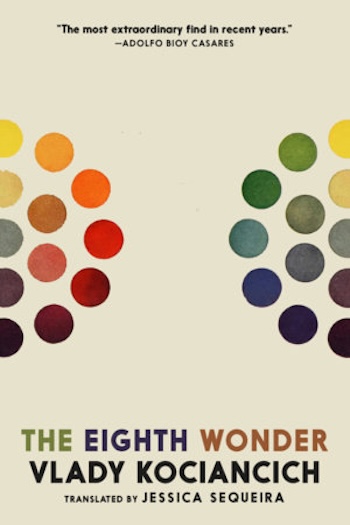
When a novel’s foreword pronounces a book “speculative fiction,” a “fantastic tale,” and a “hallucinatory book,” we know not to expect conventional storytelling, and our expectation is not disappointed in Vlady Kociancich’s The Eighth Wonder. What we do find is a masculine blend of beauty, poignant longing, and a dreamlike net of confusion and frustration.
Vlady Kociancich (1941-2022), was a late-blooming prolific member of the 20th-century Argentine literary constellation that also included Jorge Luis Borges, Julio Cortázar, and Adolfo Bioy Casares — that is, known to, but not much read by, monolingual Americans. Her first novel, The Eighth Wonder, published in 1982, now appears for the first time in English. Her second, The Last Days of William Shakespeare, a satirical romp about the 1976-1983 dictatorship of the generals, was translated in 1991.
Kociancich’s literary lineage is clear. Bioy Casares (1914-1999), who wrote the effusive foreword, was also a close friend and literary associate of Borges, the master of fantastical and philosophically intricate stories. Bioy Casares’s own books tended toward the fantastic and surrealistic. An unsigned about-the-author note in The Eighth Wonder tells us that “While Borges taught her to read, Bioy Casares taught her to write.”
Kociancich’s tale, set in the 1970s, is not overtly fantastic — no magic realism, talking animals or time travel, nothing physically impossible à la M.C. Escher — but it does meander back and forth along the frontier of reality and delusion, leaving the reader frequently confused but not to the point of throwing the book across the room. The question, “What is going on here?” is followed by curiosity as to what is going to happen next. Often I found myself asking, Is this happening or is the narrator imagining it? Is the whole thing an elaborate dream?
Alberto Paradella, the protagonist and narrator, is a 32-year-old lawyer in the Buenos Aires neighborhood of Villa del Parque whose life has fallen apart with the abandonment by his beautiful wife, Victoria. A thin character to begin with — she cheated on him with his best friend and others — Victoria seems no great loss. Still, Paradella’s life is shattered. He gets a newspaper job covering the tour business and heads to Berlin to cover a travel convention, the International Tourism Bourse of Berlin. While there, he meets another Argentinian, Juan Pablo Miller, who is making a documentary film about an obscure Nicaraguan indigenous poet, Francisco Uriaga, and persuades the reluctant Paradella to write the script. A year later, back in Villa del Parque, he is astounded to learn that the film has won an award at the Cannes Film Festival.
Paradella is a sort of Bartleby-the-Scrivener character; as to any proposed action, he “would prefer not to.” He does not want to be a lawyer, pretends to be a writer but does not actually write anything, and sets out to translate Joseph Conrad’s novel, The End of the Tether, into Spanish but can’t finish it. Before his marriage to Victoria, “I explained to her that even imagining a life of constant decisions gave me nausea and vertigo.… ‘I have a single ambition, Victoria. To say, like Ulysses, that my name is Nobody and begin with a happy ending. To never leave Ithaca, to save myself the battles and journeys.… Ithaca is Villa del Parque.’” Yet trying to avoid decision keeps him constantly busy. Despite his compulsive actions and observations, described in meticulous detail, the only thing Paradella accomplishes — if even that — is to write the Uriaga screenplay.
Among the many puzzles of this narrative is why such a film would be made in Germany, and why, though it wins an award, Paradella is not listed in the credits. It would take the rest of this review to name all the puzzling details and events of the novel. Did Paradella imagine this film? Indeed, there seems to be doubt whether Uriaga actually existed. This and other incidents provoke throughout the question of whether the described action really happened or is imagined by the narrator. Paradella sits down to write but we don’t see actually see him compose the screenplay, finish it, and hand it to the filmmaker. It is never described or quoted.

Argentinian author Vlady Kociancich. Photo: Alejandra López
Then there is the mysterious Alicia Martínez. Sometime after his divorce from Victoria, Paradella writes, “Just a few minutes ago, the girl who got off the train at Villa del Parque Station yesterday, as I was waiting there for devil knows what — not for her, of course, nor the train — appeared at my door. When I saw her, tall, naked, with long messy blonde hair, I was startled and shouted at her not to come in.” A naked woman standing outside his door? Was she naked in the train station? Why would he shout at her? He was waiting for “the devil knows what”? She does come in, says almost nothing, behaves as though the place were her own, and goes to take a shower and get dressed. In whose clothes? We never find out.
Alicia keeps popping up, briefly, in the story. She seems intent upon being a part of Paradella’s life, yet says and does almost nothing but stick close to him. She is naked most of the time. He tells us her name, but then, “I refuse to accept that she is named Alicia Martínez.” He is out in public with her, but no one else sees her. She is more like a mannequin than a person, or a figment of his imagination. Is he hallucinating? And if so, can we believe anything else that he reports?
When he gets to West Berlin (this is before the fall of the wall and reunification of the country) to cover the tourism convention, Paradella discovers that the elite Hotel Kempinski has failed to hold his reservation, but not to worry: the concierge sends him by taxi to an alternative lodging. It is the Freida Preutz Pension — apparently a brothel — and a bizarre and lurid scene follows in which he seems to spend a night with a pretty young woman. “Seems” because like so much in this tale, it is not entirely clear that he does so — there are vivid details but not much clarity. A realistic reader’s brain thinks, “Wait, a fancy Berlin hotel sends him to a shabby whorehouse? And he accepts it?”
The book includes a 14-page afterword by Sequeira, the translator, which is odd in its own way. It is more about the subject of translation than about Kociancich or her novel, but that might be key to the puzzle. Kociancich herself had translated Conrad’s End of the Tether into Spanish, and she also wrote for glossy travel magazines. About The Eighth Wonder, Sequeira quotes her from an interview: “I wanted to incorporate the idea that all of us live translating reality, translating other people, even if it’s never possible to know somebody completely.”
Sequeira also quotes Gabriela Damián Miravete, a critic who introduced a Mexican edition of The Eighth Wonder. Kociancich, Miravete wrote, “was interested in exploring the crevices that open every so often like tiny abysses in tangible reality, and are perceived by those alert to signs.… [She] read symbols, mythologies, and structures in the everyday as much as in literature.”
The Eighth Wonder — the title seems (that necessary word again) to refer to the cinema as seen in the Uriaga film — is executed in an exacting, intricate style, always in the confused and confusing voice of Alberto Paradella. You might as well not try to read it like a traditional novel. Let the confusion happen. You might not be wrong in seeing it as an elaborate dream from which the protagonist never awakes. As with the writing of Borges, you need not expect ever to “figure it out.”
David Mehegan is the former book editor of The Boston Globe.
Tagged: "The Eighth Wonder", Adolfo Bioy Casares, Jessica Sequeira, Seven Stories Press, Spanish fiction, Speculative fiction