Book Review: A Grand, Readable History of the Ottoman Empire
By Thomas Filbin
Carter Vaughn Findley’s Dreams of Empire charts the endurance, diversity, achievements, and eventual dissolution of a state that bound East and West for nearly six centuries.
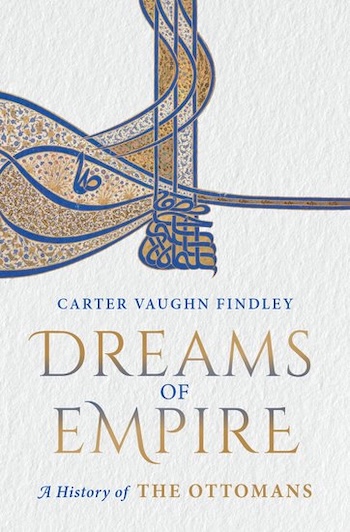
Dreams of Empire: A History of the Ottomans by Carter Vaughn Findley. Oxford University Press. 626 pp. $37.99.
A young friend of mine, quite skilled at interior design and knowledgeable about furnishings and fabrics, heard someone refer to the “Ottoman Empire” and asked, “They built a whole empire out of a piece of furniture?” The traces of empires can, once the sun has set, leave grotesque cultural remnants. The Ottomans, like the Romans and Egyptians, had their moment. Now historians are called upon to reflect on — and at times correct — the record.
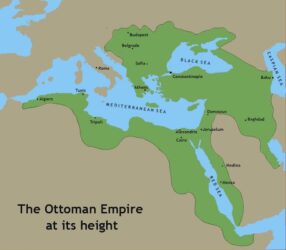
The Ottoman Empire (1350–1922) lasted longer than most, and it absorbed so many peoples, languages, and religions that it is amazing it did not break apart. One historian argued that flexibility, rather than rigid absolutism, was the key to its strength. At its height, the Ottoman Empire included eastern and western outposts, land- and sea-based economies, numerous nationalities and languages, and three religions that remain in conflict: Islam, Christianity, and Judaism. Holding together so many geographic, cultural, religious, and linguistic groups depended on adherence to a rigid formula: the sultan ruled, and all were required to obey his laws and pay his taxes. But if they did so, a group could observe its faith, within boundaries; work; prosper; and enjoy relative tranquility. Maybe what America needs today is a wise sultan rather than a clownish pretender.
Carter Vaughn Findley, a distinguished professor emeritus at Ohio State University who was educated at Harvard and Yale, has, at the age of 86, reached the pinnacle of a long career studying this part of the world, which straddles Asia and Europe. This, to my mind, is his masterpiece: the work of a lifetime, tracing the Ottoman Empire through all its dramatic iterations, from convulsions to achievements. It is a lengthy book that covers an enormous amount of territory, but that may be the only way to tell this story accurately. Readers must commit to understanding a wide and deep subject in full, not in flashes.
Findley argues that the Ottoman Empire’s dynamism grew from the intersection of three heritages: Anatolian, Islamic, and Turkish. He examines the complexity of a state that accumulated political, historical, economic, cultural, and ecological power as it expanded across a vast part of the world. Findley enriches familiar generalizations with telling specifics — for example, that Judaism and Christianity, which predated Islam in the region, remained significant throughout the empire’s history.
Some of the region’s power was initially rooted in agricultural prosperity: grain, grapes, and olives flourished there; deeply rooted crops could find water; and the climate was warm enough to sustain them even through winter. Pastoral nomadism came later, much of it originating in the steppes of Central Asia and soon adapted to the south and east. As cattle, goats, and sheep were domesticated, prosperity increased, while horse taming created a fighting force capable of domination and conquest. Fast-forward to 1300 CE, when the legendary ruler Osman laid the foundations of what we now know as Turkey. Findley spends much of his time on this period, charting how cultural transitions helped generate what eventually became the Ottoman state.
The interactions between East and West date from this time, as the Ottomans expanded their territory. Those between the Turks and the Greeks reach back to the medieval period. Gregory Palamas, the Greek archbishop of Thessalonica — Salonica to the Ottomans — was captured in 1354. He spent a year in captivity and later spoke unfavorably of his captors. Findley writes that Gregory painted a harsh picture of the conquerors, portraying them as “brutal, greedy for plunder and fanatical. They believe that God approves of their violence.” Gregory also condemned apostates who abandoned Christianity to join their new rulers’ religion. The conflict between Islam and Christianity has deep roots, and the discord is not only theological but tied to questions of governance, geography, empire, and material wealth. Plus ça change, plus c’est la même chose, as we see even seven centuries later
The sultans devised their own method of regnal succession: the eldest son was the heir. But because people often died young of disease or in battle, having multiple sons assured dynastic continuity. Of course, the new sultan would eliminate his brothers through fratricide or imprisonment, ensuring that no junior prince could consider displacing him. Life was cruel, but continuity was assured.
The expansion of the Ottoman Empire gained momentum in the 15th century. The conquest of Constantinople was the jewel in the crown. Several campaigns failed to take what remained of the Eastern Roman Empire, but its fall in 1453 — after Mehmet II arrived with a large army and naval force — toppled the last foothold of the West. Constantinople, which would become Istanbul, was chosen as the seat of the Ottoman Empire, strategically positioned at the junction of East and West.
The next two centuries found the Ottomans assuming the role of the “gunpowder empire,” seeking opportunities to expand even further. Hungary was the first European state to fall, but Ottoman eyes were set on the entire Habsburg Empire, which included Spain, Austria, the Low Countries, Burgundy, parts of Italy, and colonies in the Americas. The three-hundred-year conflict between the Ottomans and the Holy Roman Empire was not resolved until the West’s victory at Vienna in 1683. Many historians believe that, but for that victory, Europe could easily have become part of the Islamic world.
Findley’s work delves into the complexities of an empire that managed to combine myriad ethnic, religious, linguistic, and cultural dimensions. His account of Anthimos I (1717–1808), the Orthodox patriarch of Jerusalem, illustrates how such a diverse empire could accommodate so many differences. Anthimos was “born a Nestorian Christian in Iraq, … captured as a child by the Bedouin, later brought by Latin-rite Christians to Jerusalem, converted to the Orthodox Christian rite, and given a Greek education. He became known for his erudition and proficiency in Greek, Arabic, Turkish, and Persian.” Throughout this study, Findley demonstrates the unity that thrived amid diversity, a rambunctious synthesis that bound the Ottoman world together for the better part of a millennium.
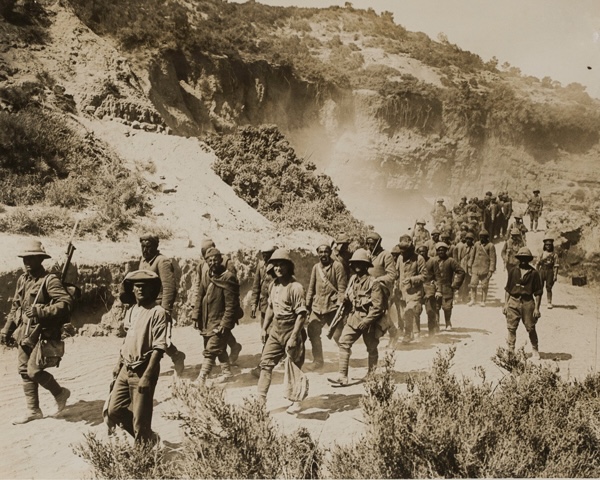
Turks captured during the Second Battle of Krithia, May 8, 1915. Photo: National Army Museum
Entering the modern era of the 19th and 20th centuries, Dreams of Empire details the economic, social, and cultural transformations that accompanied the empire’s transition into modernity. Commerce between East and West benefited both sides. In politics and culture, Turkey remained traditional and Islamic, but it was far from a backwater. Its industrial and financial muscle was on par with Europe’s, a reality that the latter rarely acknowledged.
The First World War awakened Europe to the strength of the Ottoman Empire. The Battle of Gallipoli was a humiliating defeat for the Allies. Eric Bogle’s song “And the Band Played Waltzing Matilda” evokes the eye-opening experience:
Johnny Turk, he was ready; he’d primed himself well,
He showered us with bullets and rained us with shells,
And in five minutes flat, he’d blown us all to hell,
Nearly blew us right back to Australia.
Modernity eventually brought an end to the Ottoman state. The Young Turk Revolution of 1908 set in motion changes that culminated in the empire’s collapse in 1922 and the establishment of a constitutional state. The whole world was in transformation before and after the First World War: Russia, Iran, Mexico, and China all went through gigantic upheavals during that period. That the Ottoman state lasted as long as it did, through its various iterations, was astonishing. But fact is fact: what state or empire has lasted forever?
Findley’s exhaustive narrative is scholarly yet accessible to nonspecialists. It also makes clear that the conflict between this region and the West — recurring in different forms for a millennium — remains no closer to resolution than it was in the era of the Crusades.
Thomas Filbin is a freelance book critic whose reviews have appeared in The New York Times Book Review, The Boston Sunday Globe, and The Hudson Review. His novella Carousels has just been published.