Film Review: “Teenage Sex and Death at Camp Miasma” — Slasher Summers, Reimagined
By Peg Aloi
Director Jane Schoenbrun’s seductive, funny, and unsettling meditation on horror, desire, and cinema turns summer-camp carnage into a tale of identity, intimacy, and renewal.
Teenage Sex and Death at Camp Miasma, directed by Jane Schoenbrun. Screening at Alamo Drafthouse Seaport, AMC Boston Common, AMC Causeway, AMC South Bay Center, Coolidge Corner Theatre in Brookline, and Landmark Kendall Square Cinema in Cambridge.
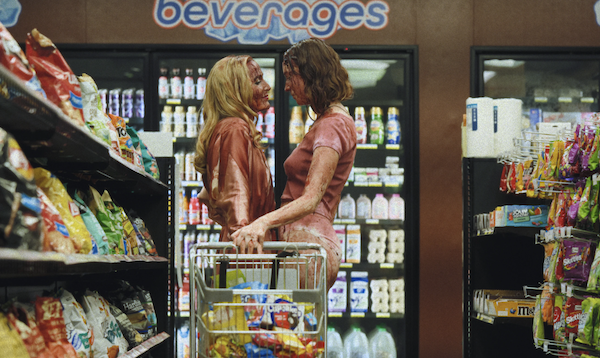
Gillian Anderson and Hannah Einbinder in Teenage Sex and Death at Camp Miasma. Photo: Ryan Plummer
Jane Schoenbrun burst onto the scene in 2021 with a low-budget indie film that deftly dramatized themes of isolation, digital community, and conspiracy-driven propaganda that many people could relate to at the time—and perhaps even more so now. In We’re All Going to the World’s Fair, Schoenbrun introduced a web-savvy young person who was part tech wizard and part mystic, crafting a compelling contemporary horror tale that was as topical as it was original. Their debut inspired widespread praise, including from renowned director Martin Scorsese. (Arts Fuse review) Next came I Saw the TV Glow in 2024, a haunting coming-of-age story exploring identity and trauma, tinged with nostalgia and steeped in fantastical imagery. (Arts Fuse review) Fans and critics alike speculated excitedly about what this gifted filmmaker would do next.
Their third film, Teenage Sex and Death at Camp Miasma—a clunky title that is nevertheless apt—delves confidently into the psychosexual implications of the slasher genre. In the hands of Schoenbrun, who is unapologetically nonbinary and transgender, the exploration feels deeply personal and widely relatable. Experimental filmmaker Kris (Hannah Einbinder, of Hacks) is preparing a pitch for producers who want to finance yet another sequel in the long-running Camp Miasma franchise. The fictional story is clearly based on the 1980 summer-camp slasher movie that started it all, Friday the 13th.
Kris manages to score an interview with the reclusive retired actress who was the original film’s “final girl,” and hopes she will agree to appear in the new movie. On her road trip, Kris finds a DVD of one of the many sequels for sale at a gas station. At her hotel that night she asks the desk clerk (Kevin McDonald) for a DVD player and it turns out he was an actor in the film. When she says she recognizes him, the guy seems distrustful—a hint of menace reminiscent of the very movie she holds in her hands. At her motel, Kris asks the desk clerk to find a DVD player for her; she watches the film, happily munching popcorn and an impressive pile of movie candy as she scribbles notes for her pitch.
The next day, Kris travels through snowy wilderness to a remote location where the actress, Billy (Gillian Anderson), has lived alone for years. She is shocked to discover that Billy’s home is the original summer-camp location where Camp Miasma was filmed. Arriving at the camp in winter is one of many subtly meaningful visual choices here, amplified by the beautiful hand-painted glass backgrounds that harken to an earlier filmic era. When Billy greets her guest, she seems to be an alluring apparition from old Hollywood: a sultry Norma Desmond in a velvet turban and full makeup, with a hint of Scarlett O’Hara’s frank sexuality.
Kris is star-struck and awkward in Billy’s glamorous presence. The star has prepared a meal consisting solely of a huge bucket of KFC and various dipping sauces. (There’s food symbolism galore in this movie, which I found clever and strangely captivating.) The ice slowly breaks as they get to know each other while devouring fried chicken. With her charming Southern drawl and smoldering sensuousness, Billy serves as a feminine foil to Kris’s outspoken queerness. The actress has little interest in the filmmaker’s jargon-laden discussion of genre, semiotics, and polyamory, but her rebuttal is gentle and polite. Self-conscious Kris gradually becomes more comfortable in Billy’s presence and agrees to spend the night at the camp, a fire crackling in the hearth while wintry weather whirls outside, dishes of movie candy strategically stashed around the room.
The next day, Kris excitedly calls her agent and gushes over Billy’s many impressive qualities, including her abstract paintings and her daily pot-smoking. When the pitch meeting occurs over Zoom — there’s a terrific cameo by Dylan Baker–Kris’s enthusiasm and oddly abstract ideas raise some eyebrows. But, by that point, she is on her own journey—one that continues as she remains at Camp Miasma with Billy.
Even those who have never seen a slasher film set at a summer camp know the tropes and set pieces: the not-quite-human killer; the final girl who makes it out alive; teen bullying and hormone-driven recklessness; gruesome murder serving as a “punishment” for sex; and, of course, the never-ending succession of sequels that perpetuate the mystique of the legendary killing spree, summer after summer. For Kris, seeing the first Camp Miasma film was a formative experience, inspiring her to become a filmmaker. But Billy’s performance was also seared into her memory, and having the fantasy made flesh is clearly unsettling.
Watching the original film on a projector at the camp, in a small outbuilding that’s been transformed into an enchanting cinema, Kris watches as Billy frantically sketches images of the killer’s persona on paper. “Little Death” (a euphemism for orgasm) was the name given to this faceless murderer, who wears a square contraption on their head that resembles an old-fashioned box fan. Billy’s drawings and paintings of Little Death’s head suggest cubist renderings of Georgia O’Keeffe’s flowers: square-edged, anything but soft, with muted colors. This fixation seems key to understanding Billy’s lonely existence, and she shares with Kris the emotional, mystical experience of filming the climactic scene that has obsessed Kris for years. They bond over this shared mystery, and tension builds exquisitely towards release and rebirth. The sexually charged symbolism Schoenbrun pursues throughout the film explodes, artfully embellished with delirious, madcap violence. It can seem heavy-handed at times but, well, so is the slasher genre.
At the time of this writing, there are rumblings that Schoenbrun is considering a Nightmare on Elm Street remake. Given this film’s deft casting—fine talents such as Patrick Fischler, Jasmin Savoy Brown, and Zach Cherry are part of the stellar ensemble, along with great performances by the young actors playing teenage Billy (Amanda Fix) and Little Death (Jack Haven)—and its stunning production and design elements, I find myself intrigued, even excited, by the prospect. That said, with critical acclaim and box-office success buoying their career, some fans may worry that bigger budgets could lead to an all-too-familiar outcome: the dilution of a talented filmmaker’s distinctive originality.
Schoenbrun may not succumb to that fate. They are clearly interested in unraveling cinema’s profound connections to psyche and sexuality, forging fresh cinematic visions of identity and culture. I can think of no worthier line of inquiry in the face of today’s oversaturated, derivative horror landscape than to flip the genre on its head while simultaneously embracing it with loving abandon. To its credit, Teenage Sex and Death at Camp Miasma goes beyond being a conventional homage or revamp of the well-trodden territory of modern gore-driven horror. In this filmmaker’s gifted hands, horror, terror, arousal, and epiphany lurk beneath a pleasing landscape of surprisingly colorful, cozy, and provocative pleasures.
Peg Aloi is a former film critic for the Boston Phoenix and member of the Boston Society of Film Critics, the Critics Choice Awards, and the Alliance for Women Film Journalists. She taught film studies in Boston for over a decade. She has written on film, TV, and culture for web publications like Time, Vice, Polygon, Bustle, Dread Central, Mic, Orlando Weekly, Refinery29, and Bloody Disgusting. Her blog “The Witching Hour” can be found on substack.
Tagged: "Teenage Sex and Death at Camp Miasma", Gillian Anderson, Hannah Einbinder, Jane Schoenbrun