Book Review: The Great Profile — Without the Myths
By Thomas Connolly
Terry Chester Shulman’s biography offers a vivid, corrective account of John Barrymore’s artistic greatness, private devastations, and spectacular decline.
Barrymore: The Spectacular, Tumultuous Life of America’s Prince of Players by Terry Chester Shulman. The University Press of Kentucky, 448 pp, $40
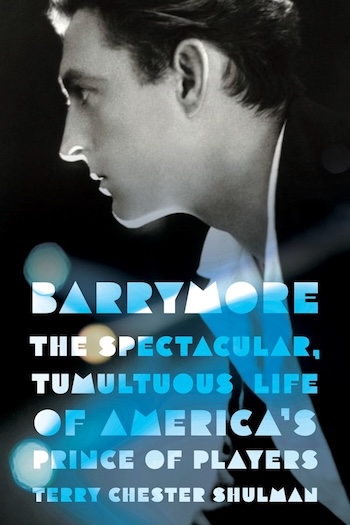 John Barrymore (1882-1942) was America’s greatest actor and the most influential Shakespearean performer of all time. He singlehandedly revived the English-speaking world’s interest in performing the Bard’s plays. Before Barrymore, mossy Victorian stage conventions systematically drained vitality from productions of the Bard. The younger generation considered the Elizabethan dramatist museum theatre. When Barrymore brought his production of Hamlet to London in 1925, he changed the careers of Laurence Olivier and John Gielgud. After they saw the American, they were determined to restore Shakespeare to center stage — with themselves playing his leading parts. Beyond making this case, Terry Chester Shulman goes on to argue that Barrymore was not only America’s greatest classical actor, but an intuitive Method actor, whose reliance on probing his own psychological depths set the bar for others to follow. Need proof? One hundred years later, Barrymore as both Hyperion and Satyr remains compelling in the popular imagination.
Why? Because no star ascended and descended as dramatically as Barrymore’s. He’s the embodiment of the adage that Americans transform their Hamlets into clowns. He began his acting career reluctantly, never playing serious roles. But, under the influence of his friend, playwright Ned Sheldon, Barrymore changed course in 1916 and electrified Broadway with a series of powerful performances. His first stab at Shakespeare was Richard III (1920), a performance that some have argued was even greater than his Hamlet. It only took nine years, but Barrymore was on the verge of entirely remaking American theatre. Following his transatlantic Hamlet triumph, the visionary set designer Robert Edmond Jones told him, “You can do anything you want in any way. There is nobody else in that position in the theater today.”
Instead, Barrymore chose to go to Hollywood. Shulman offers a new insight into his decision. Barrymore had become revolted by conventional American culture. He told friends he couldn’t bear the thought of living in the United States any more. But, when he came to California, he was invigorated by the sunshine and sparkling sea. His extraordinary contract with Warner Bros. gave him so much creative control that he could indulge himself in the only part of acting he savored: creating a role. There would be no loathsome demands for repeating the same old same old. He maintained this prestige through the end of the silent era. But overexposure on screen (he made multiple films a year) and overindulgence in alcohol began to take their toll. By 1933 he was intoxicated almost daily.
In looking at Barrymore’s life, Shulman skillfully distills the work of earlier biographers and newly available sources, uncovering racy and revelatory details. During the Broadway run of Hamlet, for example, he had frequent trysts in his dressing room with Rosalinde Fuller, who played Ophelia. His affair with a young Mary Astor is well-known, but his love for her was so profound that he wanted to bring her to London so she could play Ophelia in a new production of Hamlet. Shulman argues that if Astor’s parents’ mercenary grip on her hadn’t chained Astor to her movie commitment, Barrymore would have returned to the stage.
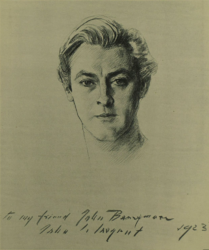
John Barrymore, drawn by John Singer Sargent. Photo: Wikimedia
In many ways, this is the first complete biography of Barrymore. It reveals his tortuous childhood journey, where he suffered the loss of his mother and his beloved grandmother. At 15, he was seduced by his stepmother. Soon after, syphilis drove his father insane, and that haunted Barrymore throughout his life — one of his “method” performances was portraying the mentally ill father of Katharine Hepburn in her first film, A Bill of Divorcement (1932). Shulman adds crucial pieces to Barrymore’s psychic puzzle. Previously, his penultimate wife (he was married four times) has been depicted as a martyr to Barrymore’s madness. Shulman describes her: “Belying Dolores’s small size and angelic beauty was a Scarlett O’Hara-like pugnacity that took on all comers with an unfettered ruthlessness whenever her interests were threatened.” So would it be when Barrymore became too much for her.
The climax of Barrymore’s career was his breakdown on the set of Hat, Coat, and Glove in May of 1934. He was so disoriented that he couldn’t figure out where he was, let alone speak any lines, Barrymore was sent home. For two days they tried filming, to no avail. After a weekend of rest, Barrymore was still unable to perform and finally flew into a violent rage on set and collapsed. Dolores was convinced he was seriously ill and had to get him treatment. Earlier accounts detail that she persuaded him to see a doctor, but Shulman, relying on Dolores’s sister’s report, reveals she tricked him into visiting the hospital, claiming it was to see a friend. As soon as Barrymore realized what was really going on, he attacked the nurses, tearing away at their uniforms. He was put in a straightjacket and confined for two weeks.
Previous biographies have accused Barrymore of paranoid delusions when he accused Dolores of wanting to have him confined. But Shulman asserts that she did want him committed. She lost her nerve, though, and took the less drastic measure of an alcohol-free cruise on their yacht. Barrymore took to drinking her perfume. He insisted on going ashore and he broke the family nurse’s nose when she tried to stop him. The marriage was over after that, and Dolores soon took up with her gynecologist (Barrymore had long suspected their mutual attraction). She began stripping their home of every saleable asset after Barrymore fled to India to see his father’s birthplace. Shulman undercuts the standard take on this trip. Barrymore supposedly went on a spiritual odyssey to find his roots and restore himself in India via an Ayurvedic cure. The truth is, his desire for redemption was desultory at best. Even the week-in-a-Madras-brothel escapade, which Barrymore enjoyed regaling shocked Hollywood party-goers with, turns out to be just another tall tale. He returned to America, and the final act began.
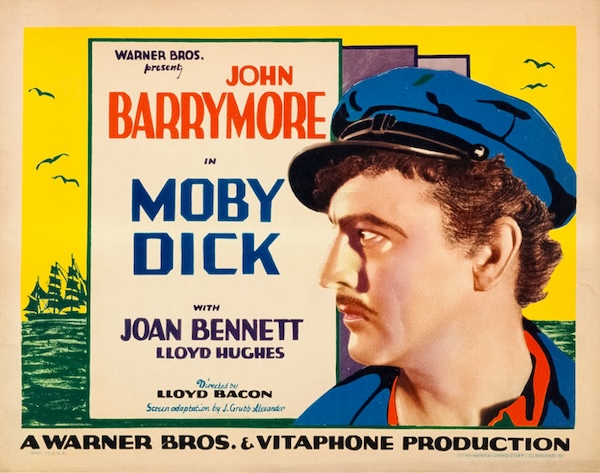
The farce of Barrymore’s marriage to a smitten Elaine Barrie, highlighted by its cross-country “Caliban and Ariel” ballyhoo, and the autobiographical travesty of My Dear Children, his final play, are sensitively handled by Shulman. He also uncovers the actor’s romance with Sally Allen, an “aspiring actress and model,” who kept company with The Great Profile in his last days. Without sentimentality, yet with sympathy, Shulman describes Barrymore’s ending days, which, even at their lowest provided glimpses of his performing genius. He shares the testimony of Orson Welles and others who saw Barrymore in his final stage role: they marveled at his timing and matchless ability to read the audience, even when he could barely stand.
Shulman’s most impressive success as a biographer is his ability to take us fully into Barrymore’s own realm, while maintaining a certain detachment. The book shows you who and what the man was. Readers are given enough of Ethel (sister) and Lionel (brother) to make sense of the family dynamic. Even (daughter) Diana’s brief appearances amplify our understanding of the Barrymore mystique, which granddaughter Drew has made wholly her own. That said, Shulman does shy a bit from the darkest aspects of the Barrymore “curse”; there is no mention of allegations of attempted incest. This is in keeping with the writer’s insistence on only recording what is certain. By sticking to that record (and usefully adding to it) Shulman has created a portrait that is fully worthy of its subject. If only his editors were as devoted to accuracy as he is. Lord Olivier is identified as “Lawrence” twice; there is no “Stanford” in Connecticut; and there is no such word as “adaption.” Cavils aside, Shulman’s Barrymore will thrill fans and enlighten even the most serious devotees of the legendary actor’s life and career.
Tom Connolly is Professor Emeritus of Humanities and Social Sciences at Prince Mohammad Bin Fahd University. He recently edited a historical study (in English) of the 19th- and 20th-century Jewish community of Döbling for the Österreichischen Akademie der Wissenschaften, Institut für Kulturwissenschaften. His book Goodbye, Good Ol’ USA: What America Lost in World War II: The Movies, The Home Front and Postwar Culture is forthcoming from Houghton Mifflin/PMU Press.