
Visual Arts Interview: Jeff Miller’s Figures in Motion — White Charcoal, Black Shapes, and Greek Vessels
By David D’Arcy
In Provincetown, the artist discusses the perceptual tricks, sly wit, and classical echoes behind his luminous figure drawings and and works on terra cotta.
Jeff Miller’s drawings put the stress on black and white. More specifically, his recent work goes for white on black.
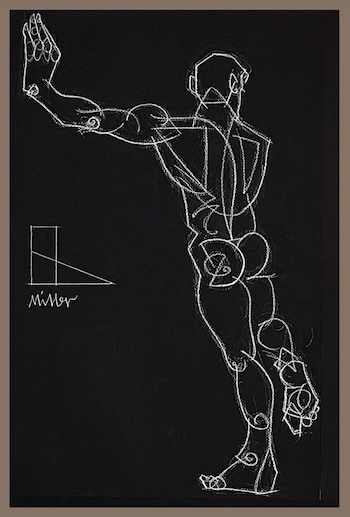
Jeff Miller, “Stop! (In the Name of Love)” – White Charcoal Pencil on Fabriano Paper. Photo: courtesy of the artist
The work he is showing at the Greg Salvatori Gallery in Provincetown, through August 13, includes the drawings of lines on paper that achieve an effect that feels anything but flat. We see bodies in motion; these are not silhouettes, but have spatial depth and nuance.
In an interview last week, Miller said that his inspirations include Jean-Auguste-Dominique Ingres, although the prodigious shadowing in Ingres’s drawings isn’t present in these white-lined figures on black backgrounds—unless the shadow is an entire body with clearly drawn boundaries. Aubrey Beardsley and Egon Schiele are other influences. Saul Steinberg is another. No surprise, since Miller’s interest is in the human figure, whether you’re admiring it or mocking it. Be prepared for wit in Miller’s work—and for exercises in anatomical geometry.
An additional influence on Miller might be Alexander Calder, especially in the clean lines of muscular, iconic men, a favorite subject for the latter. Miller says he has been told that his figures are reminiscent of blueprints or constellations in the sky. The more emblematic the figures seem, the more references they evoke.
That wide-ranging resonance carries over into another style that Miller explores in the show: “Vessels of Fancy” features drawings on vases inspired by antiquity. The terra-cotta palette on paper and the vases is radiant—strikingly so, for a man who claims not to care more about line than about color. The details surrounding figures have been partly partly plucked from ancient Greece.
There are muscular men who strike poses. There are also men in everyday scenes—a reminder, if needed, that most lives are more ordinary than heroic.
The show comes at an opportune time, now that The Odyssey, the ambitious film adaptation of Homer’s epic by Christopher Nolan, is setting box-office records. This meeting of myths is pure happenstance, says Miller, who has not seen the movie and has been working on the Greek-inspired vessels since long before the film began its publicity campaign.
That said, the Greeks on Miller’s terra-cotta vases could broaden the audience for this work. One should never let a coincidence go to waste.
I talked to Jeff Miller about why he works with white-charcoal figure drawings, and where his interest in Greek-pottery-inspired ceramic works comes from
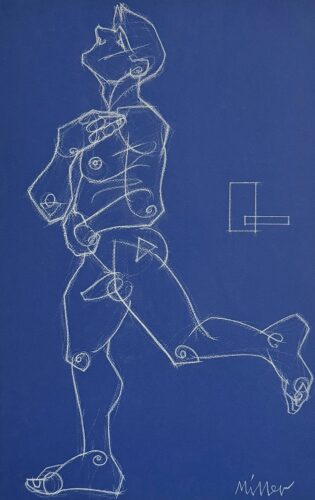
Jeff Miller, “On The Go” – White Charcoal Pencil on Fabriano Paper. Photo: courtesy of the artist
Arts Fuse: How would you describe what’s going on in your work?
Jeff Miller: What I want to do through the line is to inject the maximum amount of movement coupled with the maximum amount of stability, to keep the eye moving. I’ve said that the idea is to lead the viewer’s eye on a continual pleasure cruise.
AF: Can you explain why you chose to work in white lines on a black background?
Miller: There’s a quality of the line that happens on a black background as I draw it that would not work with a charcoal pencil on white. I started off, developing this particular style, with black on white, or black on light-colored paper, and then I kind of flipped, and started doing white on dark.
Working with the white charcoal, there’s a kind of ghost quality to the line. Black on white would just look smudgy and dirty.
When these drawings work, even though there’s no shading, even though there’s only line, they have a sense of three-dimensionality, which is a function of putting the curves in the right places.
Also, by drawing geometric shapes directly behind the figure, they tend to suggest three-dimensional space, something happening behind the figure that gives the illusion of three dimensionality.
AF: There is a secret to your process in making these drawings. Tell us about it.
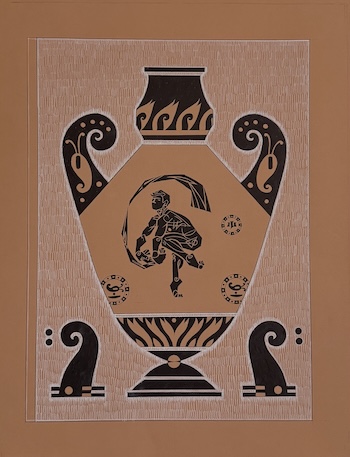
Jeff Miller, “The Dancing Veil” – Ink and White Charcoal Pencil on Canson Paper. Photo: courtesy of the artist
Miller: I do check what I’m doing with a little hand mirror. I’m constantly looking at my drawing flipped in the mirror, so I see it backwards. I have become, over the years, absolutely dependent on my little mirror, because it tells you everything. If something is not working, if something is in the wrong place, if something is out of scale, it will show you, where the naked eye won’t. As you’re drawing or doing anything on the page, your eye and your brain will inevitably normalize what you’re doing, to the point that you can’t see what’s wrong. The point is, you see it backwards in the mirror — it’s like the alienation effect in Brechtian drama. It shows you what’s wrong.
AF: With the Greek-inspired work, you seem to have made a transition to color, and then to color on terra cotta. The color is rich and invigorating.
Miller: I’m really not seeing the color. I mean, it’s there, it makes a nice contrast with the black figures.
AF: The Odyssey, a huge Hollywood hit set in ancient Greece, is being screened around the world. It shows plenty of terra cotta on the screen, including men dressed like the figures on your vases. Is that, like the color, something you weren’t paying attention to?
Miller: It’s something I wasn’t paying attention to.
David D’Arcy lives in New York. For years, he was a programmer for the Haifa International Film Festival in Israel. He writes about art for many publications, including the Art Newspaper. He produced and co-wrote the documentary Portrait of Wally (2012), about the fight over a Nazi-looted painting found at the Museum of Modern Art in Manhattan.
Thanks for the insight into the beautiful work