
Film Review: “Wild Inside” — The Story of the Owl That Stopped New York
By Peter Keough
In her wry, incisive documentary, filmmaker Penny Lane turns Flaco’s rise and fall into an unusually moving inquiry into animal sentience, urban spectacle, and the cost of liberation.
Wild Inside, directed by Penny Lane. At the Coolidge Corner Theatre on August 4 at 7:15 p.m., followed by a Q&A with the director. It also screens August 4 at the Cape Ann Community Cinema, where it opens August 7 for a weeklong run.
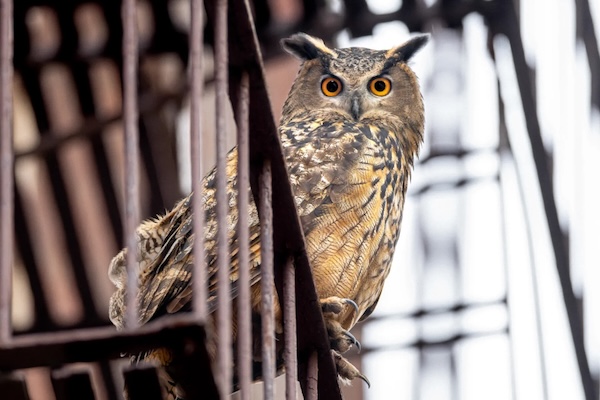
Flaco on the loose in Wild Inside. Photo: courtesy of Sandbox Films/ David Liu
In the rapidly changing world of viral animal anomalies, such recent entries as Punch, the stuffed-animal-loving monkey, and Jimothy, the stunted raccoon, have overshadowed Flaco, the Eurasian eagle-owl who escaped the Central Park Zoo in February 2023. Against all odds, he adapted to his new environment, and for a while became a symbol of underdog perseverance for countless followers. Though his glory days have passed, Penny Lane’s wry, delightful, and thought-provoking new documentary Wild Inside might bring them back.
Like the two nonhuman internet sensations that have since succeeded him, Flaco’s appeal lay in his anthropomorphized embodiment of the desires and ideals of those who embraced him. But unlike the other two, this was not just an online phenomenon; it was experienced by a real, flesh-and-blood community of New Yorkers, many of whom Lane interviews, who bonded over the bird.
One of the first to encounter the newly escaped Flaco was filmmaker Jeremy Workman (2024’s Secret Mall Apartment). Captured on video by Workman, Flaco emerges from the winter mist on the sidewalk outside Bergdorf Goodman — imperious, huge, curious, and bewildered. “It was like out of a dream, out of a fairy tale,” Workman recalls. “Like time stood still.” It seemed an otherworldly manifestation, and for several months Flaco would have a similar effect on the many who chased him down with cameras, an army of bird-loving paparazzi.
Zoo personnel tried to capture the owl, fearing that, after a lifetime in captivity, he would not be able to learn the hunting and other skills needed to survive in the wild. In one sequence reminiscent of a scene from E.T. the Extra-Terrestrial (1982), Flaco is seen at night, transfixed by flashlight beams as silhouetted figures with nets loom around him. He seems helpless before his bumbling would-be captors’ approach until he unfurls his enormous wings and flies off.
No wonder he became a hero, as New Yorkers cheered his flaunting of the authorities and his determination and resilience. That enthusiasm grew after Flaco fooled the experts and began successfully hunting the plentiful rats and pigeons in the park. After two weeks of frustrated efforts and in the face of bad publicity, the zoo gave up and declared Flaco a free bird.
Some, though taken in by the ongoing drama, had reservations about this development. D. Bruce Yolton, a New York City photographer and birder aware of the dangers that owls and other raptors face in an urban setting, recalls how, while others celebrated Flaco’s freedom, he thought, “No, he’s going to die.”
Nonetheless, for a while Flaco seemed to thrive. After several months, he decided to expand his territory beyond the park, appearing in the Lower East Side and other neighborhoods. Fed up, perhaps, with humans gawking at him, he took to peeking into windows. Residents would wake up in the middle of the night to find a giant owl with uncanny orange eyes staring back at them. Videos of such encounters went viral, and the Flaco frenzy grew.
As the film points out, the fascination with owls is not just an internet fad. As author Jennifer Ackerman notes, owls have obsessed human beings for millennia — a painting of an owl 36,000 years old was discovered deep in a cave in southern France. Another interviewee, Robyn Fleming, has been maintaining an Instagram site of images of owls she has searched for at the Metropolitan Museum of Art. So far he has found over 500. But one meaning attributed to owls across thousands of years and diverse cultures that Lane does not mention: they can be symbols and harbingers of death.
Death would come to Flaco about a year after his escape. He was found in a bleak concrete courtyard on the Upper West Side, where he died after crashing into a building. An autopsy found that he was suffering from pigeon herpesvirus and had been poisoned by four different rat poisons, an exposure that probably increased once he left the environs of Central Park for densely populated areas.
Unobtrusively, Lane explores — and wisely doesn’t answer — some of the questions that the Flaco story raises. While everyone is rooting for Flaco as he hunts, what about the lives of the pigeons and rats that are his prey? Aren’t they also sentient beings who experience terror and pain? Even a woman who calls herself the Bunny Lady — because she rescues pet rabbits abandoned in Central Park — is torn by this dilemma. It brings to mind Schopenhauer’s observation: “The agony of the devoured animal is always far greater than the pleasure of the devourer.”
And was Flaco indeed better off free, however briefly, rather than caged and safe and likely to live for decades more in the zoo? Lane confronts a zoo spokesperson with this question, and he makes a convincing case for keeping Flaco in his exhibition space. That was the only life he knew; despite flourishing for a while, the bird ultimately proved no match for the challenges outside. Unfortunately, Lane does not follow up by asking: if that was the case, why did they give up trying to capture him so quickly?
But that is a minor quibble in such a masterful achievement. Much of the film’s power lies in quiet, subtle touches, such as a shot of Flaco in a tree under a full moon, uttering his first, ghostly “who?” Or seemingly tossed-off glimpses of other Manhattan critters like foxes and raccoons, or a shot of a sedate Flaco suddenly startled by a sneak attack from an irate squirrel. Close-ups of Flaco — skeptical, sympathetic, anxious, and always enigmatic — are posed like reaction shots to various comments made by participants. And, in a meta-sequence, the technician at the wild bird clinic where Flaco was brought after his accident says that, when she saw him, it was like a montage of all similar cases passing through her mind, whereupon the film cuts to her montage of stills from those cases. Finally, toward the end, Workman, who had first witnessed the owl’s appearance, quietly leaves photos of that moment at the memorial under Flaco’s favorite oak tree.
As in previous films like Hail Satan? (2018) and Nuts! (2016), Lane begins by whimsically investigating a seeming oddity and, in the process, arrives at profound truths. Like Agnès Varda and Errol Morris, she has achieved in film the kind of personal, free-associative, exploratory essay that follows in the four-century-long tradition of Michel de Montaigne. Wild Inside is not just one of the best documentaries of the year, but one of the best films.
Peter Keough writes about film and other topics and has contributed to numerous publications. He was the film editor of the Boston Phoenix from 1989 to its demise in 2013 and has edited three books on film, including Kathryn Bigelow: Interviews (University Press of Mississippi, 2013) and For Kids of All Ages: The National Society of Film Critics on Children’s Movies (Rowman & Littlefield, 2019).
Tagged: "Wild Inside", Eurasian eagle-owl, Flaco, New York City, owl
As big fan of Lane, Nuts, and Hail Satan? I like your comparing her with Errol Morris and Varda. But the lhe link got me curious and sent me to Mark Ayers’ interesting blog. Suddenly, my morning ‘rabbit hole’ is looking for the Essays of Michel de Montaigne. Great review. I hope the Brattle Theatre brings the film and its director back to Cambridge.
Thanks, Tim. HBO is releasing it in February, but it really needs a wider theatrical outing.