
Visual Arts Commentary: The Great Spirit Gets Company
By Trevor Fairbrother
In Boston and Hanover, new works by Alan Michelson and Kent Monkman challenge the myth of the vanishing Native—and the Cyrus Dallin bronze that enshrined it.
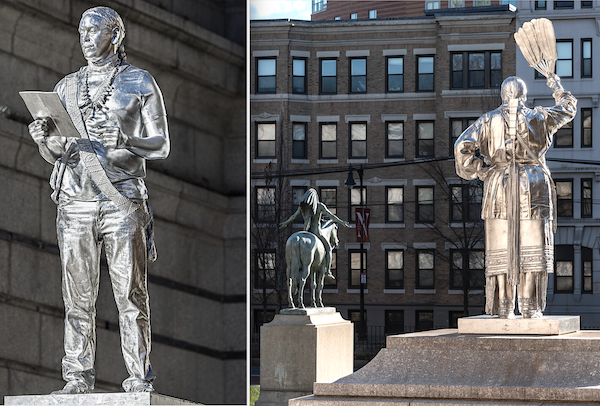
Views of Alan Michelson’s project outside the MFA Boston, The Knowledge Keepers. Images paired by the author.
In January 2024 I wrote in The Arts Fuse about the public wrangling over Appeal to the Great Spirit, the sculpture by Cyrus Dallin that has greeted visitors to the Museum of Fine Arts since 1912. There were rumors that it might be removed from Huntington Avenue because some community members think it is an offensive representation of a Native American. The MFA’s director Matthew Teitelbaum welcomed the discussion: he wanted a better “platform around Native American art,” and in 2019 established Table of Voices, a program for community feedback on the interpretative experience and design of the museum’s displays. The Cyrus Dallin Art Museum, located in Medford, Massachusetts, noted on its website that the MFA’s Appeal to the Great Spirit “has become a flashpoint for public dialogue around stereotypes, Indigenous erasure, and settler colonialism.”
The MFA’s small 2018 exhibition Collecting Stories: Native American Art gave a nod to the Dallin situation. A more conspicuous declaration came in 2021 when Wampanoag artist Elizabeth James-Perry created a site-specific work: she planted corn, beans, and sedge grass around the Dallin sculpture to proclaim Algonquian beliefs and practices. The most ambitious move was the 2024 inauguration of a sculpture program titled the “Huntington Avenue Entrance Commission.” The award went to someone raised and schooled in Boston: Alan Michelson, a Mohawk member of Six Nations of the Grand River. Michelson created life-size sculptures of two contemporary cultural leaders to be set on the historic plinths flanking the museum’s front door. This observation appeared on the MFA’s website: “Cast in bronze and gilded in shimmering platinum, [Michelson’s] The Knowledge Keepers pays tribute to the Northeastern Woodland nations’ reverence for copper, crystal, shell, and silver, materials treasured for both their physical and metaphorical luster. Platinum, with its resistance to corrosion, chemical stability, and role in advanced electronics and spacecraft, translates that tradition into the future.”
Murray Whyte extolled the project several times in the Boston Globe and used the Dallin as an easy target. He noted, “The ‘vanishing race’ notion of Dallin’s time is both chillingly outdated and an overwrought doom narrative plied for dramatic effect; Native Americans were surely decimated, but that’s their story to tell.” Whyte listed the ways in which he believed Michelson’s paired figures to be “everything Appeal to the Great Spirit is not.” He said The Knowledge Keepers shows “real, living people with specific roles in their respective Massachusetts communities – Julia Marden, [who] preserves and teaches the practice of twining, [and] Andre StrongBearHeart Gaines Jr., a Nipmuc citizen, who describes himself as ‘a cultural steward for his Tribe.'” Not so the Dallin, which “portrays no one in particular; it’s a vague pastiche of mostly Western Plains Cree aesthetics, and an avatar of generalized Indigenous suffering.” Whyte quoted Michelson, who recalled his youthful take on the Dallin: “If you were sympathetic at all toward Native people, there were almost no images of them anywhere in Boston. So I guess I kind of liked it, in a way. But I also questioned it: ‘Why is a Plains Indian here?’ There was something trophy-like about it that unsettled me.” The artist also stated, “I wanted to oppose the extinction narrative with something authentic.”
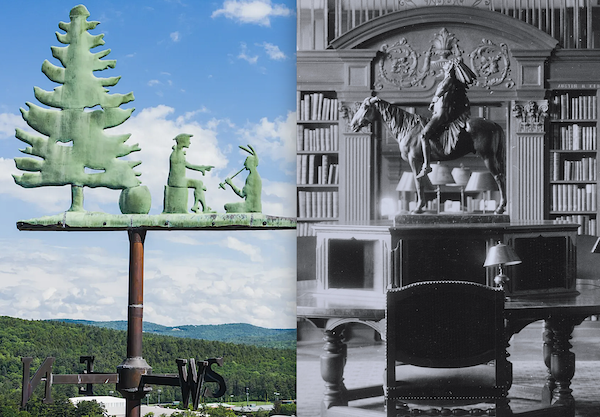
Dartmouth’s Baker Library. Left: the 1928 weathervane. Right: the Dallin bronze installed in the Tower Room. Dartmouth College website and library. Images paired by the author.
126 miles north of Boston a different Dallin situation was unfolding in Hanover, New Hampshire, on the campus of prestigious Dartmouth College. The Europeans who funded the institution in the 1760s had the impression that it would convert Indians to work as missionaries. The school soon drifted from its founding intent: in its first 200 years, only 19 Native students graduated. In 1970, at the height of the Red Power movement, Dartmouth established a Native American Program to increase enrollment. Unsurprisingly, the new students were quick to protest the use of Indian symbols as the unofficial logo of Dartmouth and its sports teams. In 1974, the Dartmouth Board of Trustees banned symbolic references to Indians, which provoked episodes of backlash for decades. To understand the pervasiveness of the Indian mascot tradition, consider the Baker Memorial Library that overlooks the College Green. It was modeled after Independence Hall in Philadelphia and opened in 1928. It featured Indian icons in two prominent locations: a six–foot–high weathervane showing Eleazar Wheelock, Dartmouth’s founder, teaching a Native American seated on the ground before him; and a splendid 40-inches-tall version of Appeal to the Great Spirit placed on a big table in the stately reading room beneath the bell tower.
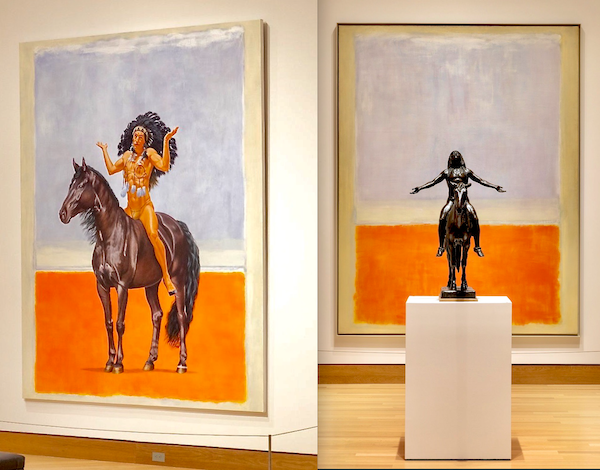
Kent Monkman’s The Great Mystery exhibited at the Hood Museum of Art, Dartmouth College in 2023. Installation photographs by Rob Strong. Images paired by the author.
In 2020 Dartmouth College received a $500,000 grant from the Mellon Foundation to advance collaboration between the Dartmouth Library and Dartmouth’s Hood Museum of Art regarding Native American and Indigenous holdings. Two early acts were the removal of the weathervane and the Dallin. Independently, the Hood Museum planned a project with Kent Monkman, an artist born in Canada and a member of the Fisher River Cree Nation. Over 20 years ago, Monkman began painting landscapes that challenged the romanticized creations of such non-Native Victorian artists as George Catlin and Albert Bierstadt. His goal was to introduce histories and experiences that those jingoistic pictorial narratives ignored, especially the lives of Indigenous and queer communities. Jami Powell, a member of the Osage Nation and the Hood’s Curator of Indigenous Art, invited Monkman to make pictures in response to art in her museum’s collection.
Powell’s exhibition, with four new paintings by Monkman, opened in April 2023. The standout work – the monumental The Great Mystery – took visual inspiration from Mark Rothko’s abstraction Lilac and Orange Over Ivory (1953) and Dallin’s Appeal to the Great Spirit. Monkman and his studio team began by painting a replica of the Rothko, which is almost 10 feet tall. This became an otherworldly landscape setting for a portrait of Miss Chief Eagle Testikle, the character Monkman invented for himself in 2002. The name suggests mischief and egotism. The sassy alter ego aids Monkman in his efforts to disrupt and reverse colonialist dogma and let it be known that the settlers were also being observed. Miss Chief is a supernatural being who incorporates two genders dressed glamorously in high heels. She is a time traveler and a two-spirit trickster who confidently shows the way to better futures.
The Hood’s exhibition was notable and ambitious, yet unexpectedly spiritless. Monkman’s highly developed, multiform instinct for theatricality failed to blossom there. The show was installed in a towering oddly-proportioned gallery with white walls. The labels were formal and unengaging, with no indication that Monkman’s art has incorporated an expression of his queer identity since the late 1990s. One rewarding component was the inclusion of the art in the Hood’s collection that Monkman had referenced; this is evident in a video produced by the museum. Thus, his The Great Mystery hung across the room from the Rothko and the Dallin that had been permanently removed from the Baker Library.
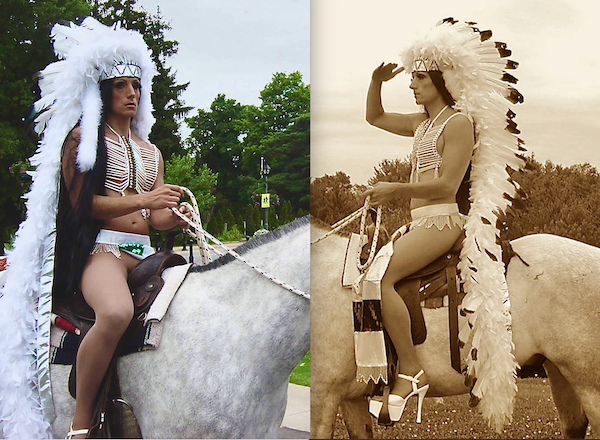
Photographs of Kent Monkman as Miss Chief in Group of Seven Inches (2004 performance and 2005 film). Images paired by the author.
Monkman’s monumental painting of a scantily-clad Show Girl/Indian Chief/Equestrienne is destined to be a mindfuck for many people for the foreseeable future. General viewers need to know that Miss Chief is not a drag character impersonating a woman. They need information about her body language – it looks like a camp shrug worthy of Joan Rivers, but is, according, to the museum, an expressive response to misunderstandings between Indigenous and Western value and knowledge systems. I think the best way for the Hood to win friends for this important painting would have been to give audiences a better handle on Miss Chief’s long history. Monkman has been making performances and films as her for years. If you want to take the plunge, I heartily suggest the performance video Another Feather in Her Bonnet, in which Monkman and trailblazing couturier Jean Paul Gaultier take vows.
Michelson’s installation remains on view outside the MFA and is well worth a visit. Dartmouth’s painting The Great Mystery has been on the road since April 2025: it is in the large exhibition Kent Monkman: History is Painted by the Victors, organized by the Denver Art Museum and currently on view at the Akron Art Museum. Visually, the work of these artists seems worlds apart. Michelson’s sculptures have realist and social documentary overtones; they make me think of the earnest straightforward portraiture of Thomas Eakins. The Monkman picture of Miss Chief is flamboyant, camp and fierce. Nonetheless, both men are practitioners of socially engaged, critically aware art, and they are equally committed to refuting the 19th-century Euro-American claims that Native cultures were fated to vanish.
Alas, progress has faltered in some of the areas I discussed. Facing a $13-million projected deficit, the MFA’s new director, Pierre Terjanian, laid off 33 employees and eliminated 23 vacant positions. Marina Tyquiengco, the Curator of Native American Art who proposed Michelson for the inaugural “Huntington Avenue Entrance Commission,” was one who lost her job. At Dartmouth, the Steering Committee for the 2020 Mellon Foundation grant has yet to report on a new weathervane for Baker Library and the replacement for the Dallin bronze in the reading room.
Trevor Fairbrother is a writer and curator. He has contributed four essays about John Singer Sargent to The Arts Fuse.
Tagged: "The Great Mystery", Appeal to the Great Spirit, Cyrus Dallin, Dartmouth College, Elizabeth James-Perry, Hood Museum, Indigenous Art, Kent Monkman