
Classical Music Review: “An American Dream?”
By Jonathan Blumhofer
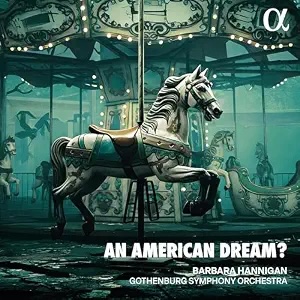
Soprano-conductor Barbara Hannigan’s semiquincentennial album reframes familiar American classics through a lens of wistfulness, insight, and quiet defiance.
 “Do you miss your president?” a Viennese restaurant owner asked me when I stopped by for a plate of döner kebabs this spring. “For us, he is…” he searched for the right words. “Ein großes Problem”—a great problem.
That comment came to mind while listening to Barbara Hannigan’s contribution to the summer’s musical celebration of the country’s semiquincentennial, An American Dream?. The question mark is intentional, as the Canadian artist’s liner notes make clear: her ambivalence about some of the United States’ cultural practices has been supercharged by events of the last decade.
Those feelings are hardly unique, as most who’ve travelled beyond these shores can attest; my Austrian acquaintance would surely second them. What they mean, practically, for this album’s pairing of works by George Gershwin, Aaron Copland, Richard Rodgers, Billy Barnes, and Jules Styne is that the fare comes across perhaps more wistfully than expected. As it turns out, though, that’s largely a good thing, as there’s considerable insight and understanding to emerge from these performances.
Hannigan’s experience as a singer seems to guide the readings she leads of the purely instrumental numbers with the Gothenburg Symphony Orchestra: they are unfailingly lyrical and centered on the melodic line. For instance, Gershwin’s Porgy & Bess Suite (heard in the version put together by Robert Russell Bennett at the request of Fritz Reiner) comes out as a fascinating study in melody, the Gothenburgers bringing an admirable delicacy and textural refinement to their playing in “Clara, Clara” and “Summertime.”
The density of Bennett’s scoring never gets in the reading’s way, which means (among other things) that the sumptuous “Bess, You Is My Woman Now”—though a bit lost in itself concerning matters of tempo and phrasing—proves hypnotic. The Hurricane music, too, is commendably blended. “I Got Plenty o’ Nuttin’” might feel a bit stately, but Hannigan’s overarching view of the music has a firm command of its style and snapping syncopations. “O Lord, I’m On My Way” is warm and rousingly anthemic.
The disc’s other big item is Copland’s Dance Symphony.
Recycling music from the composer’s ballet Grohg, this 1929 score is one of its author’s curiosities. Though the near-30-year-old Copland’s mature voice is in evidence, the music owes a considerable stylistic debt to Stravinsky: most of all, one gets a strong sense of the world of possibilities the visionary Russian unlocked for coming generations across its three movements.
Hannigan’s approach to the symphony is both songful and spacious. The last creates some problems in the finale (it sounds more sectional and structurally choppy than it needs to) but otherwise proves persuasive: the Allegro’s crispness doesn’t come at the expense of subtlety and mystery, while the Andante, with its hints of Satie and Bartók, sounds wonderfully eerie. One comes away from the hearing wondering where this music has been all its life.
That’s not an issue with Richard Rodgers’ The Carousel Waltz, which dispels the shadows with nearly ten minutes of beautiful, spontaneous-sounding, perfectly natural melody.
Meantime, the suite At the Fair makes a further detour into Broadway with a hint of Charles Ives. He turns up in the title track, a delirious mashup of patriotic songs, Sousa marches, and snatches of showtunes. Hannigan contributes the vocals for the framing numbers, Barnes’ “Have I Stayed Too Long at the Fair?” and Styne’s “Don’t Rain on My Parade.” The former is haunting and bittersweet, with an unexpectedly lush, Mahlerian ending, and the latter brings the disc to its rousing finish.
Given the context of the larger program, the last one’s climactic lyric takes on a measure of defiance, too. The American dream, Hannigan is reminding, isn’t some exclusive domestic property; in fact, it’s at least as significant abroad as it is at home. As history teaches us, local actors who seek to limit its reach risk global consequences, sometimes deeply tragic ones. If that’s a sober birthday message to consider, it’s also an apt one—but hopeful, too, since, given time, we know that dreams can renew themselves.
Jonathan Blumhofer is a composer and violist who has been active in the greater Boston area since 2004. His music has received numerous awards and been performed by various ensembles, including the American Composers Orchestra, Kiev Philharmonic, Camerata Chicago, Xanthos Ensemble, and Juventas New Music Group. Since receiving his doctorate from Boston University in 2010, Jon has taught at Clark University, Worcester Polytechnic Institute, and online for the University of Phoenix, in addition to writing music criticism for the Worcester Telegram & Gazette.
Tagged: "An American Dream?", Alpha, Barbara Hannigan