
The Annual Francis Davis Jazz Critics Poll at Midyear: Warming Up a Riff — How It Happened, and Why It Matters
By Tom Hull
Few things more clearly attest to the endurance of the human spirit and the drive for creativity than the uninterrupted and unstoppable torrent of brilliant new jazz albums we’ve already seen this year.
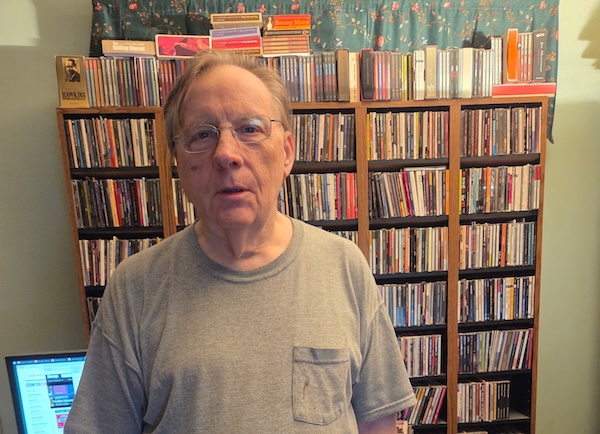
Tom Hull, the indefatigable keeper of the Annual Francis Davis Jazz Critics Poll, today. Photo: courtesy of the artist
Editor’s Note: This is Tom Hull’s overview of the poll. For the results, go to New Jazz Albums, Consensus in Retreat, and Rara Avis (Reissues/Archival), The Old World Gets Weirder. For even more, go to the poll archive website.
End-of-year lists are rites of passage. Like birthdays, they break time into manageable chunks, and reassure us that we’re done with one, and ready to move on to the next. As a critic at the Village Voice, Francis Davis was obligated to fill one out. But turning it into a poll was work beyond calling. It was outreach. It allowed him to check his own judgments against those of his peers. And in the end, it was community organizing, and service to that community.
This is the third year I’ve run a midyear poll of jazz critics. They say that something that happens once is happenstance, twice coincidence, three times a pattern. It may eventually turn into an institution. This still feels way too precarious for that, but this iteration is one more step in that direction. I suppose the real test will be whether someone else might pick it up after me.
Francis Davis got the poll running in 2006, when we were both writing about jazz in the Village Voice: he did the serious feature essays, and I mopped up the leftovers in my jazz consumer guide. Even then there was more quality jazz coming out than anyone could properly follow. We lasted past the firings of Robert Christgau and Chuck Eddy, but were frozen out after Rob Harvilla got sacked, and the Voice quickly self-destructed. Capitalism may make the world go round, but it leaves a lot of waste in its wake.
While I voted from the start, I wasn’t really involved in the poll until a couple years later, when the Voice‘s IT department balked at publishing all the ballots. By then the initial “circle” of 30 NYC voters had expanded nationwide to 99 in 2009, and to 120 in 2010. Francis always insisted that every ballot be posted, so Harvilla worked out a deal where I would host the ballots. After the Voice, Francis moved his poll to Rhapsody, then NPR, and finally to Arts Fuse — where I did the drudge work of hosting the ballots. I was happy to do so, and made myself increasingly indispensable to the operation, especially as Francis’s health began to fail.
In 2024, I proposed running our first midyear poll. I had been following midyear best-of lists, and was upset over how few jazz releases were mentioned. I figured I had the mailing list and the website tools, and could use a break from political news where the big question was how long Biden would hang on to the Democratic nomination. I started late, and had lots of email problems, but wound up with 90 ballots (Francis approved, but didn’t vote), and I wrote an essay called “Diversity Brings Riches.” I was less interested in who won (Vijay Iyer, Charles Lloyd, and Mary Halvorson) than in how many albums got mentioned (366 + 109 in Rara Avis), over half of which I hadn’t heard.
Francis kept his poll going for 19 years, until he died in April 2025. I figured he deserved a 20th, so I intended the 20th Annual Poll as a tribute to him, and saw the Mid-Year 2025 Poll as a practice run. I wound up exhausted and disappointed — the number of voters dropped from 177 to 168, the comments I invited rarely panned out (although the two for the piece on Davis were worth the effort). Then other perils and drudgeries of everyday life intervened, leaving me with doubts about carrying on. However, by June this year, I started feeling more confident, and once again I relished a break from the political news (especially the extraordinary stupidity of the war Trump had blundered into).
I had started a newsletter, Notes on Everyday Life, where I wrote long pieces on the Trump-Netanyahu wars, but it’s frustrating trying to reason about politicos who are so deluded and deranged. It’s not like we’re on the cusp of finding some magic evidence that will bring them down. We’re drowning in a tsunami of evidence, and have been for years — as anyone I could conceivably reach must already know. We should be smart enough as a species to figure it out, but unfortunately we’re run by people trapped in the tunnel vision of their own selfish interests, cloaked in a “society of spectacle” that doesn’t “manufacture consent” so much as it renders dissent unimaginable.
Yet most people can still go about their everyday lives, not oblivious to the drudgery and horror spreading everywhere, but detached enough to still be functional. And those who can still create art keep doing so. Granted, in many areas of the arts, much of the never-more-than-marginal money that once was available has dried up, a victim of the unprecedented transfer of money, both real and merely notional, to the tech and finance moguls, with their now relatively poorer cousins in what used to be called “the real economy” — the one where actual goods are made and personal services are rendered — scrambling bitterly to keep up.
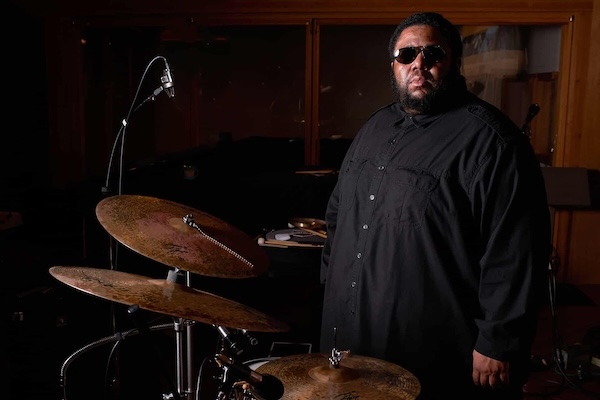
Tyshawn Sorey’s Members . . . Don’t! is the midyear poll leader. Photo: John Rogers
But jazz musicians and labels have lived on so little for so long they’re used to surviving, and in many cases thriving, in this encroaching wasteland. Few things more clearly attest to the endurance of the human spirit and the drive for creativity than the uninterrupted and unstoppable torrent of brilliant new jazz albums we’ve already seen this year. But who has heard about them? Who has enjoyed them? Very few. The problem I see is threefold:
- Media reporting on jazz is extremely thin and marginalized.
- The amount of extraordinary music they have to report on is way beyond human grasp.
- Our attentions are constantly battered, especially by those with the fame and money to hog the spotlight.
I don’t have a solution to these problems, especially the third. (Well, not here. As an engineer, I have lots of ideas, but none we can do much about any time soon, other than the individual’s last resort, “just say no!”) But I figured there was one little something I could do about the first two: run another midyear poll. This helps with the media problem by offering you a single source for a lot of basic information, presented in a consistent way, with no ulterior motives or hidden agendas. And this helps with the cornucopia problem by employing many expert critics to make an initial pass at listing the year’s most interesting albums. We compiled the best-of lists from 127 critics. They identified 462 new jazz albums, and 137 rara avis (reissues/archival), a total of 595 albums (4 appeared on both lists).
The sort may correlate somewhat with some notion of quality, but it also measures lots of other things, including how many critics heard a record, what kind of publicity it got, how extensively it was reviewed, and how useful and appealing that information was to the individual critic. Like all polls, this one may tell you more about its voters than about its subjects.
To reach the top of the list, an album has to pretty much tick all the boxes for a large segment of the voters, but that segment could be 40% or less. This year’s winner (Tyshawn Sorey) appeared on 35.4% of the ballots, followed closely by the runner-up (Tomeka Reid) at 34.6%. (Past poll winners have dipped as low as 24.2%; last year’s Rara Avis winner only appeared on 16.8% of ballots.)
I write more about this sort of thing in the notes addenda to the New Jazz Albums and Rara Avis essays.
But what I want to do here is to circle back to the critics. They (well, we) are essentially a self-defined community…
Special thanks to all voters:
Paul Acquaro, Scott Albin, Ali Alizadeh [Sir Ali], Rick Anderson, Bridget Arnwine, Hrayr Attarian, Angela Ballhorn, Chris Barton, Joe Bebco, Larry Birnbaum, Jason Bivins, Larry Blood, Richard Blute, Philip Booth, Mike Borella, Stuart Broomer, Bill Brownlee, Dan Buskirk, Pete Butchers, Nuno Catarino, Jeff Cebulski, John Chacona, Robert Christgau, Brad Cohan, Troy Collins, J.D. Considine, Mark Corroto, Michael Coyle, David Cristol, Matthew Crook, Steve Dollar, Laurence Donohue-Greene, Ken Dryden, Chuck Eddy, John Ephland, Lee Rice Epstein, Steve Erickson, Gonçalo Falcao, Steve Feeney, Gary Finney, Phil Freeman, Filipe Freitas, Pat Frisco, Matteo Gabutti, Jon Garelick, Ana Gavrilovska, Richard Gehr, Brooks Geiken, Kurt Gottschalk, David A. Graham, Ludovico Granvassu, Mike Greenblatt, James Hale, Andrew Hamlin, Eyal Hareuveni, George Harris, Ron Hart, Andrey Henkin, Geoffrey Himes, Rob Hoff, C. Andrew Hovan, Tom Hull, Jim Hynes, Martin Johnson, Sanford Josephson, Matthieu Jouan, Richard B. Kamins, George Kanzler, Glenn Kenny, James Koblin, Elzy Kolb, David Kunian, Josh Langhoff, Tim Larsen, Will Layman, Devin Leonard, Lance Liddle, Mark Lomanno, Suzanne Lorge, Marcello Lorrai, Brad Luen, Phillip Lutz, Ferruccio Martinotti, Paul Medrano, Allen Michie, Bill Milkowski, Ralph A. Miriello, Rick Mitchell, Chris Monsen, John Frederick Moore, Greg Morton, Ivana Ng, Fotis Nikolakopoulos, Tim Niland, Phil Overeem, Ted Panken, Annie Parnell, Russell Perry, Lawrence Peryer, Sergio Piccirilli, Steve Pick, Derk Richardson, Britt Robson, Akira Saito, Brett Saunders, Martin Schray, Gene Seymour, Adam Shatz, Rob Shepherd, João Esteves da Silva, Steve Smith, Stewart Smith, Jeffrey St. Clair, Michael Steinman, Ariella Stok, Mimmo Stolfi, Mark Sullivan, Dave Sumner, Derek Taylor, George Varga, Philip Watson, Ken Waxman, Jason Weiss, Michael J. West, Richard Williams, Jerome Wilson, Kazue Yokoi.
Also thanks to the members of my “jpadmin” email list, especially Nathan Van Wyck and Laura Tillem.
Tom Hull studied sociology and worked in engineering, but also wrote rock criticism in the 1970s, and the Village Voice’s Jazz Consumer Guide from 2005 to 2011. He continues to blog, and has over 20,000 short reviews on his website
Tagged: The Annual Francis Davis Jazz Critics Poll
Tom looks pretty defatigable in this picture. haha