
Jazz Album Review: Guitarist Eric Hofbauer’s High Concept Yields Deep Rewards
By Jon Garelick
Eric Hofbauer and EHX turn a wide-ranging songbook into a cohesive, emotionally charged jazz narrative.
Eric Hofbauer and EHX, Tongues / Hope Language (Creative Nation Music)
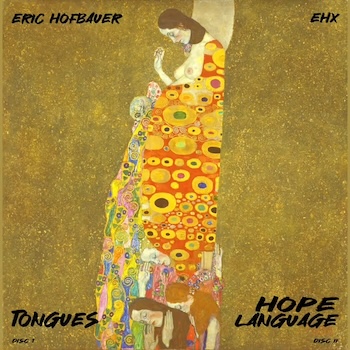
Guitarist and composer Eric Hofbauer’s latest is front-loaded with concept. The two discs of the vinyl edition are divided between “Tongues” and “Hope/Language.” Those discs (a single thread if you’re listening online) comprise 15 pieces from sources as varied as Sting and Eddie Harris, Björk and Carla Bley. Bassist Tony Leva’s notes describe the project as “a concept double-album exploring the sacred power of storytelling — from the direct and powerful to mystical and unspoken.”
What’s most striking about the album, though, isn’t the concept or back story (Hofbauer has called the recording “autobiographical”), but how satisfying and engaging it is from track to track, despite the leaps back and forth through time and the styles of source material. Out of this seeming hodgepodge, Hofbauer maintains unity and flow, with enough variety that the ear is tickled with something new in every track. So the adept, easy swing of “1974 Blues” (with tasty interchanges and solos all around for Hofbauer, Leva, tenor sax Temidayo Balogun, and drummer Miki Matsuki) segues to Regina Spektor’s “Us,” with Hofbauer’s picking and the rising octave of cellist Ana Ospina leading to the vocals by Hayley Thompson-King.
Hofbauer’s arrangements vary textures and timbres throughout, and he mixes up his small core of instrumental voices to pointed effect. Sometimes it’s a matter of Hofbauer switching up guitars (nylon-string and archtop) with subtle use of electronics, or an apt and articulate turn with tenor banjo on Paul McCartney’s “Mother Nature’s Son.” Ospina, meanwhile, deftly segues between bowing and pizzicato throughout, making for a versatile string section with Hofbauer and Leva. Leva mostly plays acoustic bass but his dancing counterpoint of electric bass with Hofbauer’s guitar on Carla Bley’s “Ida Lupino” could almost be a tribute to the great electric bass guitarist (and Bley partner) Steve Swallow. And even though 10 of the 15 tracks were originally written as vocal numbers, Thompson-King sings only four.
Call that last move a strategic deployment of a secret weapon. Thompson-King’s background includes a lot of rock, but she also trained as an opera singer. She swoops through the waves of tricky intervals in “Us” and saves Joni Mitchell’s “Amelia” from over-familiarity with just the right emotional heft in her phrasing and diction. (Here, too, credit Hofbauer’s arrangement, with its contrapuntal use of voice and guitar, guitar with bass and cello, and Noah Preminger’s sensitive tenor sax cadenza.) She is given the opportunity to to unleash rock screams on Peter Gabriel’s “Here Comes the Flood.” And she brings the appropriate laid-back cool to the swinging electric jam of Jimi Hendrix’s “Up from the Skies.”

Guitarist and composer Eric Hofbauer. Photo: courtesy of the artist
Good as she is, if Thompson-King had sung the remaining rock tunes — the Beatles’ “I Want You (She’s So Heavy”), Sigur Rós’s “Sæglópur,” Radiohead’s “How To Disappear Completely,” Björk’s “Army of Me” and “Bachelorette,” Sting’s “Russians,” and Sly Stone’s “Everybody Is a Star” — this could have turned into a prog-rock album. As is, Hofbauer gets to include the Harris, Bley, Abbey Lincoln (“Long as You’re Living”), and Charlie Parker’s “Klactoveedsedstene.”
Hofbauer’s solo career (he’s also played elemental roles in Charlie Kohlhase’s Explorers Club, among other projects) has included his solo guitar “American” trilogy, his “prehistoric jazz” quintet (Stravinsky, Messiaen, Ives, Ellington) and any number of small-ensemble and duo projects. A strain of social awareness and activism has been a constant throughout. On the EHX album, you don’t have to read the liner notes to catch the themes of geopolitical oppression and climate disaster, or the need for human connection and kindness. As for the music, the skill of the writing and playing, along with the uniform emotional commitment, rewards multiple listenings. In addition to Thompson-King, every instrumental solo carries the required weight and then some. There’s not an arbitrary or wasted moment. In this experiment of musical narrative, every note tells.
Jon Garelick was an arts editor at The Boston Phoenix and is a retired member of the Boston Globe opinion pages staff. He can be reached at [email protected].
Tagged: "Tongues / Hope Language", Ana Ospina, Eric Hofbuaer, Hayley Thompson-King, Kyle Aronson, Miki Matsuki, Noah Preminger, Temidayo Balogun