Book Review: “The Selected Letters of Jane Kenyon and Alice Mattison” — Two Writers, One Rare Friendship
By Rebecca Leamon
These letters between Jane Kenyon and Alice Mattison offer a moving portrait of literary life, daily labor, and mutual devotion.
What Clever Friends: The Selected Letters of Jane Kenyon and Alice Mattison, edited by Chad Wriglesworth. University of Michigan Press, 534 pages, $49.95 (paperback)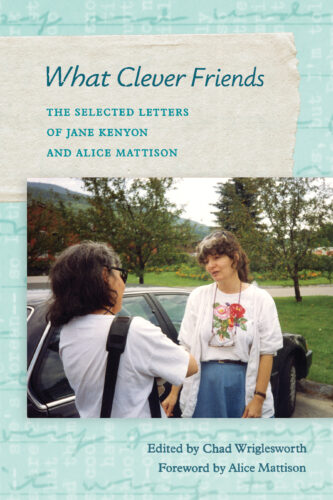
This is a doorstop of a book, weighing in at nearly two pounds and over 500 pages. But it is also an absorbing, thought-provoking, and celebratory volume, illustrating the power of the written word, a survey of the correspondents’ life work through a personal, cheerful, and regular exchange via the U.S. mail. It engaged me fully and has left me with a desire to read more of both authors’ works and to write more letters of my own. What clever friends they were, and what clever friends I have acquired.
The letters unfold in several layers. Each author draws on her sense of humor. Writer and teacher Alice Mattison invites poet Jane Kenyon to “have lunch and go swimming or whatever,” and Kenyon responds that she is “battening down for waves of company, including [her] mama.” A range of topics animates these missives: pets, gardens, baseball (Kenyon was a Red Sox fan, with all that entails), the demands of small-town church life for Kenyon, and larger questions of faith for Mattison, along with her social work in New Haven’s soup kitchen. Throughout, there are pointed exchanges about their writing, their professional opportunities, and their personal lives.
Early on, Mattison states, “I’ve never been the kind of writer who works at writing for whole days, and I don’t think I’ve ever thought about poetry for two days straight.” Still, the two women inevitably discuss teaching, workshops, and publication opportunities as they make editing suggestions on each other’s work. They also offer encouragement. In an early letter, Mattison remarks, “I also have been wanting to tell you how much I like the poem in The New Republic.” Kenyon comments on Mattison’s use of “strict” in one poem, saying it was “so surprising, accurate, and good.” This supportive connection, enhanced by various friends and organizations, evolves into a workshop composed of Mattison, Kenyon, and poet, editor, and teacher Joyce Peseroff that meets regularly despite the obstacles of distance, the demands of family and daily life, and daunting health issues.
Their letters are full of the daily work of writing and the importance of supporting each other in that endeavor. They bemoan the length of time it takes between the acceptance of a poem or manuscript and its publication, commiserate over the issues of choosing cover art, and lament the irritating unresponsiveness of editors. They appreciate each other’s successes: “You cannot imagine how proud of you I am and how delighted,” Mattison writes to Kenyon; Kenyon congratulates Mattison: “I am so happy for your success. You deserve it.” This is not to say there are not, on occasion, strong disagreements and even hurt feelings over what is seen as thoughtless or misplaced feedback.

Poet Jane Kenyon. Photo by William Abranowicz
The letters frequently address the challenges of literary creation and revision. Mattison describes the editing process memorably: “. . . sometimes I feel like somebody in a totalitarian country getting shot for writing; it hurts, but at least someone is paying attention.” Kenyon confesses, “My ear is not working, my poetry ear. I can’t write a line that doesn’t sound like pots and pans falling out of the cupboard.” As Kenyon struggles to produce new work, Mattison helps by way of nuanced advice: “I really do think you have to be rigid with yourself . . . about sitting there, maybe reading some poems, but not requiring that you write great stuff or write at all. . . . I think I write less well than you because to me it’s just a job, but I write more, and at present it would cheer you up to write more.” Kenyon accepts this suggestion, though it becomes part of a continual debate about editing, work pace, and even tone. The conflict is healthy and never turns bitter. Later, Kenyon closes a letter with a spirit that runs throughout their correspondence: “Having said my harsh words, let me remind you that you are . . . ‘incorrigibly dear to me.’”
Health was a major issue for both, and they coped with significant difficulties. Mattison’s vision problems—she refers to her “eye energy” early on—limit her ability to read and edit texts. The letters discuss treatment options, with Kenyon offering sympathetic inquiries. Kenyon’s illnesses are more acute: she developed a rare inner-ear condition as well as salivary-gland cancer. Depression, part of her bipolar disorder, was also a lifelong burden. She mentions hopes for one treatment, only to discuss its drawbacks shortly thereafter. Given the emotional burden she endured, Kenyon’s creative output is remarkable.
Both writers were married and oversaw active households. Family life and commitments were constant: both women refer jokingly to a Kate Gawf postcard. It is “… a drawing of a lady with her hair tied up in a rag, reading [a poem] from a piece of paper, in a kitchen, to a row of canisters and a vacuum cleaner, plus a toaster, a blender, and a coffee pot.” Mattison writes to Kenyon, “I’m glad you like my kids, who spent the weekend spilling orange juice, tracking in mud, and shrieking. Ugh.” Kenyon’s role as “Mrs. Hall,” wife of writer Donald Hall, involved monitoring her husband’s energy level, health, and writing practice.
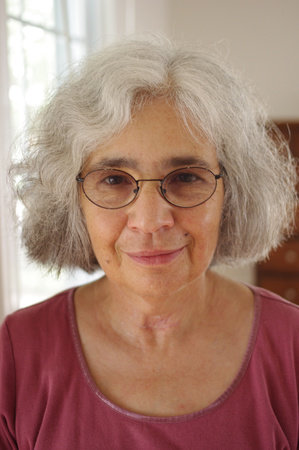
Writer Alice Mattison. Photo: Ben Mattison
Kenyon’s battle with leukemia, which ended with her death in 1995, closes the collection. As Hall and Kenyon traveled to Seattle for a bone marrow transplant, Mattison writes: “I couldn’t sleep last night, thinking of you going to Seattle to have somebody else’s bone marrow put into you. I have always loved you to the marrow of your bones, and now I love you to the marrow of somebody else’s bones.” She concludes, “But then you’ll be better”—a poignant, unfulfilled hope.
Some of the editorial decisions made by Chad Wriglesworth are confusing. The volume’s cover photograph is oddly blurry and unprofessional. The book’s font is small, which makes it hard to differentiate between the letters and editorial commentary. The latter can be sketchy at times. Wriglesworth notes, “In a previous letter, Mattison enclosed a ‘gift’ from Meg, Mattison’s dog.” Kenyon later refers to the gift, but we are never told what it is. At one point, Mattison raves, “Oh, my shirt! I just love it. I only take it off to wash it.” There is no further reference to the garment. Why not cut those, and other, confusing lines? Also, understandably, Mattison is protective of her privacy, which means that some of the issues she and Kenyon discussed are not fully explained.
Despite these flaws, the collection provides a nuanced reminder of the power of the written word through a 15-year friendship between two big-hearted writers, a relationship that is loving, committed, and joyous. In one letter, Mattison comments on a biography of Elisabeth Bishop: “I liked reading about Bishop and [Robert] Lowell knowing each other over the years, sending back and forth poems and critiques. It really is the heart of the writing life, knowing other writers.” That precious “heart”—that inspirational give-and-take, support, and feedback—beats forcefully throughout What Clever Friends.
Rebecca Leamon has always been a voracious reader, a habit nurtured by her BA in English, her Master of Arts in Teaching (English), and the 35+ years she’s spent as a public high school English teacher. Beginning her reading during the reign of the “Dead White American Male,” she delights in the variety of voices and stories available to readers today, and she strives to share as wide a range as possible with her students, friends, and anyone she encounters in the stacks of her beloved public library.
Tagged: "What Clever Friends: The Selected Letters of Jane Kenyon and Alice Mattison", Alice Mattison, Chad Wriglesworth