
Jazz Concert Review: East Coasting
By Jon Garelick
The Bevan Manson Trio surfs some cool waves
Bevan Manson Trio. w/Bob Nieske, Matt Wilson, and Allan Chase. At the Lilypad, July 7
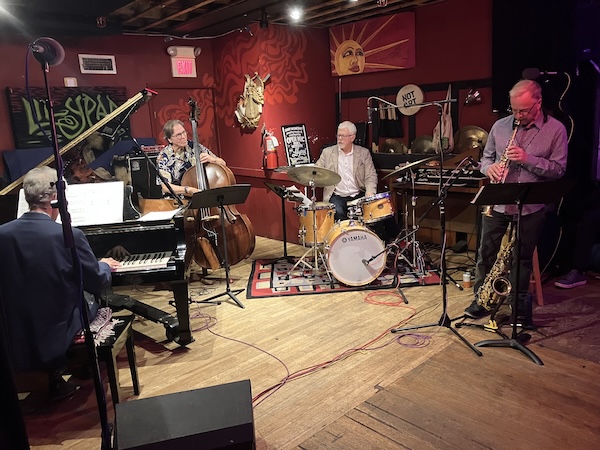
Pianist Bevan Manson, bassist Bob Nieske, drummer Matt Wilson, and saxophonist Allan Chase at the Lilypad. Photo: Jon Garelick
What is serious art without a few laughs? Humor and high artistry went hand in hand with the Bevan Manson Trio’s performance at the Lilypad on Tuesday night.
The performance by the trio (pianist Manson, bassist Bob Nieske, drummer Matt Wilson) was a reunion of sorts — the band made the disc Rhythm Chowder 35 years ago (described by Manson as an “underground hit,” and long out of print), when all three were based in the Boston area and before Manson decamped for the West Coast. They were joined for this gig by saxophonist Allan Chase, another comrade from the old days.
Manson is a musical polymath — aside from playing jazz piano, his work in California has included teaching, a variety of compositional credits, and a scattered discography. That entails commissions from classical ensembles like the San Francisco Symphony, and string arrangements for jazzers like baritone saxophonist Gary Smulyan and Manhattan Transfer singer Cheryl Bentyne. His previous appearance in the Boston area was at the Regattabar, where Tierney Sutton was the featured vocalist, performing music from Manson’s album Talking to Trees.
In front of the packed, standing-room-only audience at the Lilypad, Manson, skinny as a rail, with a gently hawkish face and a thatch of gray hair, dropped deadpan one-liners between songs. He said that one number from his album When the Cup Is Lifted involved 76 musicians . . . “but only two trombones.”
Manson’s compositions are the core of Rhythm Chowder, and so they were on Tuesday, with new and old work and a few standards as well as contributions from Nieske and Wilson. Everything was high flying — there wasn’t a slack moment in the nearly two hours of music I heard. Instead, we got the kind of transcendent moments of group interplay that you can get only from jazz musicians who know each other well and are constantly looking for new ways to surprise each other. Engage! That was the imperative, for players and audience alike.
The band’s approach to each piece was evident in the opener, “Take the A Train.” Coming at the well-worn Billy Strayhorn number from an angle, Manson started with some broadly spaced chords and settled into a chiming rhythm that Wilson matched with the handle of a brush on a cowbell, gradually finding its way to the tune before Manson took off on accelerated runs with a glancing reference to “Beginning to See the Light,” one of many quotes in his solos throughout the night.
Despite all-around virtuosity, there was nothing show-offy in Manson’s playing. Everything he played grew organically out of the material. That goes for all those glancing quotes — “Surrey with the Fringe on Top” showing up in a couple of songs, even “Jingle Bells,” and a few I was not quick enough to name. But only a bar or two and never so much that it turned into a mannerism, just a free-association transition from one burst of invention to the next.
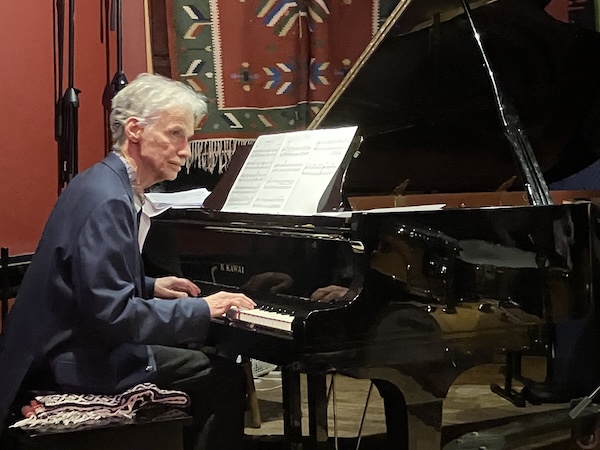
Pianist Bevan Manson at the Lilypad. Photo: Jon Garelick
Midway through the second set, Manson announced from the piano, “We’re going to clear the dance floor!” Wilson laid down a rhythm with an egg shaker in his right fist, a brush on the snare, and thumps of his bass drum. Manson circled around on his keyboard until Juan Tizol’s “Caravan” came into view. He explored with his right hand while his left kept the rhythm with soft, barking chords (like Tizol’s valve trombone?). Manson and Nieske dug into a hard-swinging walk against Wilson’s steady rumba and Nieske upped the tension, taking his patterns high into the upper register, before the piece settled back into the rumba beat and the tune.
Wilson was a wonder all night, offering a master class in how tone and timbre are a part of rhythm, how dynamic shifts create swing as much as the timing of the hits. I could swear he was getting different pitches out of that shaker just by manipulating it with his fist, modulating along with Manson and Nieske. Maybe it was an auditory hallucination. Or just magic. He played another extended solo entirely on his two cowbells, higher ping and lower tonk. It was spellbinding. Elsewhere, he soloed almost entirely with a single brush on his ride cymbal.
From that first album, the band played Nieske’s “Fast Edd,” about a fisherman taken on a kettle-pond version of a Nantucket sleigh ride by a giant pike. Manson’s “Dangerous Paws,” about “leaping and gamboling dogs,” was uptempo with some ecstatic (or fearful?) bird cries from Chase’s soprano. Nieske’s “Charlie’s Rondo” used that form to pay tribute to Charlie Haden, in ballad tempo with some beautiful Haden-esque low tones. Wilson got the crowd to sing along to his “RGB” (for Ruth Bader Ginsburg): “Ruth Bader Ginsburg/honor her pleas/serve the community.”
The band came at “Body and Soul” from another oblique angle, with Nieske transposing the second chorus down with a slapstick slide, and then another uptempo outpouring from Manson. It ended with solo piano, at the very top of the keyboard, in a hushed phrase from “Over the Rainbow.”
Manson’s “When the Cup Is Lifted” might have been the most extended form of the night. Inspired by a Palestinian restaurant in a Jewish neighborhood of Brooklyn, where both communities mingle and share stories over great food, it twines various contrapuntal lines, with a dancing middle section and a rolling locomotive rhythm that brought to mind Herbie Hancock’s “Succotash.”
After the tune, Manson explained the use of counterpoint. “It’s about speaking the same language in different ways,” and offered to explain in more detail to any musicologists in the audience. He added, “It’s not meant to be sad, either.”
Jon Garelick, a former arts editor at the Boston Phoenix and retired staff member on the Boston Globe opinion pages, can be reached at [email protected].
Tagged: Allen Chase, Bevan Manson, Bevan Manson Trio, Bob Nieske
2 Comments
Leave a Comment
Bevin “The Hawk” Manson is a true entertainer and talent.
Great review!!! Congratulations!!