Book Review: “Hujar: Contact” — The Captivating Tip of a Photographic Iceberg
By Trevor Fairbrother
A trove of contact sheets reveals Peter Hujar’s working method, restless eye, and the breadth of an underseen archive.
Hujar: Contact by Joel Smith. MACK Books, 364 pages, $70 (paperback).
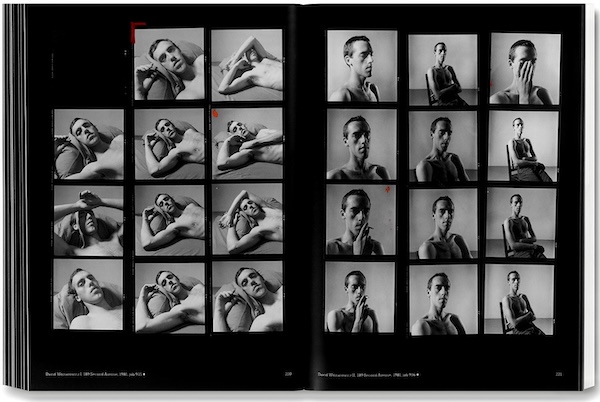
Contact sheets showing David Wojnarowicz in 1981. A spread from Hujar: Contact. Photo: MACK Books.
During his lifetime the New York photographer Peter Hujar (1934-1987) was extolled below 14th Street and not widely known elsewhere. Today he is a canonical figure. His most admired works are subdued, empathetic portraits of bohemians and individualists, but he is also noted for thoughtful studies of architecture and distinctive, sometimes sexually charged, male nudes.
In 2013, the executor of Hujar’s estate, Stephen Koch, sold a sizeable cache to New York’s Morgan Library & Museum and, in one fell swoop, the institution became an Hujar epicenter. In addition to 100 masterful lifetime prints, the purchases included: all Hujar’s black and white contact sheets; his business records; his correspondence; published materials featuring his commercial works; and numerous snapshots of the artist and his friends. In 2017 Joel Smith, the Morgan’s curator of photography, organized the major traveling show, Peter Hujar: Speed of Life and edited the hardcover monograph of the same name.
Hujar: Contact, Smith’s second Hujar exhibition, showcases more than 110 contact sheets from the museum’s collection. Usually measuring about 11 by 8½ inches, these prints display thumbnail images of every frame on a developed roll of film. To make them, the photographer cut the film into segments and arranged them on a sheet of photographic paper. A sheet of glass served to hold the negatives flat. The empty space surrounding the film strips appeared black in the finished print.
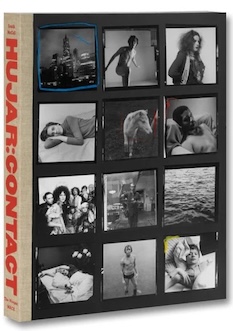
The press release for Hujar: Contact states that the project “elevates the contact sheet, traditionally a working tool, into an art object worthy of close visual reading in its own right. … Many of the contact sheets include Hujar’s own handwritten notes, marks, and annotations, which indicate his changing approach to cropping and printing and elucidate the editorial decisions behind each final image.” The companion publication, produced in collaboration with MACK Books, is a natty flexibound item with 364 pages, a linen spine and scads of spreads in which the illustrations are set against black backgrounds. There is a faux contact sheet on the front and back: each is an eye-catching sampler of the goods within. Joel Smith wrote the introductory essay, titled “Hujar in Twelve Frames.” The main part of the book presents the photographs, divided into five chronological groups. Olivia McCall, an art historian and curator, wrote the extensive closing item, “Peter Hujar’s Job Books.” She has transcribed and annotated the notebooks in which the photographer recorded his projects from 1954 and 1985. In addition, McCall documents the contact sheets from sessions for which there is no written record. They were the shoots that transpired after his AIDS diagnosis early in 1986.
Hujar: Contact excels as a publication in which photographs rather than words convey the most important content. It offers an irresistible conglomeration of images: dogs; dairy cows; children; dancers; cross-dressers; people in the street; city skylines; abandoned buildings; night scenes; still lifes; interiors; the surface of the Hudson River; self-portraits; Roberto Rossellini; Janis Joplin; Gil Scott-Heron; David Wojnarowicz; some sexy but not-fully-identified people (T.C., Evaristo, Tattoo Charlie); and the youthful Stephen Koch (Hujar’s future executor) saucily flaunting his cock. It is astonishing to discover that everything pictured here is the tip of an iceberg: the Morgan owns 5,783 of these contact sheets. Regrettably, the vast majority cannot be viewed digitally on the museum’s website.
To indicate the value of Hujar’s contact sheets, I’ll discuss the acclaimed portrait known as Candy Darling on Her Deathbed. The Morgan owns six contact sheets from that session, which took place at the Cabrini Health Care Center in September 1973. Hujar: Contact illustrates a couple of them. Born James Lawrence Slattery, Candy Darling was a young actress acclaimed for her contributions to Andy Warhol’s films, including Flesh (1968) and Women in Revolt (1971). She was undergoing tests for lymphoma when Hujar photographed her. The contact sheets show the actress striking different poses. A few shots have glimpses of friends who were visiting. Several smiles and guffaws confirm that the occasion was far from lugubrious.
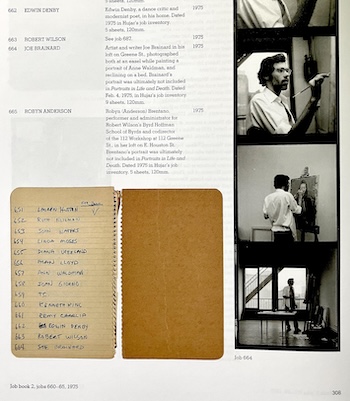
Detail of a page from the “Job Books” section of Hujar: Contact. Photo by author.
Hujar used a red marker to flag the frame he enlarged. The choice was a canny emulation of the glamorous deathbed scenes from Hollywood’s heyday. Tranquil and glamorous, the recumbent blonde siren awaited her demise, cocooned in white sheets and accompanied by flowers. Hujar’s considerable darkroom skills served him well when making the finished prints; for example, he accentuated the pallor of the face and gave radiance to the chrysanthemums looming in the background. He recalled that the actress expressed a wish that her portrait be published as a memorial with a black border and the headline “Candy Saying Good-bye to Her Fans.” Indeed, when she died in March 1974 the New York Daily News included the picture in its obituary.
Hujar’s biography was as chaotic and improbable as his oeuvre. Raised Catholic in poor and adverse circumstances, he left home in his mid-teens and worked as an assistant in commercial photography studios. Inspired by his interactions with his long-time idol, Richard Avedon, Hujar finally opened a commercial studio of his own in 1967. He attracted clients from the music and fashion industries, but he closed shop after a few years, hoping his personal work would bring him fame. At the time, a few Manhattan museums and galleries were taking a stronger interest in contemporary photography. The sea-change was evident in February 1967 when the Museum of Modern Art exhibited works by Diane Arbus, Lee Friedlander, and Garry Winogrand in a show titled New Documents. Another landmark was the 1975 retrospective of Richard Avedon’s portraits at Marlborough Gallery. In 1976, Hujar published his only monograph Portraits in Life and Death. The book began with recent images of 29 friends and acquaintances followed by 11 pictures of 19th-century corpses displayed in the Capuchin Catacombs of Palermo in 1963. Susan Sontag wrote an affected and self-serving “Introduction” for the book: she quoted a line from her first novel (“Life is a movie. Death is a photograph.”) and interpreted Hujar’s portraits as memento mori that tapped into life’s “sweet poetry and its panic.” The book was poorly received.
While working on this review I found a telling comment on Hujar’s temperament made by his last major client, Dianne Benson. In 1981 Hujar made a series of photographs to be used in ads for the retail store, Dianne B., including one of his friend Ethyl Echelberger modeling an outfit by Jean Paul Gaultier. In 2018, Benson recalled: “Although he was particular and moody, [Peter] liked our exchange because, I think, he had total freedom. … I always went back to Peter because his ideas excited me the most and I loved his unpredictability coupled with his sense of beauty, his rigor, and his insistence on quality.” That description of Hujar as “particular and moody” is discreet. As Joel Smith notes in Hujar: Contact, he grew bitter in the 1970s because he felt his work was being overlooked during the boom in art photography. Moreover, he was “increasingly prone to volcanic anger about matters large and small.”
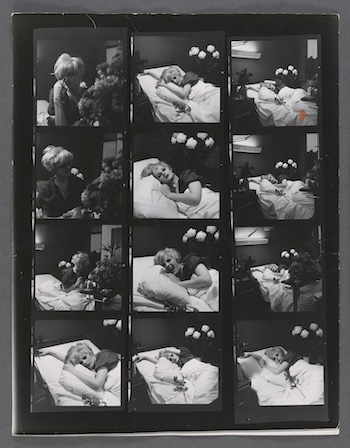
One of six Peter Hujar contact sheets showing Candy Darling in hospital in 1973. The Morgan Library & Museum, Peter Hujar Collection, New York.
It is hard to fathom why Hujar was difficult to the point of professional self-sabotage. Smith evokes the stereotype of the starving artist who refused to sell out when he writes, “In 1973 [Hujar] effectively decided he would be as poor as he could bear in order to focus on making photographs he cared about.” This ties in with his discussion of Hujar’s interactions with Andy Warhol. The chronicle begins on a happy note in 1964, when Warhol invited Hujar and his lover, Paul Thek, to participate in his Screen Test series. But Smith is quick to draw a line: he opines, “[Hujar and Thek] intersected with the [Warhol] scene at a slant, declining to submit to its current, or to give it a central place in their work.”
In reality, Warhol fascinated and inspired Hujar. In June 1969 the underground magazine Newspaper (published by Hujar’s onetime lover Steve Lawrence) included photographs by both artists, alongside others by Warhol’s associates Brigid Berlin and Billy Name. That same year, Hujar made some headshots titled Orgasmic Man that clearly paid homage to Warhol’s 1964 silent film Blow Job. In 1975, Hujar photographed Warhol intending to include him in Portraits in Life and Death. (The sitting resulted in six contact sheets, and the Morgan has illustrated none of them.) In 1979, a snapshot of Hujar and Fran Lebowitz, a regular contributor to Andy Warhol’s Interview, was included in the opening section of Warhol’s book, Exposures. After learning that Andy Warhol died on February 22, 1987, Stephen Koch began soliciting artists for comments, intending to gather them in a magazine article. The ailing Hujar told him that he considered Warhol a visionary who was exceptionally attuned to the issues of his day. Hujar also spoke out against people who dismissed Warhol as a “gay party person” and a “rich fag.”
Hujar: Contact is a hardcore photobook, packed with previously unpublished images. If you want a fuller assessment of his temperament, check out Andrew Durbin’s recent book The Wonderful World That Almost Was: A Life of Peter Hujar and Paul Thek. (Arts Fuse review) If you want more nitty-gritty on his commercial projects consult the very useful “Chronology” in Joel Smith’s 2017 monograph noted above. Otherwise, sit back and let the photos flow.
Trevor Fairbrother is most grateful to Olivia McCall of the Peter Hujar Foundation for fielding his research questions. Last year he reviewed the previously unpublished journal of queer photographer Minor White for The Arts Fuse.
Tagged: "Hujar: Contact", Joel Smith. Peter Hujar, Stephen Koch