Film Review: Life Comes at You Fast in “Jinsei”
By Peter Keough
Ryuya Suzuki’s DIY animated epic fuses pop-idol satire, existential dread, and apocalyptic spectacle into a singular coming-of-age saga.
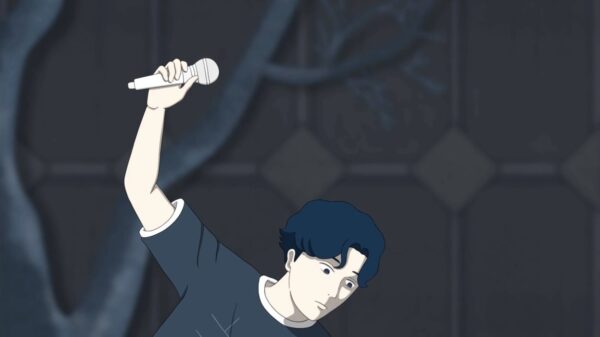
The protagonist of Jinsei (voiced by rapper Ace Cool). Photo: © Ryuya Suzuki
Jinsei, directed by Ryuya Suzuki. At the Boston Common, Alamo Drafthouse, and the suburbs.
Like Pete Docter and Bob Peterson’s 2009 animation breakthrough Up (a comparison I’m not the first to make), Ryuya Suzuki’s stunning and almost incoherently inventive debut feature Jinsei (the title is the Japanese word for “Life” perhaps an allusion to Kurosawa’s Ikiru –“To Live”) opens with a montage in which years pass in minutes like snapshots from a family album.
There are significant differences between the two. Rather than relying on an army of animators and a multimillion-dollar budget, Suzuki crowdfunded a modest production and wrote, directed, and animated the film himself. The result is not seamless Pixar-style CGI but a hand-drawn minimalism — childlike and crude yet paradoxically controlled and sophisticated, with echoes of South Park and Rick and Morty. The transitions are elliptical, even cryptic, rather than lucid and concise as in Up. And though the film similarly traces the tragic arc of a romance — here between an angelic taxi driver and a drug-addled pop star — it ultimately shifts focus away from the grieving widower to the damaged child of that union: Se-chan (Ace Cool), a grim, brooding figure marked by trauma and an early glimpse into the void of human existence..
Se-chan assumes many names over the course of his century-long life, from “The Grim Reaper” — a taunt from his classmates — to “God” and “Love,” among others. Each name, paired with a year, serves as the title of the chapters that structure the film’s 93 minutes. In “2007/The Grim Reaper,” with his mother dead and his biological father, Eito, in a coma, Se-chan lives mute, impenetrable, and alone with his guilt-stricken guardian, Hiroshi (Shōhei Uno). He finds a friend in Kin (Taketo Tanata), a fellow outcast with an obsessive love of pop idols who dreams of becoming one himself. Through Kin’s fanboy collection, Se-chan discovers his father’s rise and fall — and spends the rest of the film watching and rewatching a ghostlike video of Eito dancing.
It turns out that Se-cha is someone with not only many names but many fathers — his adoptive dad Hiroshi, the absentee Eito, his wealthy and intolerant grandfather, and the Roger Stone-lookalike Shiratori (Kanji Tsuda), who groomed Eito for meteoric and doomed stardom. He sees in Se-chan the same potential as the father. After Se-chan’s grandfather takes him from the devoted Hiroshi, Shiratori tracks the boy down and lures him and Kin to an audition. He hires the two and four others to form the boy band ZENROKU and he drives them hard to achieve success. But, like most of Se-chan’s ventures, this dream ends badly and in bloodshed.
As the years go by, Se-chan survives a gruesome contract killing and an earthquake. He reinvents himself as an international movie star and finds love and a family. The years pass; the times darken and grow dystopian, though, briefly, the film’s palette brightens and becomes more varied, with primary colors and pastels added to the grays, blacks, and browns. But then the visuals revert to near black-and-white, with splashes of blood red, its imagery surreal and geometric, recalling the paintings of Magritte and de Chirico.
In the chapter “2050/Love,” an apocalyptic war consumes Japan. Se-chan takes shelter in a luxury bunker for billionaires straight out of Joshua Oppenheimer’s The End (2024). But a new world waits on the horizon, with its own triumphs and pitfalls. When his century is up, Se-chan is treated to a trip-like montage that is like the climax of Kubrick’s 2001 by way of Steven Spielberg, but more cryptic and ambivalent than either.
Though challenging and even frustrating in its obliqueness and sketchy storytelling (a second viewing may be required), Jinsei is a rewarding excursion into the cinematic and philosophical depths, its pointillist narrative held together by recurrent motifs, such as swans, cigarettes, and the word of the title. On the one hand, it foregrounds contemporary (and beyond) Japanese pop culture with its “idols” and J-pop boy bands and the weird, ubiquitous head globes that are the cell phones of the future. But it also draws on traditional art forms, such as ukiyo-e prints for its visual style and haiku for its poetic concision. And, for better or worse, it is the only film to my knowledge that includes a cameo by a Tesla Cybertruck. Jinsei opened here without fanfare, and that is unfortunate. This is the debut of a provocative and visionary new talent — you should not miss an opportunity to catch his career at the very start.
Peter Keough writes about film and other topics and has contributed to numerous publications. He was the film editor of the Boston Phoenix from 1989 to its demise in 2013 and has edited three books on film, including Kathryn Bigelow: Interviews (University Press of Mississippi, 2013) and For Kids of All Ages: The National Society of Film Critics on Children’s Movies (Rowman & Littlefield, 2019).