Visual Arts Review: “Calder: Dreaming in Equilibrium” — Equipoise Under Pressure
By Margherita Artoni
A major Alexander Calder exhibition reveals how movement, once radical, has been absorbed into the grammar of contemporary perception.
Calder: Dreaming in Equilibrium, edited by Anna Karina Hofbauer and Dieter Buchhart. Editions Hazan, Paris, 360 pages, $50.
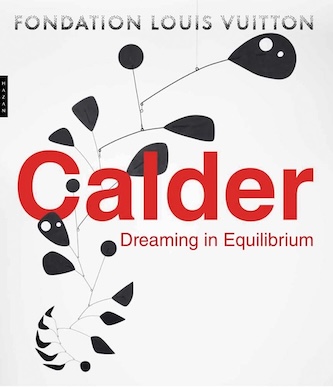 Today, Alexander Calder is less encountered than he is already seen.
His mobiles circulate within a critical and curatorial vocabulary so familiar that it often precedes perception itself. Calder no longer appears as an open field of experience but as a precoded sign of modernity: “movement,” “lightness,” and “balance.” These terms do not simply describe the work; they anticipate it, structuring in advance the conditions under which it becomes legible as sculpture. What once disrupted sculptural syntax now arrives already translated into recognition, as if perception were only confirming what language has already decided. This is not misreading. It is the condition of visibility itself. Calder is recognized before perception fully takes place, as if interpretation were no longer something that follows seeing but something that quietly organizes it in advance.
The show Calder: Rêver en équilibre at the Fondation Louis Vuitton does not so much propose a new reading as expose this condition without fixing it into a single frame. Calder appears as the inventor of sculptural motion, but also as a figure whose work now sits almost too comfortably within the language used to describe it. Across the galleries, motion is staged as controlled visibility. The mobiles hang in calibrated intervals where movement is allowed to register, but rarely to disrupt. Instability is not absent; it is held within thresholds that make it immediately readable.
The catalogue, Calder: Dreaming in Equilibrium, registers this logic across more than 300 works — mobiles, stabiles, wire sculptures, drawings — organized as a trajectory from experimentation toward kinetic resolution. Chronology produces clarity rather than tension. What might once have appeared as rupture is absorbed into sequence. Early works, such as Cirque Calder, resist this smoothing more than the book’s choice of retrospective framing suggests. Movement has not yet been organized into a grammar of balance. It accumulates without hierarchy, forming relations that have not yet settled into order.
That excess is gradually reabsorbed into a dominant horizon: balance. In Calder, however, balance is never a settled condition. It is closer to a continuous deferral of collapse, sustained through material precision rather than resolved harmony. Stability is produced in real time rather than given. Ironically, the critical vocabulary surrounding Calder often accelerates this stabilization. “Lightness,” “play,” “and harmony” do not misdescribe the work, yet they tend to close it too quickly. Instability becomes immediately recognizable; something is already lost when these words are used.
This tension, between stability and instability, has long structured how Calder’s work has been received. A formalist lineage, associated with critic Clement Greenberg, reads his art through optical autonomy and medium specificity. Phenomenological approaches, associated with Dore Ashton, shift the emphasis toward embodied perception and duration. Between these positions, Calder remains unresolved, neither object nor experience fully secured.
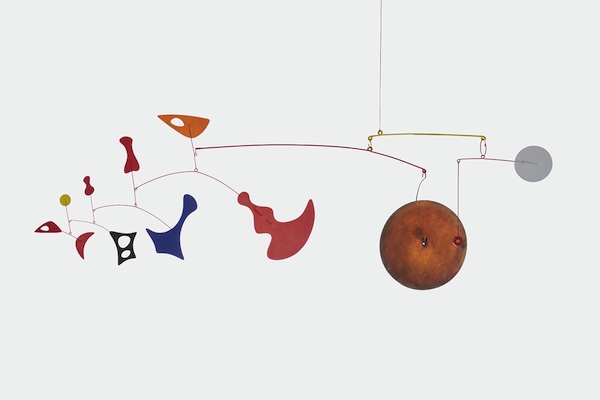
Alexander Calder, Dispersed Objects with Brass Gong, 1948. Photo: © 2025 Calder Foundation, New York / ADAGP, Paris
A broader sculptural genealogy helps clarify this volatility. The condensation of form associated with Constantin Brâncuși moves sculpture toward stillness and essence. In Jean Arp’s biomorphic work, form gives way to a sense of continuous flow. In the spatial constructions of Naum Gabo, structure becomes relational rather than material. Calder stretches these trajectories across time, treating form as something that unfolds rather than settles. In Eucalyptus (1940), motion is distributed among suspended elements that never resolve into a single configuration. Red Maze III (1954) turns space into an active field, shaped by shifting relationships rather than serving as a static backdrop.
Across these works, balance never settles into a final state. It is continually renegotiated among gravity, material resistance, and air. What reads as stability is only a temporary alignment of forces still in play. At this point, the catalogue’s language becomes limiting. Terms like “lightness” and “harmony” make the work more accessible, but flatten its tension into easy recognition. Instability is framed, then quickly absorbed as familiarity. The design of the exhibition reinforces that effect: pacing, lighting, and circulation guide the viewer toward smooth adjustment, turning looking into accommodation rather than encounter.
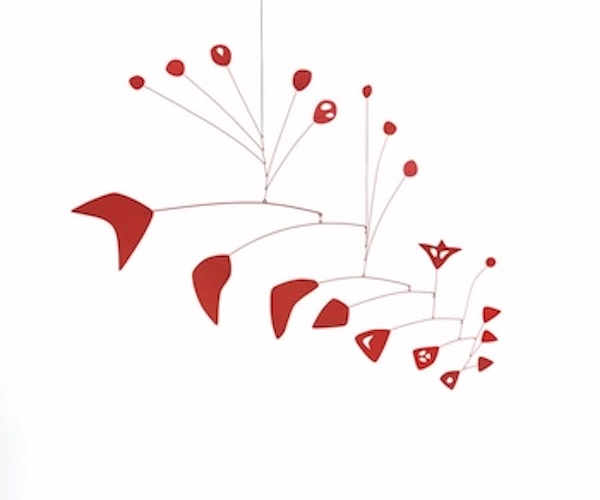
Alexander Calder, Red Maze III, 1954. Sheet metal, wire, and paint. 56″ x 72″. Photo: © 2025 Calder Foundation, New York / ADAGP, Paris
What emerges, almost quietly, is a gap between how Calder’s work operates and how it is presented. The sculptures remain structurally open, but the conditions of display make that openness feel familiar. Instability is not eliminated; it is quickly absorbed into recognition. The catalogue points to this tension without articulating it fully. Calder’s work depends on instability, even as its institutional framing relies on making that instability legible. The more it is translated into “lightness,” the less its underlying risk registers.
The works themselves resist that closure. A mobile never settles into a fixed meaning; it sustains a state in which meaning remains provisional and slightly deferred. Each shift in air reorganizes the composition without resolving it. Calder: Dreaming in Equilibrium is at its most compelling when its writers are alert to that condition. The catalogue is at its weakest when Calder’s delicate balance is treated as an endpoint, not an open question. Then he emerges as an artist of equilibrium under pressure — continually made and unmade within the same field of perception.
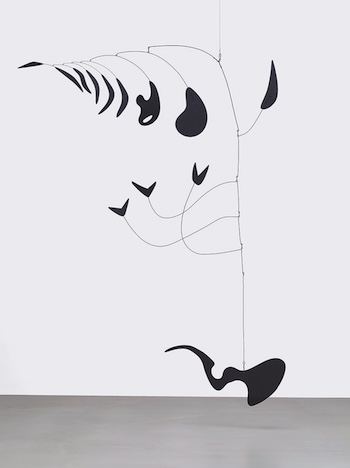
Alexander Calder, Eucalyptus, 1940. Sheet metal, wire, and paint. Photograph: Tom Powel Imaging © Calder Foundation New York
What remains is not Calder as an artist of balance, but as one in whom instability begins to blur into recognition. The catalogue does not resolve that condition. It holds it open just long enough to register, and briefly — almost imperceptibly — to pass as stability even as it unfolds.
What gives Calder renewed urgency today is not the novelty of motion, but the conditions under which motion is viewed. In a visual culture shaped by speed — feeds, screens, exhibitions calibrated for quick legibility — instability no longer registers as delay but as a form of variation. Seen from this perspective, Calder’s mobiles read less as discrete sculptures than as early models of perceptual speed: systems where change is constant but immediately graspable. What once demanded sustained attention now aligns with the fast-tracking strategies of contemporary viewing.
From this angle, the catalogue should be doing more than historicize Calder; it should place him within a broader shift in how perception is organized. The question is no longer whether his work represents movement, but whether it anticipates a moment when movement is already built into readability. The mobile becomes less an object of contemplation than a diagram of accelerated attention, where instability persists only insofar as it can be quickly recognized. In that sense, Calder feels unexpectedly current — not as one of the originators of kinetic art, but as a precursor to a visual culture in which complexity is acceptable, though only when it comes across as instantly legible.
Margherita Artoni is a contemporary art critic and curator working between Italy and the United States. She began her career collaborating with Flash Art and currently writes for Segno, Juliet, Artribune, Exibart, Inside Art, ArteIN, part of cult(ure), The Arts Fuse, and Whitehot Magazine.
She has directed galleries in Turin — including NEOCHROME and EDGE Art Space — and in New York at TEAM Gallery. Her curatorial work has included exhibition programs with international artists such as Rashid Johnson, Theaster Gates, Ali Banisadr, Angel Otero, Tim Rollins & K.O.S., Laura Owens, and Mika Tajima.